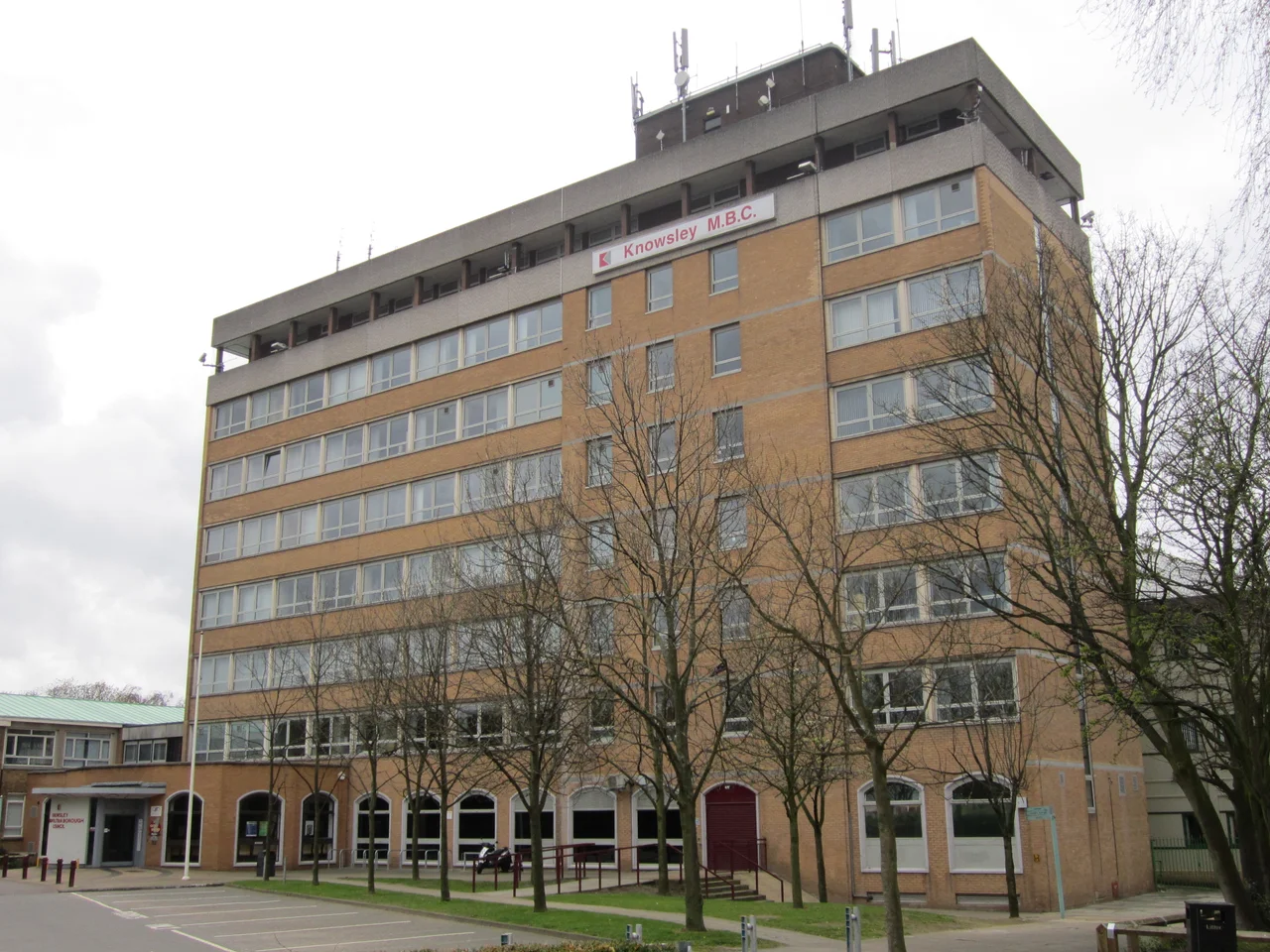

Huyton
Huyton was the home of Harold Wilson, the Labour MP and twice prime minister whose statue now stands in the town centre. It was the home of Steven Gerrard, the Liverpool captain who lifted the European Cup in Istanbul. It was the home of Stuart Sutcliffe, the fifth Beatle, whose grave is in Huyton Parish churchyard. It was where the Beatles played fifteen times before the Cavern Club discovered them, and where John Lennon got into a fight at Paul McCartney's 21st birthday party. For a working-class commuter town on the eastern edge of Merseyside, it has put up an unusual number of names.
Hitune to Huyton
Huyton was first settled around 600-650 AD by Angles, the Germanic settlers who gave their name to England, on a low hill surrounded by marshy ground. The first part of its name may suggest a landing place, probably on the banks of the River Alt that runs nearby. Both Huyton and the neighbouring village of Roby are mentioned in the Domesday Book of 1086, with Huyton spelt Hitune. For most of its first thousand years Huyton was an ancient parish in the West Derby Hundred of Lancashire, containing within it Croxteth Park, Knowsley, and Tarbock - country names belonging to country places. The county boundary changes of 1974 moved Huyton into Merseyside and the new Metropolitan Borough of Knowsley, ending eight hundred years of Lancashire identity by a stroke of parliamentary pen.
Stephenson's Railway
In 1830 Huyton received the most consequential railway in the world. The Liverpool and Manchester Railway, supervised by George Stephenson, opened that year and became the first scheduled passenger train service on Earth. Both Huyton and Roby got their own stations. On the day of the official opening, Arthur Wellesley, the first Duke of Wellington and victor of Waterloo, alighted at Roby station. The line is still in use today, carrying Northern services between Liverpool and Manchester past more or less the same fields and brick rows it has passed for nearly two centuries. The arrival of the railway began the long process of turning Huyton from a Lancashire farming parish into a Liverpool commuter town. By 1950 the population was over 55,000, the great majority having moved out from the city to new council estates built by Liverpool City Council on land bought from the Earl of Derby.
Refuge and Imprisonment
During the Second World War, Huyton hosted three wartime camps: an internment camp, a prisoner-of-war camp, and a base for American servicemen. The internment camp, opened in May 1940 in a partly-completed council estate ringed with barbed wire, may have been the largest in the United Kingdom. Among the thousands of internees, many were refugees from the Nazis: socialists like Kurt Hager, artists Martin Bloch, Hugo Dachinger, and Walter Nessler, the dancer Kurt Jooss, the sociologist Norbert Elias, the anthropologist Eric Wolf, and the composer Hans Gal, who wrote a song cycle called Huyton Suite while interned here. More than 40 percent of the internees were over 50 years old. Twelve men were assigned to each council house; many slept in tents in the gardens. The deportations to the Isle of Man stopped after the troopship Arandora Star was torpedoed in July 1940 with the loss of 805 lives. Most internees were released before the camp closed in 1942.
Trautmann and the Streets That Followed
The German prisoner-of-war camp closed in 1948. Among the inmates was Bert Trautmann, a former Luftwaffe paratrooper who stayed in Britain after his release, signed for Manchester City as a goalkeeper, and became one of the most respected players in English football. He famously broke his neck in the 1956 FA Cup final and kept playing. The streets around the former internment camp on the so-called Bluebell Estate were given the names of the war's great battles. Today the housing estate looks like any other 1940s Merseyside council estate, with its bus stops and its corner shops, and almost no visible sign of what the streets were for. The camp's most famous internees would go on to shape European thought: Elias to write The Civilizing Process, Wolf to redefine anthropology, Gal to compose late into the 1980s. They were all once here, twelve to a house.
Gerrard, Wilson, and the Quarrymen
Huyton's modern fame is largely football. Steven Gerrard, captain of Liverpool from 2003 to 2015 and of England between 2012 and 2014, grew up here, attending Cardinal Heenan High School with the future England striker David Nugent. Peter Reid, the England midfielder and later Everton, Manchester City, and Sunderland manager, was also from Huyton. So were Leon Osman, Tony Hibbert, and Lee Trundle. The town's other great export is politics: Harold Wilson, Labour leader and prime minister twice (1964-70 and 1974-76), was MP for Huyton for 33 years. His statue went up in 2006, eleven years after his death. Then there is the Beatles connection. As the Quarrymen, the band played the MPTE Social Club in Finch Lane. They played a hall in Page Moss fifteen times between January 1961 and January 1962. Paul McCartney's aunt Jin lived in Dinas Lane, where he held the eventful 21st birthday party. And Stuart Sutcliffe, who played bass before he died young in Hamburg in 1962, lies in Huyton Parish churchyard.
From the Air
Huyton sits in Knowsley borough on the eastern edge of the Liverpool urban area at 53.41°N, 2.84°W, just west of the M57 motorway. Liverpool city centre is 6 miles to the west via the M62. Best viewed from 2,000-4,000 ft. Liverpool John Lennon Airport (EGGP) is 5 nm south-southeast; Hawarden (EGNR) is 15 nm south-southwest. Look for the town centre with its bus station and railway station, and the dense brick housing estates that make up most of the urban area, bounded by the M57 on the east and the M62 corridor on the south.
Nearby Stories
- RAF Wrexham 3.3 km away
- Birkdale Palace Hotel 3.7 km away
- Turton Tower 4.1 km away
- Tatton Park 5.6 km away
- Abergele Rail Disaster 9.6 km away
- Diglake Colliery Disaster 13 km away
- Ysbyty Ifan 16 km away
- Celtic Array 62 km away