
Birkdale Palace Hotel
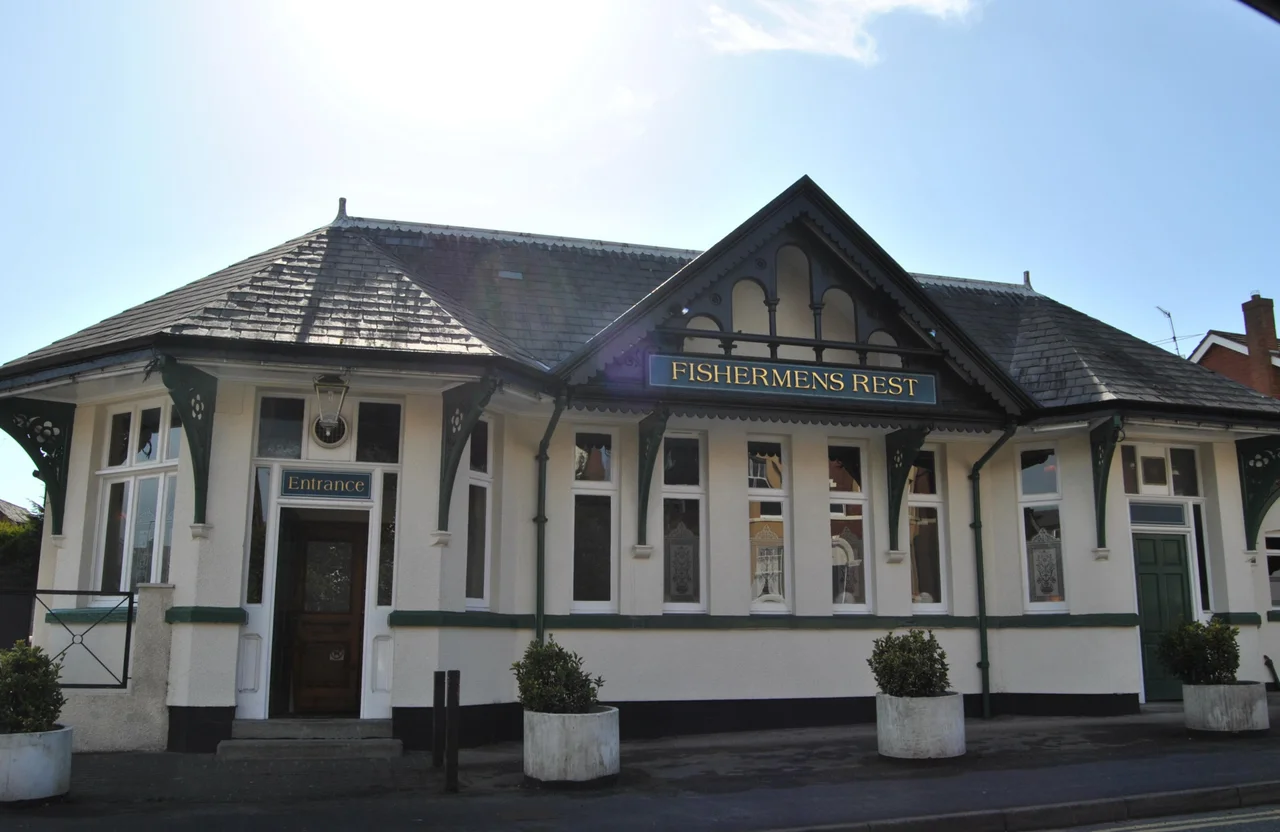
There is nothing left of it now except a pub and a housing estate. The Birkdale Palace Hotel rose two hundred feet long above the Birkdale shore in 1866, a grandiose Victorian pile with seventy-five bedrooms built for £60,000 by a syndicate of Manchester merchants who believed Southport's expanding railway suburbs would support a first-class seaside resort. For a hundred and three years it dominated the dunes south of Southport, attracting in its time the Beatles, Frank Sinatra, Clark Gable, fifteen thousand US bomber crews on rest leave during the war, and a long catalogue of more obscure visitors whose ghosts, according to local legend, were what made the demolition crews jittery in 1969. The pub that survived the wrecking ball is named the Fishermen's Rest, and it carries a darker memory than the lift that the demolition workers thought was haunted.
The Architect Who Did Not Jump
Local folklore got two things badly wrong about the Palace Hotel. The first was that it had been built the wrong way round, with the front facing inland and the back facing the sea. The second was that William Mangnall, the architect responsible, threw himself off the roof when he realised. Recent research has put both stories away. There is no evidence the hotel was built the wrong way round at all, and Mangnall actually died of tuberculosis two years after the hotel opened, at his home on Lord Street in Southport. He did not jump. But the ghost stories about him pacing the second-floor stone corridors and travelling up and down in the lifts persisted, the way stories that suit a building persist regardless of the facts behind them.
Hydropathy, Sea Water, and Stars
The Palace went into liquidation early. It was too isolated, with no road or tram service in 1866, and its first investors lost their money. A refurbishment in 1881 reduced the grounds from twenty acres to five, installed a battery of baths, ran a pipe to draw salt water in from the sea, and reopened the building as a hydropathic establishment competing with Smedley Hydro in Birkdale. The Southport and Cheshire Lines Extension Railway opened Birkdale Palace railway station next door in 1884, which finally solved the access problem. By the early twentieth century the hotel had electric lighting, an aviation ground for flights from Blackpool from 1919 onward, and a guest book that read, by 1939, like an early Hollywood manifest: Frank Sinatra, Clark Gable, Sunday afternoon orchestral teas in the dining room, the Beatles performing there in 1962.
Bomber Crews on Leave
The most consequential guests came in 1942. The American Red Cross took over the entire building and ran it as a rest and recreation home for crews of the United States Army Air Force flying daylight bombing missions over German-occupied Europe. Their tours were twenty-five missions long; the casualty rates in the Eighth Air Force in 1942-43 were among the highest of any American military formation in the war, and crews flew with the knowledge that statistical survival was unlikely. Over fifteen thousand airmen passed through the Birkdale Palace between 1942 and 1945. They walked the beach. They ate hot meals. They slept in beds that did not shake from engine vibration. Some of them flew back to Norfolk afterwards and did not come home from the next raid. The building's R&R role is the quietest of the dignifying things it ever did.
Fourteen Lifeboatmen
The pub that survives is the Fishermen's Rest on Weld Road. It was originally the coach house, later a non-residents' bar to keep the main hotel quiet for guests. On 9 December 1886 the German barque Mexico was driven aground at Trunk Hill Brow, Ainsdale, in a storm. The Southport lifeboat Eliza Fearnley launched and capsized; fourteen of her sixteen crew drowned. The St Annes lifeboat Laura Janet launched and capsized; all thirteen of her crew drowned. Twenty-seven men in total were lost, the greatest single disaster in the history of the RNLI. The Lytham boat reached the Mexico in time and saved her twelve sailors. The fourteen Southport bodies were laid out in the Palace Hotel's coach house, which served as a temporary mortuary while the coroner held inquest at the hotel itself. The pub is named for those men, and a commemorative poem is read in it every December on the anniversary, followed by a minute's silence.
Demolition and the Lift That Would Not Stop
The final owners, Heddon Hotels, went into liquidation and were wound up in 1967, when only two guests remained in the building: an elderly permanent resident and the company controller's wife. Tigon British Film Productions used the empty hotel as a film base in 1968-69 for What's Good for the Goose with Norman Wisdom and The Haunted House of Horror, which was also shot at Bank Hall in Bretherton. The producer Tony Tenser suggested Southport Council buy the hotel jointly with him to keep it as a film studio. The Council declined on the grounds that they did not enter commercial partnerships. The wreckers came in 1969. The demolition foreman Jos Smith told the Southport Visiter that strange voices and noises woke his men at night, that the lift began moving by itself after they had cut its power, and that they eventually had to hammer it loose so it crashed into the basement. A more prosaic explanation, the paper noted, was an auxiliary power supply. Either way the building came down. Ascot Close, a housing estate, occupies the site now. The coach house, the Fishermen's Rest, and the memory of fourteen drowned men are what remain.
From the Air
Coordinates 53.6377 N, 3.0256 W on the Birkdale shore south of Southport. Recommended viewing altitude 2,000 to 3,000 feet to take in Weld Road, the Ascot Close housing estate now on the hotel site, and the Birkdale dunes running south toward Ainsdale. Nearest airports: Blackpool (EGNH) 14 nautical miles north, Liverpool John Lennon (EGGP) 15 nautical miles south, RAF Woodvale (EGOW) 3 nautical miles south. The Sefton coast dune system is one of the largest in England; from altitude the broad sands and the regular grid of Edwardian Birkdale streets are unmistakable.
Nearby Stories
- Kingsway Tunnel 3.1 km away
- Helmshore Mills Textile Museum 8.3 km away
- Heysham Port 9 km away
- Tatton Park 13 km away
- Abergele Rail Disaster 18 km away
- Malham Cove 23 km away
- Llandudno 47 km away
- Egremont Castle 57 km away