
Tatton Park
Stand on the lawn in front of Tatton Hall and look north-west toward open parkland, and you are looking at an empty field with a 60,000-person history. Between July 1940 and early 1946, this stretch of grass was the dropping zone for No. 1 Parachute Training School at neighbouring RAF Ringway. Every paratrooper trained in Europe during the Second World War, British and free Polish, French, Belgian, Dutch, Norwegian, Czech, all of them came here for their first descent. A free-standing stone memorial marks the far edge of the field today. The neoclassical mansion behind you is one of the great Wyatt houses of England, the parkland holds 2,000 acres of red and fallow deer, and 0.6 miles to the south-east a Shinto shrine stands among Japanese maples. Tatton holds an unusual number of stories at once.
The Deserted Village
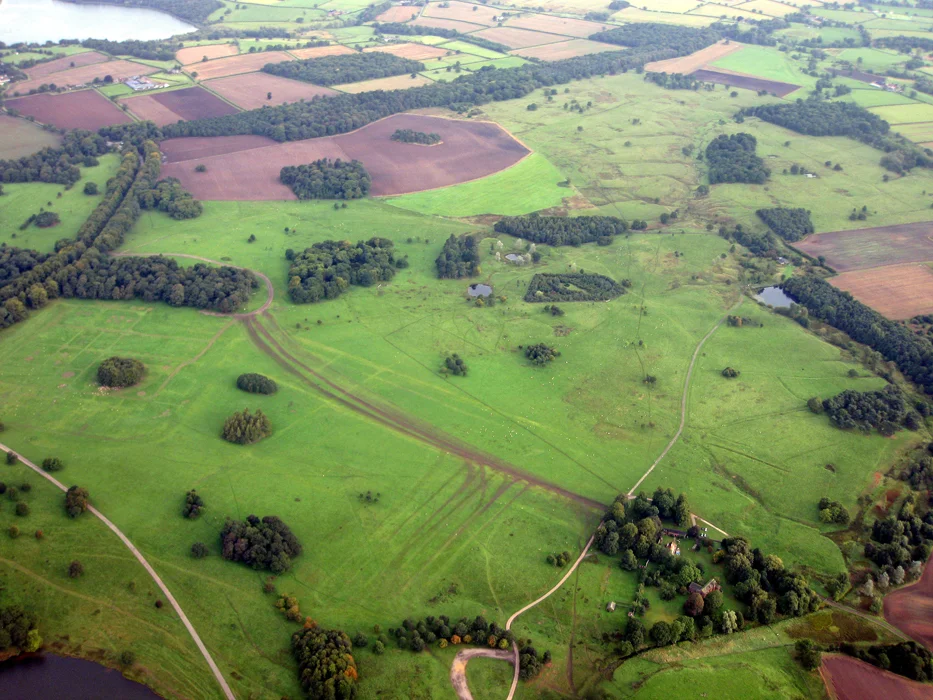
There is evidence of human habitation in Tatton's grounds going back to the Iron Age. The medieval village of Tatton stood here too, until depopulation in the late medieval period reduced it to imprints on the turf. Buildings and roadways can still be traced as low earthworks in the parkland, and the site is now a scheduled monument. By the end of the 15th century the land was owned by the Stanley family, who built what became known as the Old Hall, an L-shaped timber-framed house that the Breretons later enlarged and replaced its timber with brick. Sir Thomas Egerton, Lord Chancellor of England under Elizabeth I and James I, bought the estate in 1598 from his half-sister Dorothy Brereton. The Egertons would hold Tatton until 1958.
Wyatts and Egertons
John Egerton, Sir Thomas's grandson, built a new house in the late 17th century, about three-quarters of a mile west of the Old Hall, completed around 1716. Improvements began in 1758. Between the 1770s and 1816, most of that house was replaced by the present neoclassical mansion, designed by Samuel Wyatt and his nephew Lewis William Wyatt. Further additions came in 1861 to 1862 and again in 1884. The library holds first editions of two Jane Austen novels. The walls hold portraits of the Egertons alongside paintings by Canaletto, Poussin, Chardin, Van Dyck, and Vasari. The family firm of Gillows of Lancaster supplied much of the furniture. One room is given over to the world-spanning collection of curios and souvenirs accumulated by Maurice Egerton, the last Lord Egerton, an aviator and big-game traveller who died without an heir in 1958.
Gardens and a Japanese Mountain
The gardens lie to the south of the hall and range from the rigidly formal to the wandering and naturalistic. The Italian Garden, immediately south-east of the hall, was designed by Joseph Paxton and laid out by Edward Milner in 1847 on two terraces around a statue of Neptune; it was restored to its original design in 1986. The Walled Garden grows the same fruit and vegetables that Tatton grew in the Edwardian era. The Broad Walk runs south to a Monument modelled on the Choragic Monument of Lysicrates in Athens. Beyond the arboretum, which holds 880 plants of 281 species, lies the Japanese Garden built in the 1910s, with a Shinto shrine, a tea house, a bridge across the Golden Brook, and a mound shaped to resemble Mount Fuji. It became overgrown and was restored in the early 2000s. There is also a maze, a topiary, and a rose garden.
Paratroopers Over the Park
On 6 July 1940, Squadron Leader Louis Strange came to Maurice Egerton with a wartime request. Strange and Egerton had been fellow aviators before the First World War, and they trusted one another. The RAF needed the parkland to train paratroopers, jumping from cages suspended beneath barrage balloons over open ground north-west of the hall, and then from aircraft taking off from RAF Ringway. Egerton agreed without hesitation. The first live test jumps were made by RAF instructors on 13 July. Between then and early 1946, approximately 60,000 trainees from Britain and several European countries, including special agents bound for occupied Europe, made their first drops here. Aircraft took the trainees up at Ringway for the short flight to overhead Tatton Park, where they jumped from around 800 feet in batches of ten and later twenty. A few asked to be dropped into Tatton Mere or into the parkland's trees, to prepare for the conditions of real operations. The memorial that marks the dropping zone stands about 0.6 miles north-west of the hall.
Deer, Meres, and the RHS
The deer park itself dates from a royal charter of 1290, and deer have grazed here for over 700 years. Red and fallow deer share the parkland today, around 400 breeding stock between them, alongside rare-breed Hebridean and Soay sheep. Tatton Mere is natural; Melchett Mere is younger, the result of subsidence in the 1920s, and both are Sites of Special Scientific Interest and Ramsar wetland sites. When Maurice Egerton died in 1958 he left the house to the National Trust and the park in lieu of death duties; Cheshire County Council, and now Cheshire East Council, holds a 99-year lease. The RHS Show has come here every year since 1999 to fill the parkland with flowers, and the home farm still breeds Tamworth pigs, Red Poll cows, and Leicester Longwool sheep in a 1930s yard, the year electricity replaced steam on the farm machinery. The park does not pick between its identities. It just keeps them all running together.
From the Air
Tatton Park lies at 53.3306 N, 2.38356 W, north of Knutsford in Cheshire. The estate is 4 miles south-west of Manchester Airport (EGCC), and the parkland sits beneath EGCC's western approach corridor. The deer park, the two meres, and the neoclassical mansion provide clear visual landmarks. Liverpool John Lennon (EGGP) is roughly 25 miles to the west. Recommended viewing altitude is 2,500 to 4,000 feet AGL, with ATC clearance required for the airspace closer to the airport.
Nearby Stories
- Hope Cement Works 1.5 km away
- Liverpool John Lennon Airport 3 km away
- Diglake Colliery Disaster 3.4 km away
- Holt Castle 4.6 km away
- Bank Hall 6.9 km away
- Rochdale Pioneers Museum 8.3 km away
- National Coal Mining Museum for England 9.6 km away
- Belper North Mill 19 km away