.jpg)
Liverpool John Lennon Airport
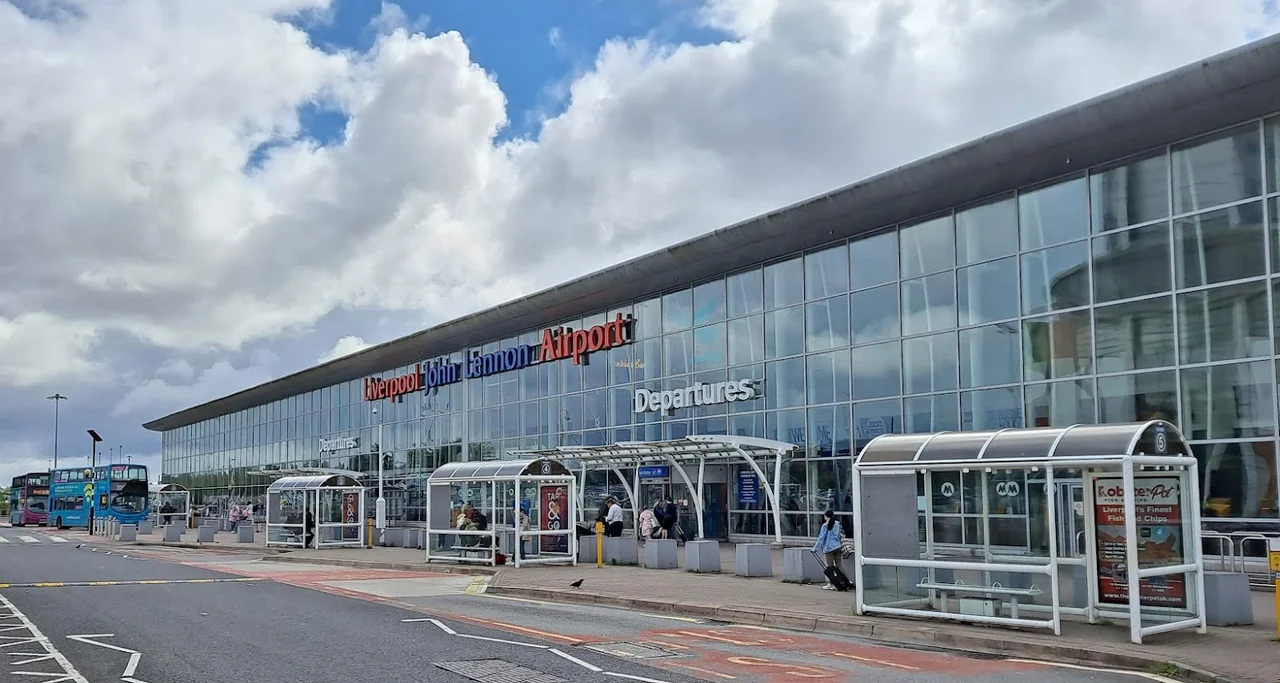
Look out the left-hand window on final approach to runway 27 and you can read the words painted across the terminal roof: "Above us, only sky." The line is from John Lennon's 1971 song "Imagine," and the airport beneath it was named after him in 2002, making EGGP the first airport in the United Kingdom to take a person's name. Yoko Ono unveiled the dedication. A 7-foot bronze statue of Lennon now stands in the check-in hall. A full-scale Yellow Submarine sits on a traffic island at the entrance. None of which entirely captures the strangeness of the place. The airport began life in 1933 as Speke. It built Halifax bombers during the war. It was where the Beatles' fans waited for their boys to come home from Hamburg. And it now operates from a terminal where the original 1930s art-deco buildings, perfectly preserved, stand as a Crowne Plaza hotel beside the modern aprons.
Speke, 1933
It opened officially on 1 July 1933, on a flat stretch of land between the Mersey estuary and the village of Speke. The first scheduled service had already begun three years earlier — Imperial Airways flying from Liverpool to Croydon via Manchester and Birmingham, the first proper attempt to knit British provincial cities together by air. The 1930s buildings that survive on the eastern edge of the present airport were among the finest aerodrome architecture of their era. Two great art-deco hangars flanked a curving control tower and a passenger terminal with public viewing terraces, all built in the streamlined moderne style that signalled aviation's confidence in itself. By 1937 the Air Ministry had leased part of the Speke estate on a 999-year lease to build a shadow factory — a dispersed wartime production site safely north of the targets German bombers might prioritise. Construction began on 15 February that year. By the time the war started, Rootes Securities was producing Bristol Blenheim bombers there, and would go on to build 1,070 Handley Page Halifax heavy bombers before VE Day.
Lockheed at Speke, Bombers Overhead
During the Second World War, RAF Speke was one of the most important aviation manufacturing centres in Britain. The Rootes factory turned out hundreds of bombers. Lockheed set up an assembly line on site for aircraft shipped in pieces across the Atlantic — Hudson maritime patrol aircraft and P-51 Mustang fighters were unpacked at Liverpool Docks, trucked the short distance to Speke, and assembled into flying aircraft on the airfield. The Merchant Ship Fighter Unit, an unusual outfit that flew Hurricanes catapulted from the bows of merchant ships during the Battle of the Atlantic, was based at Speke. After VE Day civilian operations resumed and grew steadily. By 1948 the airport was handling 75,000 passengers a year and still outranked Manchester. Then ownership by the Ministry of Aviation became a drag. Manchester pulled ahead. Liverpool's only ground-controlled radar approach unit was withdrawn, and the airport entered a long period of decline that would last almost forty years.
The Birdman of Speke
The airport held public air displays through the 1950s in aid of the Soldiers, Sailors and Air Force Association charity, and they pulled crowds in the tens of thousands. On 21 May 1956, the headline act was Léo Valentin, a French parachutist who performed as "the Birdman." Valentin had become famous after inventing a free-fall stable position that, in modified form, is still taught to skydivers today. His show involved jumping from an aircraft with rigid balsa-wood wings strapped to his arms, gliding through the sky like a man-sized model glider before deploying his parachute for landing. That afternoon, exiting the aircraft over Speke, Valentin's wing struck the doorframe of the plane. The collision threw him into an uncontrolled spin. He tried to deploy his emergency canopy but it Roman-candled — the lines tangling and the chute failing to inflate — and Valentin fell to his death in front of the crowd that had come to watch him. "The world has been robbed of a daring personality," ran the local headline. He had been twenty-six.
The New Runway and the Old Terminal
In 1966 Prince Philip opened a new 7,500-foot runway on the south-eastern side of the airfield, freeing the airport from the limits of its 1930s site. The old terminal, however, refused to be erased. Famous for the television footage of screaming Beatles fans waving from its terraces in 1963 when the boys came back from a tour, the streamlined moderne building was left derelict when the new terminal opened in 1986. It might have been demolished. Instead, in 2001 it was lovingly converted into a hotel — first a Marriott, then the Crowne Plaza after a 2008 renovation — preserving every Art Deco detail. The Grade II listing keeps it that way. The former apron is also listed and now houses several preserved aircraft, including the BAe Jetstream 41 prototype and a Bristol Britannia. One of the two original art-deco hangars is now a David Lloyd leisure centre. The other became the headquarters of the Very Group, an online retailer, under the name Skyways House.
Above Us, Only Sky
By 1997 the airport handled 689,468 passengers a year. By 2007 the number was 5.47 million. EasyJet built it into a major hub. The rebranding in 2002 — the name change, the statue, the Lennon motto on the roof — captured a moment when Liverpool itself was reasserting its identity after decades of decline. A short-lived attempt to fly to New York with Flyglobespan in 2007 lost money quickly and folded within the year, but the European and Mediterranean routes have kept growing. Through the 2010s and into 2026 the airport sits in a strange equilibrium. There are no jet bridges, no travelators — passengers walk across the apron to their aircraft, as people did in 1955. A Yellow Submarine sits on a roundabout. A Hampton by Hilton sits beside the terminal. And above the check-in hall, in stainless steel letters six feet high, an inscription that reads exactly the same to every traveller who passes beneath it: "Above us, only sky."
From the Air
Liverpool John Lennon Airport (EGGP/LPL) is located at 53.334N, 2.850W on the north shore of the Mersey estuary, 6.5nm southeast of Liverpool city centre. Single runway 09/27, 7,500ft, ILS Category III. The Crowne Plaza (former 1930s terminal) and preserved art-deco hangars are on the eastern edge. The Mersey Gateway Bridge crosses the estuary 5nm south of the airport. Nearby airports: Hawarden (EGNR) approximately 14nm southwest, Manchester (EGCC) approximately 26nm east. Standard arrivals via DESIG/LISTO; consult current charts.
Nearby Stories
- RAF Wrexham 3.3 km away
- Birkdale Palace Hotel 3.7 km away
- Turton Tower 4.1 km away
- Tatton Park 5.6 km away
- Abergele Rail Disaster 9.6 km away
- Diglake Colliery Disaster 13 km away
- Ysbyty Ifan 16 km away
- Celtic Array 62 km away