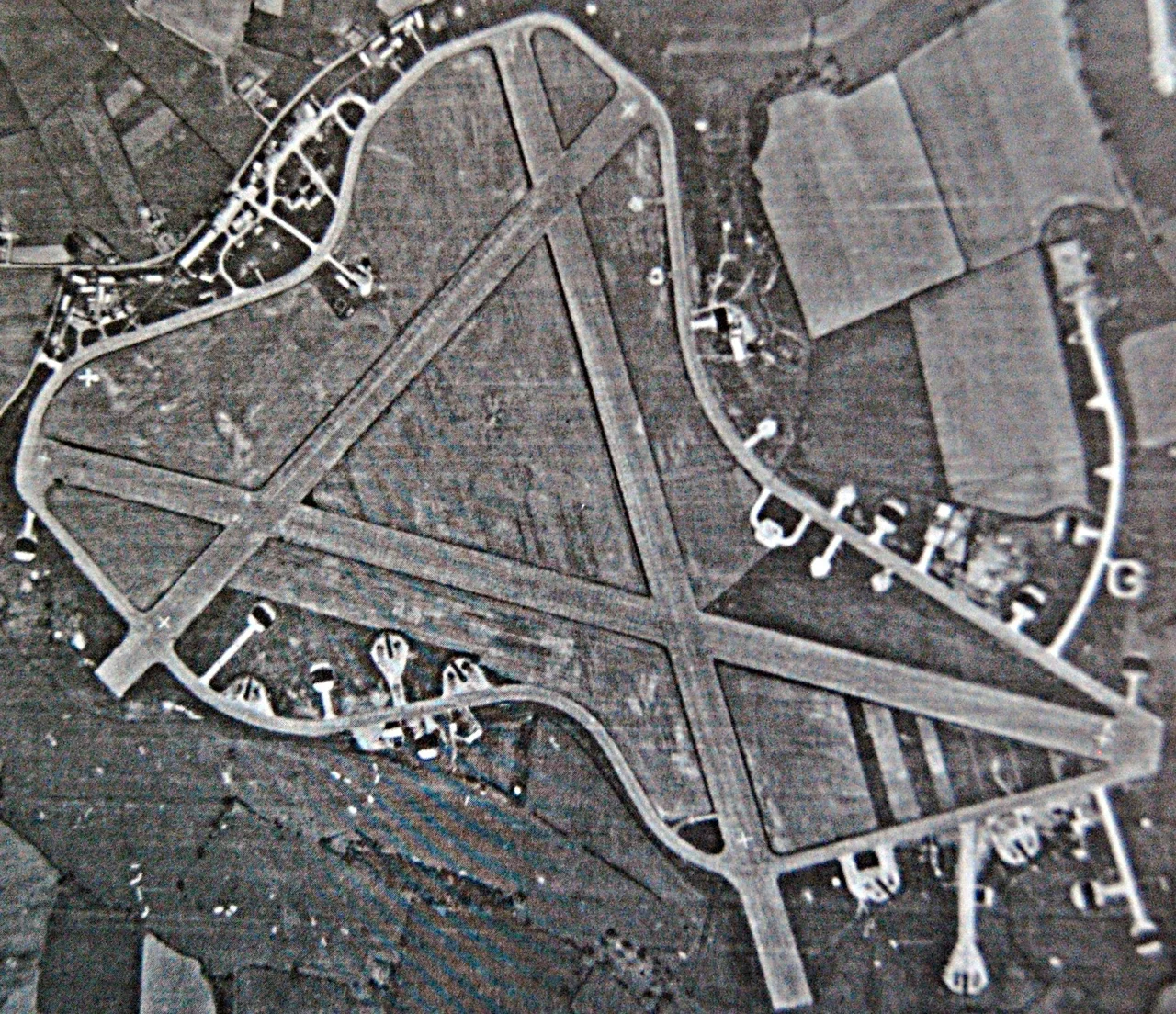

RAF Wrexham
Most British wartime airfields were built on whatever flat ground could be found - reclaimed estuary mud, drained marshland, hastily levelled farmland. RAF Wrexham had a rare advantage: a dry plateau. While neighbouring fields at Sealand and Hawarden, both reclaimed from the River Dee, turned to claggy mud through Welsh winters, Borras stayed firm. Training squadrons noticed. So did the night fighters defending Liverpool and Manchester. So, eventually, did the US Army's Piper Cubs, the Royal Observer Corps men listening for Soviet bombers, and the recording engineers who turned the nuclear bunker into a studio. Borras did a lot of jobs across the 20th century. Quarrying has now almost obliterated it.
Edwardian Air Displays to the First War
Aviation came to Wrexham in 1912 when Gustav Hamel, the celebrated young pilot, performed at the Racecourse Ground - the same ground that today is the world's oldest international football stadium. Wrexham council immediately discussed whether the racecourse might become a municipal airport. It didn't, but the idea moved a few miles northeast to Borras Lodge, where between 1917 and 1920 Nos. 4 and 51 Training Squadrons of the Royal Flying Corps used the fields. After the Armistice, RAF training units based at Shotwick (later Sealand) and Hooton Park used Borras too. The Lancashire Aero Club and Liverpool and District Aero Club flew air displays here through the 1930s. Sir Alan Cobham brought his National Aviation Day Circus twice - the barnstorming, joyride-selling roadshow that did more than anything else to put aviation into ordinary British imaginations between the wars.
Night Fighters and Decoy Fires
Construction proper began in December 1940 and ran through to June 1941, often by floodlight through the dark winter. Three grass runways of about 550-660 yards were laid down with hardened concrete, lit for night operations, and ringed with defences linked to those of the nearby Royal Ordnance Factory. The airfield's primary job was to house a night fighter squadron protecting Liverpool and Manchester from the Luftwaffe. No. 96 Squadron RAF moved here from Cranage in 1941. No. 285 Squadron arrived to fly target-tug aircraft - Bristol Blenheims, Lockheed Hudsons, Westland Lysanders, then later Boulton Paul Defiants and Miles Martinets - pulling targets behind them so trainee gunners could practice. To the west, on Esclusham Mountain, a decoy airfield burned lights at night to fool German bombers. The trick worked, in a way: the mountain was bombed several times, and the Luftwaffe crews, watching fires burn on the slopes after a bomber missed the Monsanto chemical works at Cefn Mawr, sometimes believed they were watching Liverpool burn. The fires drew more raids.
American Cub Strips in Welsh Fields
Less famous than the night fighter squadrons, but more peculiar, were the US Army cub strips. The 400th Armored Field Artillery Battalion and No. 33 Signals Construction Battalion were billeted in local houses - Acton Hall most notably - and needed somewhere for their Piper Cubs to land. The result: small unmarked landing areas, no surface treatment, no buildings, just designated fields. One on the airfield itself, two in Acton, one just outside Borras, and one in Gresford opposite the gates of Gresford Colliery, where in 1934 the mining disaster had killed 266 men. The 322nd Field Artillery Battalion of the 83rd Infantry Division used these strips. None of them lasted more than a year. The Cubs flew, the Americans crossed to Normandy, and the fields went back to being fields.
The Cold War Bunker That Plays Records Now
The RAF left in 1945. The airfield went onto care and maintenance, was sold to United Gravel Company in 1959, and from the 1970s onwards has been progressively swallowed by Tarmac's quarrying operations. As late as 2004, sections of original runway surface and paint were still visible. But before the gravel pits took most of it, the site got one more military life. Between 1962 and 1992, a hardened nuclear bunker stood at Borras - the headquarters for No. 17 Group Royal Observer Corps North Wales. Up to 80 volunteers in RAF-style uniforms trained weekly. They were the field force of the United Kingdom Warning and Monitoring Organisation, and their job was to sound the four-minute warning and track radioactive fallout if the worst happened. The Soviet bloc collapsed in 1989. The Observer Corps was disbanded between September 1991 and December 1995. The bunker survived - converted into a recording studio. Records and rehearsals where the four-minute warning would have been declared. In 1977 the National Eisteddfod of Wales was held here too, between the airfield's military closure and the bunker's musical reopening - a Welsh-language poetry and music festival on the concrete where Defiants had once dispersed for the night.
From the Air
RAF Wrexham (Borras Airfield, sometime ICAO reference EGCE) sat at 53.07N, 2.95W on a plateau just northeast of Wrexham. Most of the site is now an active quarry - DO NOT attempt to land here. The bunker, hangar remains, and gunnery butts are still traceable on aerial imagery. Nearest active airports are Hawarden (EGNR, ~6nm north), Liverpool (EGGP, ~22nm north), and Shawbury (EGOS, ~25nm southeast). Cruise at 2,000-3,000 ft AGL to see the quarry pits and the surviving outline of one Bellman hangar.
Nearby Stories
- Lilleshall Abbey 5 km away
- RAF Hooton Park 5.5 km away
- Gwrych Castle 6.7 km away
- Knutsford 7.5 km away
- Battle of Blore Heath 9.7 km away
- Ysbyty Ifan 14 km away
- Powis Castle 15 km away
- Machynlleth 28 km away