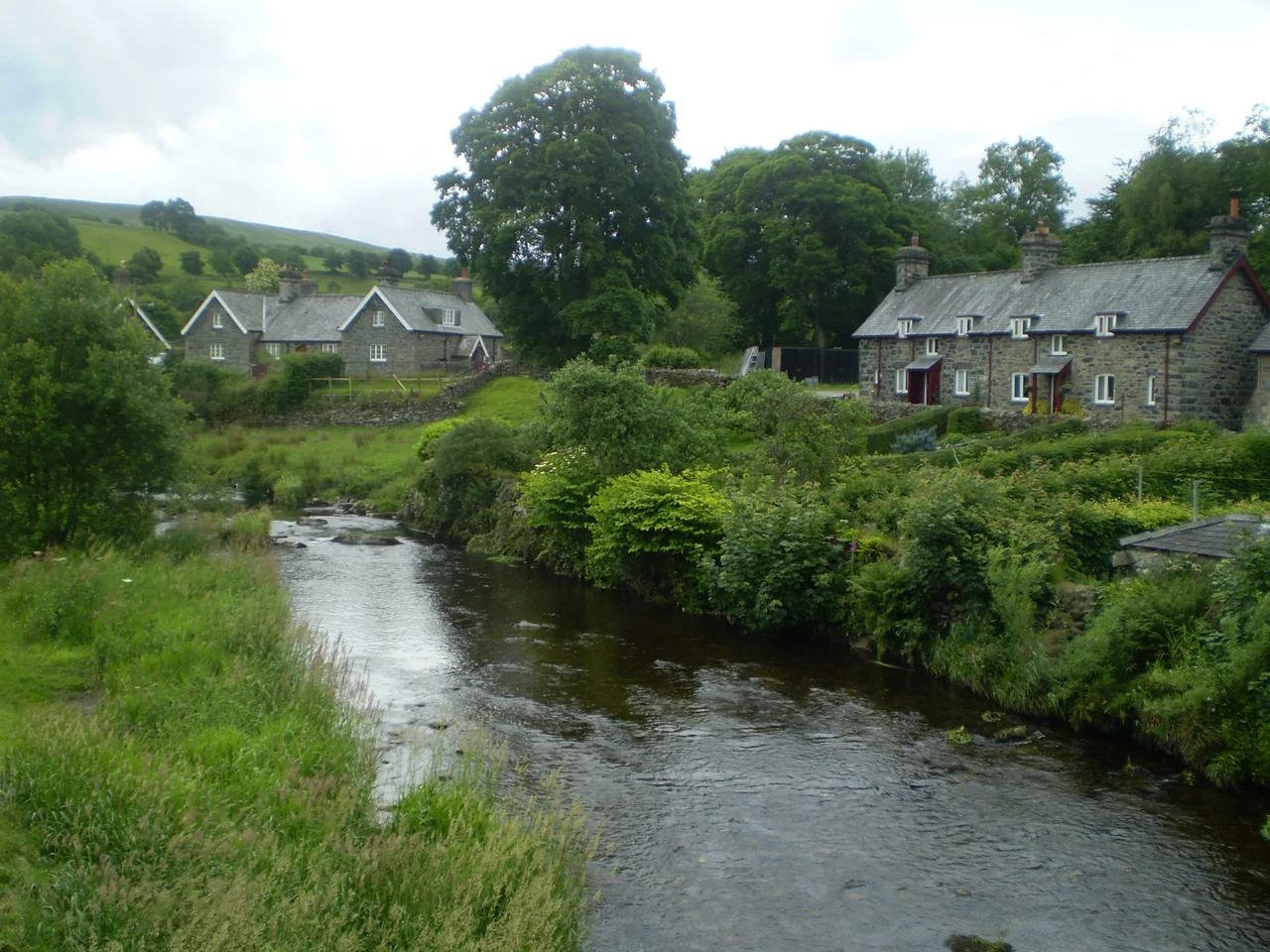

Ysbyty Ifan
The name is itself the story. Ysbyty Ifan means John's Hospital, after Saint John the Baptist, patron of the Knights Hospitaller who ran a refuge here from sometime in the late medieval period until the order was suppressed in 1540. The pilgrims they cared for were walking the long Welsh routes - between Bangor-on-Dee and Holyhead, between Bardsey Island and St Davids, between the Cistercian abbeys of Aberconwy and Cymer. Today, the village holds 196 people and a single stone bridge across the upper Afon Conwy. The traffic has gone elsewhere. The name remains.
The Hospitallers' Refuge
The Knights Hospitaller, formally the Order of Saint John, were a military religious order originating in Jerusalem in the 11th century. They built a network of hospitals and hostels across Europe to care for pilgrims and the sick. Their Welsh house at Ysbyty Ifan sat at a crucial crossing point - the head of the Conwy valley, where pilgrims walking between the great Welsh religious sites of Bardsey and St Davids needed shelter, food, and a bed. The settlement provided all three. The Hospitallers' Welsh holdings vanished during the Dissolution of the Monasteries in the 1530s and 1540s, but the village kept the order's name. The church in the centre of the village still holds three medieval effigies, said to depict Rhys Fawr ap Maredudd, his wife Lowri, and their son Robert.
The Man Who Carried the Standard at Bosworth
Rhys Fawr ap Maredudd - Rhys the Great, son of Maredudd - was a local nobleman who became a kingmaker by accident of geography. In 1485 he served Henry Tudor at the Battle of Bosworth, where Richard III was killed and the Wars of the Roses effectively ended. Tradition holds that Rhys carried the standard of the new king, Henry VII, in the closing moments of the battle. His son Robert went on to become chaplain to Cardinal Wolsey, one of the most powerful men in early Tudor England. From a small Welsh upland village, in two generations, the family stood at the centre of English politics. The effigies in Ysbyty Ifan church are weathered now, the faces softened by five centuries of cold. The descendants of the people they describe are everywhere.
Lincoln's Roots
There is a derelict farmhouse called Bryn Gwyn on the edge of the village. Once, in the 17th century, it was the home of a man called John Morris. His daughter joined a group of Quakers and emigrated to Pennsylvania. Several generations later, her descendant Abraham Lincoln, son of Welsh and English forebears, became the sixteenth president of the United States. The connection is real - Lincoln's great-great-grandfather lived here - but easy to miss. There is no historical marker on the lane to Bryn Gwyn. The farmhouse is roofless. A village of 196 people sent one daughter across an ocean, and four generations later the United States got a leader who held it together through civil war. History does not always advertise itself in obvious places.
The National Trust's Largest Estate
The land around the village is now the Ysbyty Ifan Estate, the largest single estate managed by the National Trust. Its 8,000 hectares cover moorland, river valleys, hill farms, and the Migneint - an area of upland blanket bog designated as a Site of Special Scientific Interest. The Trust keeps a working agricultural landscape here, with grazing sheep, hedgerow walls, and stone barns, in cooperation with the farming families who have worked these hills for generations. Holiday cottages are tucked in among the workings; Foel-Gopyn, off the grid entirely, runs on water from a stream and solar panels on the slate roof. The Migneint blanket bog is a living archive of cool wet upland Wales: peat thirty feet thick in places, holding more carbon per acre than a rainforest.
Two Hundred People and a Village Eternal
Almost 80% of the village's residents speak Welsh, according to the 2011 census. The primary school has two classrooms. The rugby pitch sits next to the playground. Tomos Prys, a 17th-century buccaneer who wrote poetry between voyages, lies buried in the churchyard. Siôn Dafydd Berson - poet, clog-maker and lay reader, who taught the great Welsh poet Twm o'r Nant to read - rests there too. Orig Williams, the independent wrestling promoter known as El Bandito, was born here; a plaque records his memory. Clough Williams-Ellis, the architect of Portmeirion, designed the small country house of Voelas just outside the village in the late 1950s. A village this small does not need many monuments. The monuments are everywhere - in the church effigies, in the stones of the bridge, in the Welsh that the children speak on the playground.
From the Air
Ysbyty Ifan sits at 53.021 degrees north, 3.723 degrees west, at the head of the Afon Conwy valley in northeast Snowdonia. The village is small - a clutch of stone buildings on either side of the river - and easy to miss from the air. Look for the stone bridge over the Conwy, surrounded by upland sheep pasture and the dark expanse of the Migneint moorland to the west. Nearest airports: RAF Valley (EGOV) 36 nm northwest, Hawarden (EGNR) 38 nm northeast, Caernarfon (EGCK) 25 nm west. Mountain weather and low cloud over the Migneint are common; the area is also a designated peat-bog SSSI.
Nearby Stories
- Battle of Bryn Derwin 4.9 km away
- Welsh Mountain Zoo 5.2 km away
- Pontcysyllte Aqueduct 6 km away
- Pant-y-Saer Burial Chamber 6.3 km away
- Neston 7.3 km away
- Powis Castle 9.4 km away
- Machynlleth 19 km away
- Cardigan Bay 29 km away