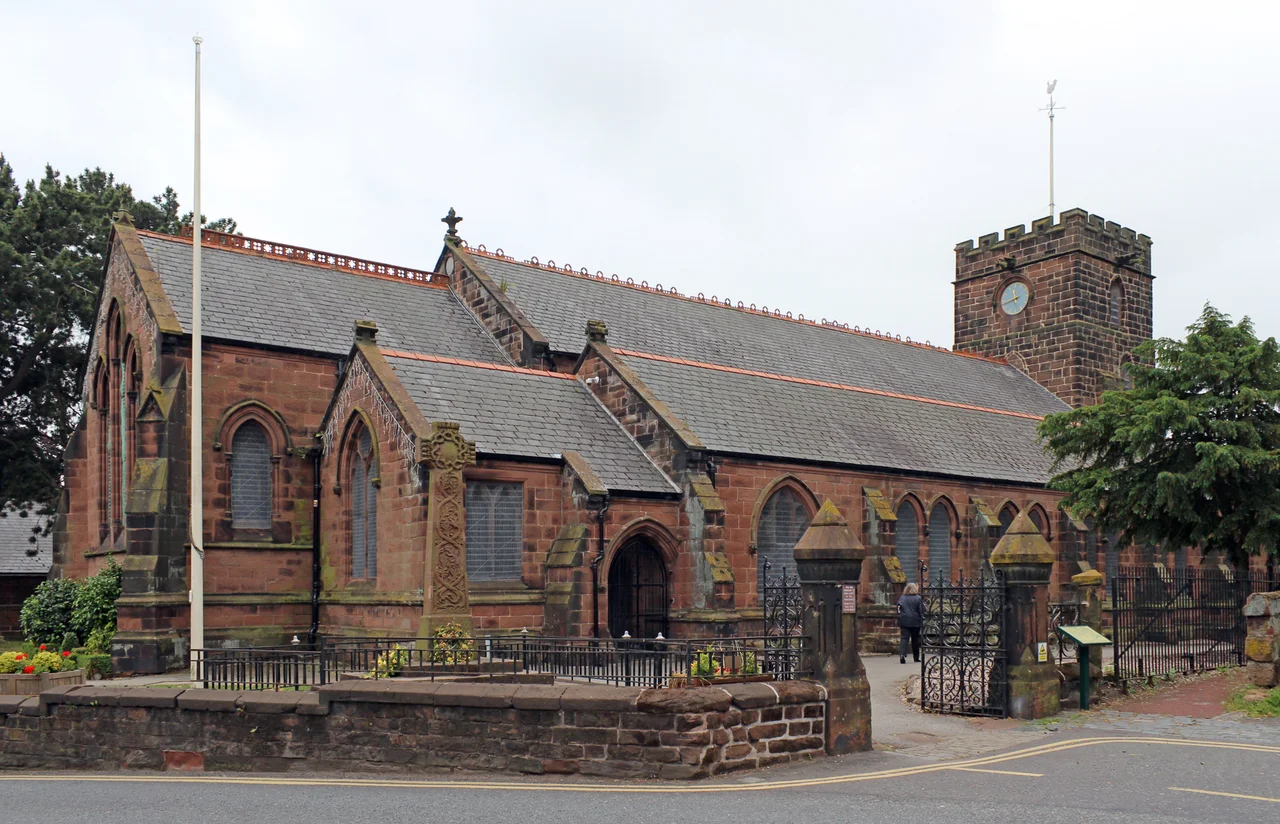

Neston
The Vikings named it. Nes-tun in Old Norse means the settlement near the headland, and at the western edge of the Wirral Peninsula, where the land curls down toward the silted Dee Estuary, Neston still occupies the headland its name describes. There is a near-twin called Nesttun outside Bergen in Norway, evidence of how widely the Norse traveled and how literally they named the places they settled. By 1086 the Domesday surveyors found a settlement here under William Fitznigel with eight households. By 1728 it had a royal market charter. By the eighteenth century it was a busy port - and then the river that made it a port quietly stopped cooperating, and the town had to find another way to matter.
When the River Walked Away
The Dee Estuary used to be navigable all the way to Chester. By the seventeenth century it was silting fast, and the ships that brought trade to Chester began stopping further downstream at Neston. For a while Neston was the port for the city of Chester itself, an arrangement that lasted long enough for the town to grow comfortable with the role. Then the silt kept moving. The port shifted down to neighbouring Parkgate, and by the early nineteenth century the traffic had transferred again, this time across the peninsula to Liverpool on the Mersey. Today you can stand on the Parkgate seafront and look out over what should be water and see, instead, miles of salt marsh stretching to the Welsh coast. The boats are gone. The marshland that replaced them is now a nature reserve, home to harriers and short-eared owls hunting voles in the long grass.
Coal Under the Estuary
Neston sits at the northern edge of the Flintshire Coalfield, and from 1759 to 1855 the Ness Colliery worked seams that ran out under the Dee Estuary itself. Boats hauled coal on canals dug deep underground, an arrangement so remarkable that it would still be remarkable today. The colliery was the property of the Stanley family of Hooton, who fought a feud with the rival Cottingham mine that escalated from contract disputes to outright sabotage; the Cottingham mine collapsed in the 1840s under conditions Stanley adversaries blamed squarely on Stanley hands. Ness Colliery itself closed in 1855 when the workable seams gave out. A second mining era began in 1875 with Neston Colliery, served by a new branch line off the Chester and Birkenhead Railway. The government took it over during the First World War, returned it after, and watched it collapse in 1927 when bigger mines undercut it. One hundred and eighty miners lost their jobs.
Swan Cottage and Lady Hamilton
In 1765, in a place called Swan Cottage in the township of Ness on the southern edge of Neston, a blacksmith's daughter was born and christened Amy Lyon. Her father died when she was two months old. Her mother took her to live with grandparents nearby. The girl who left this village as a teenager would change her name twice - first to Emma Hart, then to Emma Hamilton when she married the British ambassador in Naples - and would become the most famous woman in Georgian England. She sat for portraits by George Romney that hang now in galleries from London to New York. She became the lover of Admiral Horatio Nelson and bore him a daughter. After Trafalgar killed Nelson she was abandoned by his family, ran through her money, and died destitute in Calais in 1815. Neston remembers her in street names - Romney Close, Romney Way - and in the parish church where she was christened. The girl from Swan Cottage came back to the village only in name.
Ladies Club Day
On the first Thursday of every June, Neston does something almost no other English town does: the women march. Ladies Club Day - simply called Ladies Club locally - traces its roots to the Neston Female Friendly Society founded during the Napoleonic Wars, when women without husbands or with husbands at sea pooled small subscriptions to insure against sickness and burial costs. The society survived. The annual procession survived with it. Today the marchers wear white and carry banners through the High Street, and the procession ends with a service at St Mary's and St Helen's Church, the same medieval church where Emma Hart was baptised in 1765. It is one of the longest-running women's friendly society parades in England, a piece of working-class self-organisation that outlasted the empire it began under.
The Town Now
Neston had a population of 15,392 at the 2021 census - a market town with independent shops, cafes, and the Friday market that has run since the 1728 charter. Ness Botanic Gardens, opened in 1898 and run by the University of Liverpool, occupies the southern edge of town. The Borderlands Line railway carries commuters north to Bidston and south into Wrexham. Tim Hunt, born in Neston in 1943, won a share of the 2001 Nobel Prize in Medicine for discoveries about how cells divide. Three of the town's sons earned Victoria Crosses in the World Wars. Neston has outlasted the port that built it, the coal that fed it, and most of the empire whose wars commemorated its dead. The Wirral Way footpath, built on the old railway bed that once carried that coal, now runs past the town for walkers and cyclists, the rails gone, the cuttings green.
From the Air
Neston sits at 53.29°N, 3.06°W on the western Wirral Peninsula, looking across the silted Dee Estuary to the Welsh coast. Best viewed at 2,000-4,000 ft. Liverpool John Lennon Airport (EGGP) is 14 nm east-northeast; Hawarden Airport (EGNR) is 7 nm south. Look for the broad green ribbon of marsh stretching west from town to the river channel, with the long thin town centre running parallel to the estuary.
Nearby Stories
- RAF Wrexham 3.3 km away
- Birkdale Palace Hotel 3.7 km away
- Turton Tower 4.1 km away
- Tatton Park 5.6 km away
- Abergele Rail Disaster 9.6 km away
- Diglake Colliery Disaster 13 km away
- Ysbyty Ifan 16 km away
- Celtic Array 62 km away