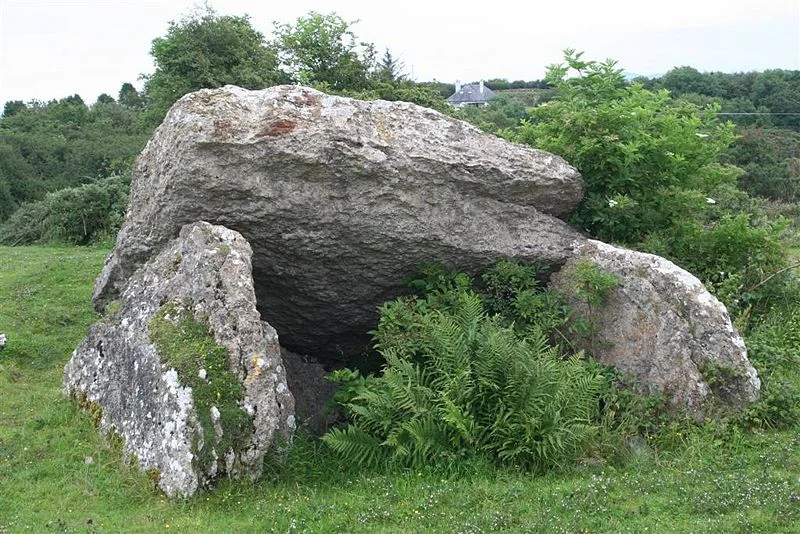

Pant-y-Saer Burial Chamber
When archaeologists opened the lower chamber of Pant-y-Saer in 1912, they found the bones of fifty-four people. Men, women, children, infants - and among them, nine newborn babies. Two more individuals had been removed in 1875. The total comes to fifty-six known dead lifted from a single Neolithic chamber on a scrubby hilltop near the small town of Benllech in east Anglesey. That is one of the largest burial assemblies ever recovered from a single Welsh dolmen. The chamber could not have held all those bodies at once. The grave was repeatedly reopened over generations - perhaps centuries - to admit the next dead of a community that returned again and again to this single low chamber, until the bones lay layered like documents in an archive. The massive capstone now rests at one end on the ground, partially collapsed. Two upright stones still hold the other end aloft.
The Stones and the Slide
Pant-y-Saer Burial Chamber sits on a hilltop in the parish of Llanfair Mathafarn Eithaf, a short walk from the modern caravan parks behind Benllech beach. The capstone measures roughly three metres long by three metres wide and half a metre thick - smaller than the slab at Lligwy a few miles north, but still massive. Two upright stones support it now, one on the north side and one on the south, both with rounded tops. The rounded tops are probably why the capstone eventually slid off whatever third support once held it level; it now rests with one end on the ground and the other end angled up into the air. Excavations show that the chamber was originally covered by a cairn or earthen mound, of which traces remain. The cairn was walled at the front, with a curved forecourt adjoining the northern upright - and on the far side of that forecourt, an offering pot had been placed deliberately, marking what was almost certainly the main approach to the structure.
Fifty-Six People
The 1875 investigation found and removed the bones of two people. The 1912 investigation, working at a deeper level, revealed a lower chamber whose contents had been accumulating for far longer. Fifty-four people lay there - of all sexes and ages, and including the nine infants who had not lived long enough to be weaned. The numbers point to repeated use over many generations rather than a single mass interment. People died, the chamber was opened, the new dead were laid inside alongside the older ones, the entrance was closed. Sometimes the old bones were pushed aside to make room. Sometimes new chambers were added. The high proportion of infants and small children suggests a community that placed all of its dead, regardless of age, into the same monument - not just adult elders or important figures, but everyone. It was a family tomb in the largest sense. The community kept the chamber in continuous use through what may have been a thousand years.
Reading a Tomb
The offering pot at the far side of the forecourt suggests that the architecture had two zones - the chamber proper, where the bones were laid, and an outer ritual space where the living met the dead. Comparable Neolithic forecourts elsewhere in Britain have held the residues of feasting: animal bone, cracked pots, ash. Mourners gathered here, performed whatever ceremony marked the closing of the tomb, and left. The orientation of the forecourt - facing roughly north, towards the bay at Benllech - probably mattered, though we cannot recover the cosmology. Pant-y-Saer is one of around two dozen surviving Neolithic chambered tombs on Anglesey, a density unmatched anywhere else in Britain except Orkney. The island was clearly important to the late Neolithic farming communities of the Irish Sea. Some scholars think the chamber tombs functioned partly as territorial markers - the visible houses of the dead that asserted a community's claim to the land. Others see them as gathering places that helped scattered farmers keep cultural cohesion across generations. Probably they were both at once.
From the Air
Pant-y-Saer Burial Chamber lies at 53.32 N, 4.24 W, on a hilltop near Benllech on the east coast of Anglesey. The chamber sits in a scrubby field about 1 km inland from Benllech beach, in the parish of Llanfair Mathafarn Eithaf. From the air the site is small and best identified by its position relative to the caravan parks behind Benllech. Nearest airports: Anglesey/Valley (EGOV) 19 nm west, Caernarfon (EGCK) 16 nm south-west. The east coast of Anglesey is generally sheltered from west and south-west weather; visibility at low altitudes is usually good. The Anglesey Coastal Path passes nearby, and the larger Lligwy Burial Chamber lies 4 km north along the same coast.
Nearby Stories
- Llandudno Lifeboat Station 3.8 km away
- Glynllifon 6.1 km away
- German submarine U-1024 9.4 km away
- Irish Sea Bridge 11 km away
- Ysbyty Ifan 12 km away
- Irish Sea 18 km away
- Celtic Array 18 km away
- Birkdale Palace Hotel 56 km away