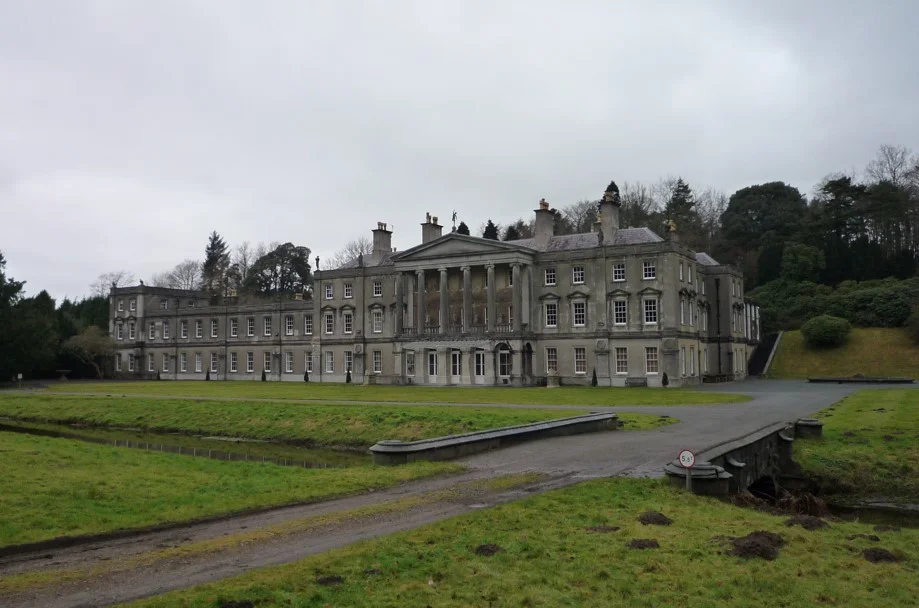

Glynllifon
There are six per cent of Britain's lesser horseshoe bats living in the cellars and outbuildings of one Welsh country estate. The colony at Glynllifon, three miles south of Caernarfon, is both a maternity site and a hibernation site for one of the rarest mammals in the UK - and it is the smallest of the contradictions packed into this 189-hectare patch of land. Glynllifon has been, in turn, a seat of medieval Welsh princes, the country house of a baron who spent a fortune playing soldier, an investiture ballroom for Prince Charles, an agricultural college, and a luxury hotel that went bankrupt twice in twenty years. The bats have outlasted them all.
Four Houses on the Same Spot
The current Plas Glynllifon was built in 1836-1848 to designs by Edward Haycock of Shrewsbury, with a major extension in 1889-1890, and it is the fourth house known to have stood on the site. The original medieval residence was replaced around 1600. That building was rebuilt in 1751 as a 'moderate-sized brick mansion', and then destroyed by fire in 1836. What rose from the ashes was a different scale of ambition: a neoclassical three-storey block with a thirteen-bay south-facing facade dominated by a massive hexastyle pedimented portico - six monumental columns supporting a pediment that would not look out of place on a Greek temple. The house has 102 rooms. The slate roof carries an Italianate water tank. It is Grade I listed - the highest category of architectural protection in Britain.
Glynns to Wynns
The estate had been the seat of the Glynn family - hence Glynllifon, 'the Glynn glen' - for centuries. In 1700 it passed by marriage to the Wynn family of Bodvean when Sir Thomas Wynn married Frances Glynn, the heiress. Their grandson became Sir Thomas John Wynn, who built Fort Williamsburg and Fort Belan and raised the Carnarvon Militia at his own expense; he was created the 1st Baron Newborough in 1776. The Wynn line held Glynllifon for nearly two and a half centuries. In 1888 it passed to Frederick George Wynn, youngest son of the 3rd Baron, and in 1932 it reverted to the main line under the 5th Baron Newborough. The aristocratic ownership ended in 1948, when the house was sold to a timber merchant.
College and Investiture
In 1954 the council bought it. Plas Glynllifon and its park became Glynllifon Agricultural College - the great mansion converted to offices and dormitories, the parkland reused for teaching purposes, the estate workshops repurposed for instruction. Fifteen years later, on 1 July 1969, Prince Charles was invested as Prince of Wales at Caernarfon Castle, and the investiture ball was held that evening in the grand rooms at Plas Glynllifon. For one night the agricultural college was a royal ballroom. The college went on. The current Coleg Glynllifon, the descendant of the 1950s institution, still operates within Parc Glynllifon teaching agriculture and craft skills, with the cafe and maze at the entrance run as visitor attractions.
Bats and Steam Engines
Parc Glynllifon itself is one of the most ecologically and architecturally protected estates in Wales. The gardens hold Grade I Historical Garden status. The whole site is a Site of Special Scientific Interest, and a designated Special Area of Conservation under European nature legislation, principally because of the lesser horseshoe bats - tiny nocturnal mammals with fluttering, almost butterfly-like flight, of which about six per cent of the entire UK population summer and winter here. Visitors are more likely to notice the 1854 De Winton horizontal stationary steam engine and its Cornish boiler, restored by the late steeplejack and television presenter Fred Dibnah, which sits on display in the park. Steam fairs are held here regularly.
The Receivers Return
The mansion has had a brutal twenty-first century. From 2000 it operated as a privately owned luxury hotel; the business failed and went into receivership; new owners reopened it; that business failed too; in January 2020 it went into receivership again. In June 2022 a Manchester-based property developer, Davis Savage, bought the house. As of 2026, the question of what becomes of the great portico and the 102 rooms behind it is unresolved. Plas Glynllifon is too grand to demolish, too expensive to maintain, too remote from any obvious market to operate easily as a hotel. The horseshoe bats are oblivious. The agricultural college continues. Lord Newborough's military fancies in the parkland still wait, listed and silent, for whatever Glynllifon becomes next.
From the Air
53.07°N, 4.30°W on the A499 between Caernarfon and Pwllheli, near the village of Llandwrog. Best viewed at 1,500-3,000 ft to take in the great south-facing portico of Plas Glynllifon, the symmetrical formal gardens, and the wider parkland with Fort Williamsburg visible to the south. EGCK (Caernarfon) is 4 nm north.
Nearby Stories
- GeoMôn 1.9 km away
- Battle of the Conwy 3.2 km away
- Irish Sea Bridge 5.2 km away
- Ysbyty Ifan 10 km away
- Machynlleth 16 km away
- Barmouth Lifeboat Station 23 km away
- Irish Sea 27 km away
- HMS Tyler 32 km away