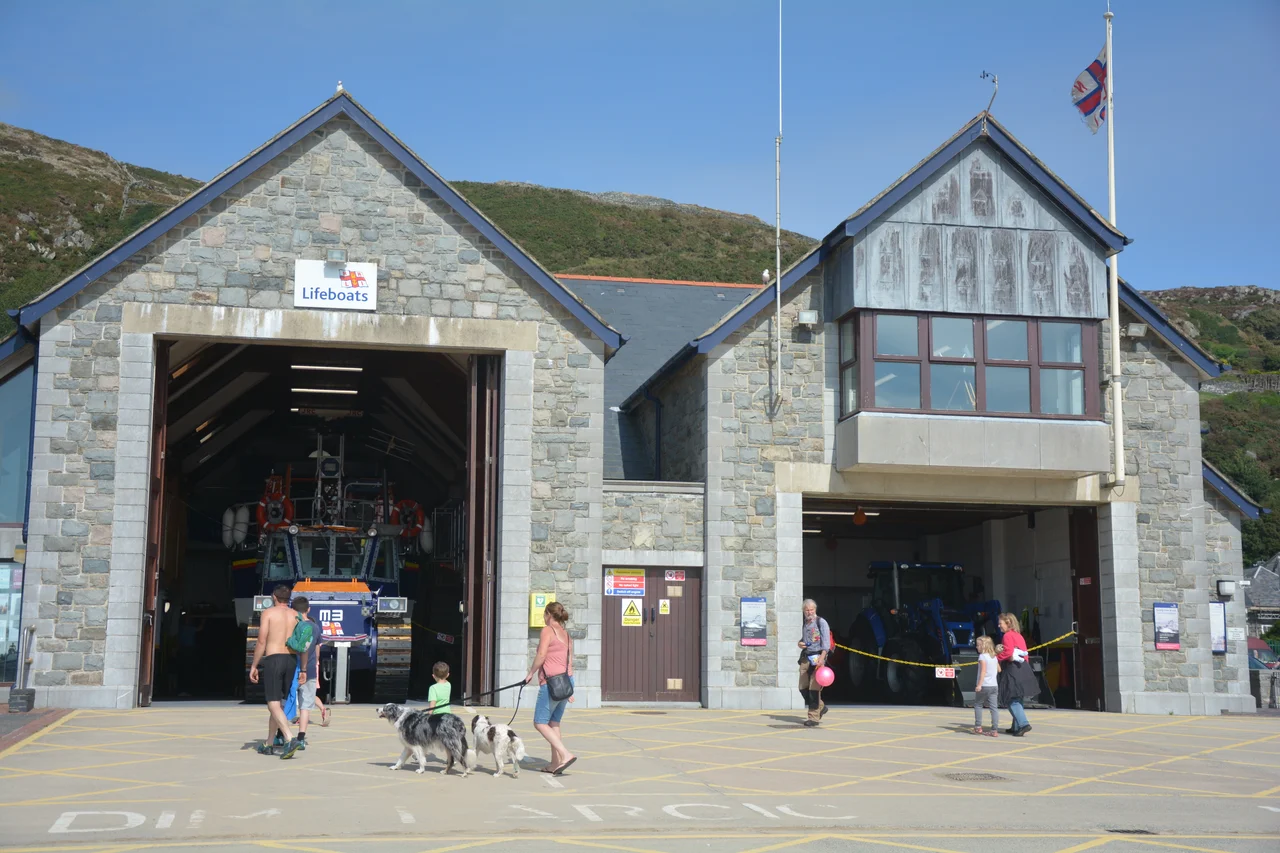

Barmouth Lifeboat Station
On a cold wet 25 November 1982, Diana, Princess of Wales, stood on a wooden slipway at Barmouth in front of a brand-new orange lifeboat and gave it a name. Princess of Wales, the boat was called; the first Mersey-class she-boat fitted with radar, built by William Osborne of Littlehampton for £240,000. Diana was 21 and still in her honeymoon year. The Mawddach was running grey, the rain was sideways, and the crowd that pressed against the harbour rails barely cared that they were wet. Behind them, somewhere up on the slopes of Cadair Idris, the fog hung in tatters. The station had been there since 1828, one hundred and fifty-four years before its newest boat got a royal name.
Reverend Ricketts and the Sloop Dove
Barmouth's lifeboat tradition begins with a clergyman. In 1828 the Reverend Frederick Ricketts wrote to the Royal National Institute for the Preservation of Life from Shipwreck, the predecessor of the RNLI, and asked for a boat. The Institute agreed. On 25 October 1828 the sloop Dove sailed into Barmouth carrying a 26-foot, six-oared lifeboat, the first of many. The boat had no name. It served for twenty-five years before a replacement was ordered. By 1851 the original was deteriorating and Captain Kenyon, also of Barmouth, wrote again. In 1853 a new boat arrived by an unusual route: the London and North Western Railway and the Chester and Holyhead Railway carried it free of charge to Caernarfon, and the Barmouth crew sailed it the rest of the way home themselves.
Medals for Cliff Falls and Trawlers
The wall of awards in Barmouth's boathouse reads like a chronicle of accidental geography: this is where coast meets mountain, and where people fall. On 21 June 1971, a woman fell from a cliff. John Henry Stockford, Colin Pugh, and Dr Robert Haworth went in after her and brought her out. They received RNLI Silver Medals, an unusual honour for what was essentially a rescue from rocks rather than the open sea. In 1978, Coxswain Evan Jones earned a Bronze Medal for taking two men off the fishing vessel Boy Nick in heavy weather. In 1982, Acting Coxswain Edward Vaughan and four crew brought three men off the trawler Gardelwen on the last day of October, when the bar at the Mawddach mouth was breaking and the sky had turned the colour of old tin. The Vellum certificates went out the following year. They are still framed on the wall.
The Bridge and the Jumper
Barmouth Bridge crosses the Mawddach estuary just south of the town - 909 yards of timber and iron, the longest wooden viaduct in Wales. People sometimes jump. On 19 October 1980, John Henry Stockford, who had already won a Silver Medal for the cliff rescue nine years earlier, entered the water to save a man who had jumped from the bridge. The Royal Humane Society issued him a parchment testimonial. Stockford was, by then, becoming a one-man rescue legend in a village that thought of him simply as the helmsman who happened to be there when things went wrong. The bridge is closer than you would think from the boathouse; it is a five-minute run in the inshore boat, less in good weather. Most of the calls do not end as well as Stockford's did.
Ella Larsen and Craig Steadman
Today the station keeps two boats. Ella Larsen, a Shannon-class all-weather lifeboat, has been on station since 2019, capable of speeds the Mersey-class Princess of Wales could only dream of, self-righting, water-jet propelled. Craig Steadman, an inshore D-class, arrived in 2017 and takes the quick calls in the estuary and along the beaches toward Harlech. Both boats are named for crew members of other stations who died in service, a quiet RNLI tradition. The Barmouth volunteers who launch them come from the same village families who launched the unnamed 26-foot boat in 1828, the Princess of Wales in 1982, and every boat in between. Two hundred years next time round. The Mawddach has not yet stopped throwing things at them.
From the Air
Located at 52.72N, 4.06W on the harbour front of Barmouth, just north of the mouth of the Afon Mawddach. From the air, look for the long curve of Barmouth Bridge crossing the estuary immediately south of the town, with Cadair Idris (893m) rising sharply behind. Barmouth itself is a strip of pastel buildings between the bay and the steep Welsh hills of the Rhinogydd. Nearest airports: Caernarfon (EGCK) approximately 22nm north; Welshpool (EGCW) approximately 36nm east; Aberporth (EGFA) approximately 50nm south. Recommended viewing altitude: 1,500-2,500 ft for the boathouse, bridge, and estuary in one frame. Cardigan Bay sea state builds fast under south-westerly weather.
Nearby Stories
- Penrhyndeudraeth 2.7 km away
- Cwmhir Abbey 11 km away
- Battle of Maes Moydog 13 km away
- HMS Whirlwind (R87) 14 km away
- Strata Florida Abbey 18 km away
- Bardsey Lighthouse 19 km away
- HMS H5 22 km away
- Llangollen Railway 23 km away