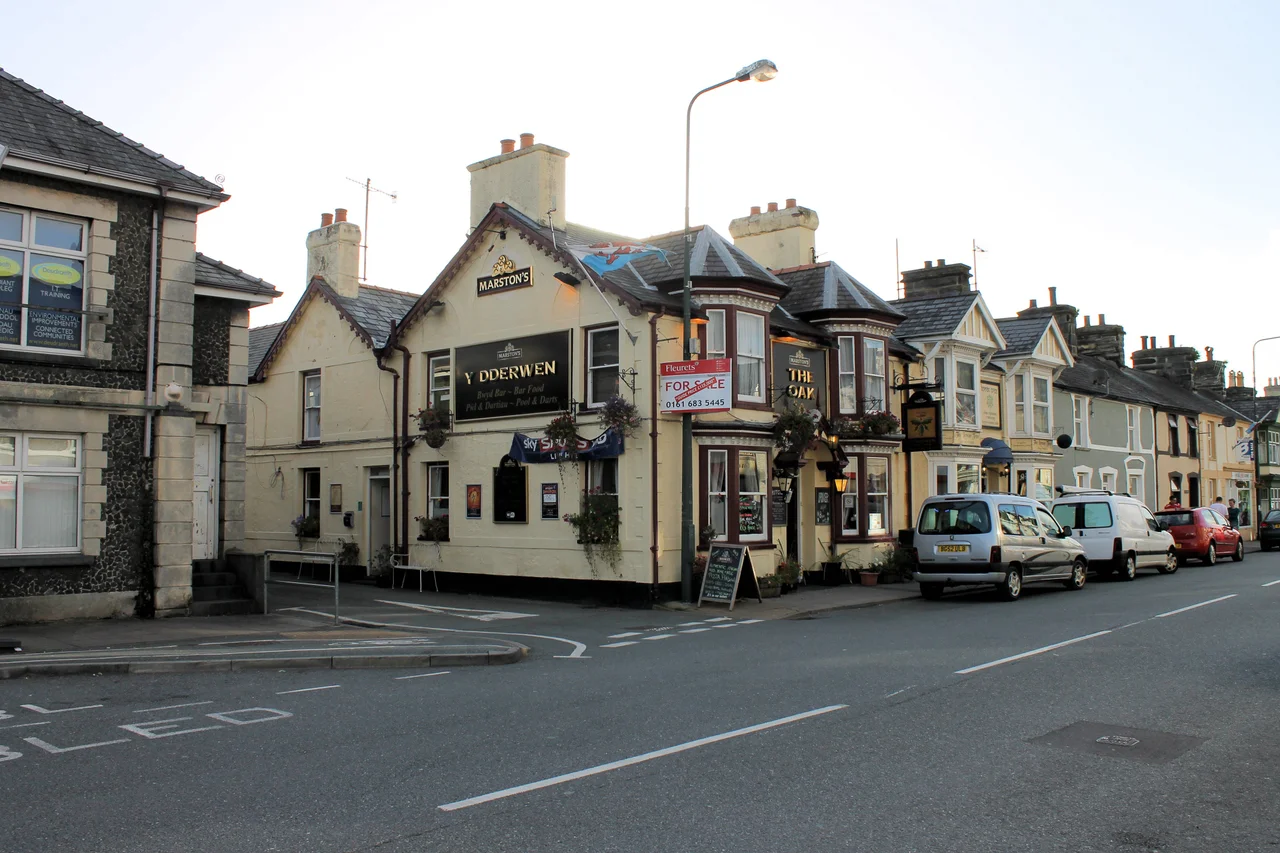

Penrhyndeudraeth
The ground that Penrhyndeudraeth stands on was, until the 1840s, a malarial swamp around a huge stagnant pool. The villagers were a handful of cottagers at Upper Penrhyn - they called the place Cefn Coch, the Red Ridge - and they made their meagre living from agriculture, copper, and from the women who gathered cockles in the estuary. Outsiders still call the town Penrhyn Cocos, Cockletown. The proper town came later, deliberate and dry, drained and laid out in broad streets by a Victorian landowner with Italian craftsmen in his head and a town plan in his hand.
A Town Built on a Bog
David Williams of Castell Deudraeth, near Minffordd, drained the swamp in the mid-nineteenth century. He had grown up next door to the planned town of Tremadog, built a generation earlier by William Madocks with the help of Italian masons, and he borrowed the same approach: broad streets, generous public spaces, a central square where four roads converge - to the station, to Porthmadog, to Maentwrog, and out toward Llanfrothen and the Pass of Aberglaslyn. His daughter Alice built one of the country's first Women's Institute halls here, an Institute Hall on a wide square in a Welsh town that had not existed a generation before. The town's primary school is still called Ysgol Cefn Coch - the Red Ridge School - keeping the old name on its slate sign.
One Hundred and Thirty Years of Explosives
The economic engine of Penrhyndeudraeth, for over a century, was a factory that turned cellulose, glycerine and acid into things that explode. The Patent Safety Guncotton Company opened in 1865 on a damp site at the edge of town, chosen because the valley walls would contain any accidental blast. In 1915 most of the original factory was destroyed by an explosion. The newly appointed Minister for Munitions, David Lloyd George, requisitioned the site for the war effort and rebuilt it as HM Factory Penrhyndeudraeth, employing 349 workers. The factory survived two world wars and changes of ownership, became known locally as Cooke's Works, was acquired by ICI in 1958, and finally closed in 1995 as cheap foreign coal eliminated demand for British mining explosives. Many people died in accidents over those 130 years. A slate plaque at the top of the site, in a spot the workers called Klondike, commemorates them. The land is now a nature reserve named Gwaith Powdwr - Powder Works.
The Philosopher of Plas Penrhyn
In 1956 the Welsh philosopher Bertrand Russell moved into Plas Penrhyn, a modest house above the village with a view of the Dwyryd estuary and Snowdon beyond it. He was eighty-four and still writing - the Russell-Einstein Manifesto against nuclear weapons had appeared the previous year. From this small Welsh house he conducted the founding correspondence for the Campaign for Nuclear Disarmament. He kept writing, speaking, and protesting until just before his death in 1970 at the age of ninety-seven. The house remains a private residence. The villagers, who put up with the curious visitors and the press cars in the lane, treated him simply as a neighbour.
The Old Languages
Penrhyndeudraeth is the nineteenth most Welsh-speaking community in Wales. According to the 2011 census, 76% of residents aged three and over could speak Welsh; 79% of pupils at the primary school come from Welsh-speaking homes. The language is not an accessory. In June 2011 new English landlords at the Royal Oak pub told customers to stop ordering drinks in Welsh; the customers walked out, were threatened with an airgun on their way, and the pub changed management soon afterwards. The town hosts a children's chaired Eisteddfod at the Memorial Hall every year. The Snowdonia National Park's Welsh-medium headquarters stands halfway between the town and Minffordd.
Faeries and Cockles
Welsh folklore clings to the hills around Penrhyndeudraeth like sea mist. One legend recounts a servant named Dafydd Fawr escorting his young mistress home one evening. As he walks behind her, a brilliant meteor splits the sky, trailing a ring of fire. Inside the ring he sees a handsomely dressed lady and gentleman of small stature, embracing. They land, draw a circle on the ground, and a great company of dancers appears within it. Dafydd watches, transfixed, while the most beautiful music he has ever heard plays. When the meteor reappears and the dancers vanish back into the sky, he stumbles home to find that what felt like three minutes had been three hours. The young woman ahead of him had walked on, completely unaware. Her son, the Reverend Robert Jones, told the story to the folklorist Elias Owen, who wrote it down. A philosopher, a powder works, and the Tylwyth Teg: this is what a small Welsh town carries with it.
From the Air
Penrhyndeudraeth sits at 52.930 degrees north, 4.066 degrees west, on the north shore of the Dwyryd estuary about 3 nm east of Porthmadog. The town is visible from cruising altitude as a compact pattern of streets on a low ridge between the estuary and the foothills of Snowdonia. The Snowdonia National Park headquarters complex stands at the western edge. Nearest airports: Caernarfon (EGCK) 16 nm north-northwest, RAF Valley (EGOV) 27 nm northwest, RAF Mona 23 nm northwest. The estuary is a haven for migrating birds; expect significant bird traffic at low altitude in spring and autumn.
Nearby Stories
- Barmouth 1.6 km away
- Beaumaris Castle 3.1 km away
- Trearddur Bay Lifeboat Station 3.9 km away
- Rhuddlan Castle 4.6 km away
- Tudweiliog 12 km away
- Battle of Maes Moydog 16 km away
- Ruthin Castle 19 km away
- HMS Whirlwind (R87) 51 km away