.jpg)
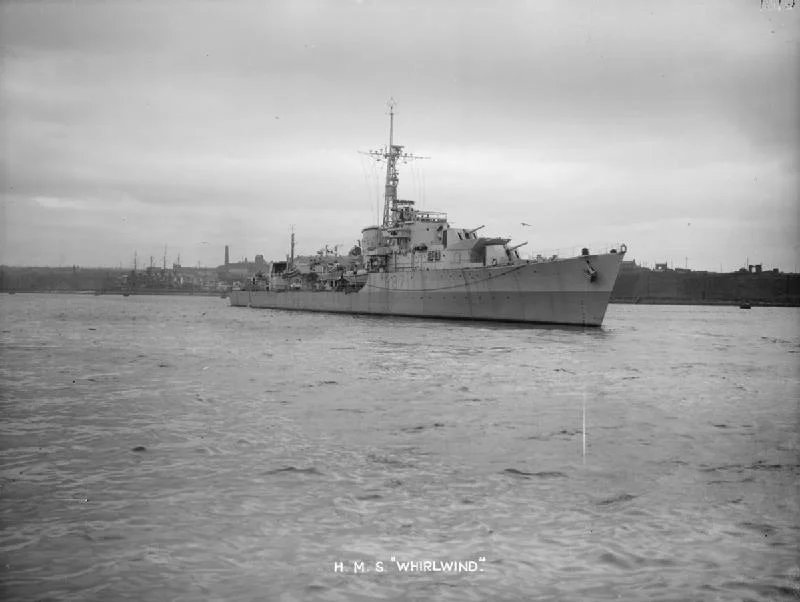
HMS Whirlwind (R87)
On the 29th of October 1974, a hulk that had once been a warship slipped beneath the grey water of Cardigan Bay. There was no ceremony. The vessel had been towed out from Pembroke Dock five years earlier, stripped, repainted in dull red, and moored as a target for missile trials. The sea did what the sea does to abandoned ships. HMS Whirlwind, R87, took her last bearing on the sea floor about 14 miles off the coast of west Wales. She had been launched at Hawthorn Leslie's Hebburn yard on the 30th of August 1943, sailed in three different navies' worth of theatres, and finished her active career as a frigate in the West Indies. Then she came home to be killed.
Built for War in a Hurry
Whirlwind was one of the eight W-class destroyers of the 9th Emergency Flotilla, ordered on 3 December 1941 when Britain still expected the war to last for years. The War Emergency Programme destroyers were built to be simple, fast to construct, and good enough. They borrowed the hull and machinery of the pre-war J-class and accepted whatever armament was available, the priority being to get hulls into the water. The W-class shared their general design with the U and V classes that preceded them, but added a new dual-purpose fire-control director that could handle both surface and anti-aircraft work. Her keel was laid down at Hawthorn Leslie's Hebburn shipyard on the Tyne on 31 July 1942. Thirteen months later she slid down the ways, the bottle broke against her bow, and the cheering rang across the Tyneside river the way it had for every destroyer that yard had built. She was completed in July 1944.
Pacific Fleet
Whirlwind sailed for the Eastern Fleet in October 1944, was briefly pulled aside to escort the battleship King George V during the bombardment of German-occupied Milos in the Aegean on 13 November, then continued to Trincomalee in what was then Ceylon. When the British Pacific Fleet formally constituted itself on 22 November 1944, Whirlwind was part of it. She joined in Operation Robson, the fleet's first action, a carrier strike against Japanese-held targets in Sumatra in December. The following January, she screened the carriers during Operation Meridian, the strikes against the Pladjoe and Soengei Gerong oil refineries near Palembang, which significantly reduced Japanese aviation fuel supplies in the closing months of the war. By 4 February 1945 the fleet had reached Fremantle in Western Australia. The crew that ran her engines and stood her watches were largely Hostilities Only ratings, civilians in uniform, doing the work between the war and home.
Conversion and Cold War Service
After the war the W-class destroyers were modernised for a different kind of conflict. Between 1952 and 1953, Palmers' shipyard at Hebburn rebuilt Whirlwind as a Type 15 fast anti-submarine frigate, fitted with new sonar, hedgehog mortars, and a deep low-set forward superstructure designed to chase down Soviet submarines. She emerged with the new pennant number F187 and recommissioned in July 1953 for the 5th Frigate Squadron in the Mediterranean. In 1954 she helped recover wreckage of a de Havilland Comet airliner that had broken up at high altitude off the island of Elba, the disaster that ultimately revealed the dangers of metal fatigue in pressurised aircraft. In 1956 she stood off the Egyptian coast during the Suez Crisis, then ran patrols off Cyprus through the EOKA emergency. A long refit at Rosyth between 1959 and 1961 prepared her for one more tour.
Bahamas Patrol
Her last operational years were spent with the 8th Frigate Squadron in home waters and the West Indies. In 1964, she ran patrols in the Bahamas to intercept smuggling traffic from Cuba in the years following the Cuban Missile Crisis, working those same warm Atlantic shoals where pirates had operated three centuries earlier. By 1966 she had reached the end of her useful life. The Type 15 hulls were aging, the Royal Navy was shrinking, and the new general-purpose Leander-class frigates were arriving. Whirlwind was placed on the disposal list and laid up. There was no plan to preserve her. Of more than seventy War Emergency destroyers built, only a handful would survive to museum status.
Cardigan Bay
On 12 August 1969 Whirlwind was towed from Portsmouth to Pembroke Dock, where she was stripped of useful fittings and prepared for use as a target ship on the MoD Aberporth range in Cardigan Bay. She rode at her mooring through five winters of Atlantic weather. Various missiles and shells were fired at or past her. On the 29th of October 1974 she finally foundered, the last act of a working warship reduced to a measure of explosive force. The wreck still rests on the bay floor at moderate depth, occasionally visited by divers and recorded on Admiralty charts as a magnetic anomaly. The bay above is now also the test range for Watchkeeper drones flown out of Aberporth Airport, the place where one set of military technologies tests itself above the rusting hull of another.
From the Air
Wreck approximately 14 nautical miles off the Ceredigion coast in Cardigan Bay, near the MoD Aberporth danger area. Coordinates around 52.28 degrees north, 4.68 degrees west. Cruise altitude 3,000-6,000 feet over the bay; airspace inside the Aberporth danger area is restricted during active range operations. Check NOTAMs before flight. Nearest airfields are Aberporth (MoD, EGUC), Haverfordwest (EGFE) to the south, and Welshpool (EGCW) inland.
Nearby Stories
- Newport Lifeboat Station 7.2 km away
- German Submarine U-1302 7.9 km away
- Talyllyn Railway 9 km away
- HMS Tyler 14 km away
- Aberystwyth Lifeboat Station 15 km away
- Talley Abbey 17 km away
- St Davids Lifeboat Station 17 km away
- Bardsey Lighthouse 22 km away