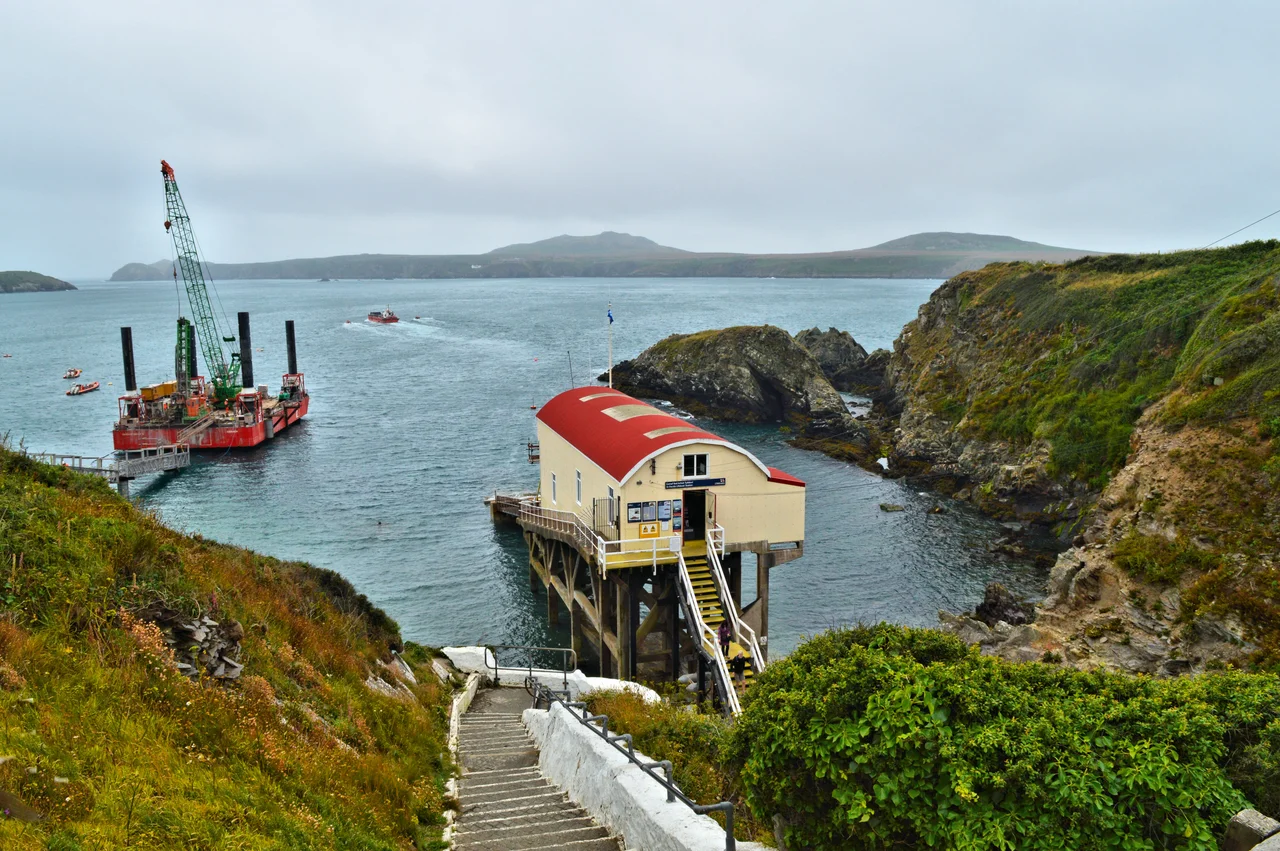

St Davids Lifeboat Station
On the night of 13 October 1910 the lifeboat Gem launched from St David's into Ramsey Sound and never came home complete. She struck The Bitches reef during a rescue and broke up in the tidal race. Coxswain John Stephens drowned. So did lifeboatmen Henry Rowlands and James Price. The papers concerning their deaths sit today at the Pembrokeshire Record Office under reference DX/93/11, a thin folder for a heavy thing. The station they served still exists, a few hundred yards from where Gem launched, and a lifeboat still answers the same call on the same water.
A Surgeon's Letter
It started with a doctor who watched too many bodies wash up. On 5 November 1868 the RNLI committee in London read a letter from H. Hicks, a surgeon at St David's, arguing for a lifeboat to cover St Brides Bay. The Inspector of Lifeboats was dispatched, came back convinced, and on 3 December 1868 the committee resolved to establish a station here, calling the location 'central' enough to command the whole bay. Funding of £420 came from the Earl of Dartmouth and the tenants of his estate. The boat they bought was a 32-foot self-righting pulling and sailing lifeboat with ten oars, and before she ever saw Welsh water she was carted to Staffordshire and floated on the 75-acre Great Lake at Patshull Hall so the Earl could see what his money had built. The Countess of Dartmouth named her Augusta. She served St David's from 1869 to 1885 and saved 23 lives.
The Roll of Honour
Every RNLI station accumulates a list, and St Davids has accumulated a long one. The Silver Medal for gallantry was awarded to Coxswains David Hicks in 1892, William Narbett in 1903, and fisherman Sidney Mortimer in 1910. Coxswain William Watts Williams won the Silver in 1955 for a rescue so dangerous the French government also gave the crew its own first-class medal afterwards. Bronze Medals followed: David John Lewis in 1956, William Thomas Morris in 1978, Frederick George John in 1982, David Chant in 1989. Dr Joseph Soar, the station's honorary secretary, earned a Bronze in 1943 and the MBE in 1947, and the second lifeboat to bear his name served from 1963 until 1985, saving 45 lives in her tenure. The medals stand for moments when ordinary fishermen rowed into weather that should have killed them and brought strangers back alive.
From Oars to Tamar
The boats themselves trace a century and a half of marine engineering. Augusta gave way in 1885 to Gem, the boat lost on The Bitches. Charlotte stood in for two years from Porthclais while a new station and slipway were built for the station's first motor-powered lifeboat, General Farrell, which arrived in 1912. Joseph Soar, donated by the Civil Service Lifeboat Fund in 1963, was eventually fitted for self-righting in 1974 and after retirement was sold off in 1992 with a civic send-off at Poole. She is still afloat in Northern Ireland today, refitted in 2012-13, touring RNLI stations as a fundraiser. After the RAF Rescue Service helicopter was withdrawn from nearby RAF Brawdy, St Davids added an inshore lifeboat in 1997, then took permanent delivery of Dewi Sant (Saint David) in 1998. The current all-weather boat, the Tamar-class Norah Wortley, came on station in 2013 and launched for the first time from the new £9.5 million boathouse on 21 October 2016.
Today's Crew
Two people work here full-time: the Coxswain and the Mechanic. Everyone else is a volunteer, and the rule is that they all live within about three miles of the station so that when the pager goes off they can reach St Justinian's quickly. The neighbouring stations are Fishguard to the north, Little and Broad Haven to the south, and Rosslare Harbour across the Irish Sea to the west, a Welsh-Irish geography of mutual rescue that has functioned since before either nation had radios. On most summer days the slipway sees a different kind of traffic: the lifeboat station is also the embarkation point for the Thousand Islands ferries to Ramsey Island. The same boathouse that has launched into October gales for over 150 years now lets tourists out to look at puffins and seals. Both jobs, the RNLI would argue, are about the same thing.
From the Air
St Davids Lifeboat Station sits at 51.88 N, 5.31 W on the small inlet at St Justinian's, on the mainland directly opposite Ramsey Island across Ramsey Sound. From the air the station appears as a slipway-and-boathouse complex hard against the cliffs, with the much older smaller boathouse visible nearby. Good viewing altitude is 2,000-3,000 feet AGL. The Bitches reef shows as a line of broken water extending east from Ramsey Island at most tide states. Nearest airport is Haverfordwest (EGFE) about 14 nm to the east-northeast; the disused RAF Brawdy lies a few miles inland and was historically the source of helicopter rescue cover for this coast.
Nearby Stories
- Pembroke Castle 0.3 km away
- Cwm Gwaun 4.7 km away
- German Submarine U-1302 13 km away
- Action of 17 November 1917 18 km away
- HMS Whirlwind (R87) 19 km away
- Johnstown Castle 37 km away
- Hook Lighthouse 68 km away
- 1979 Fastnet Race 144 km away