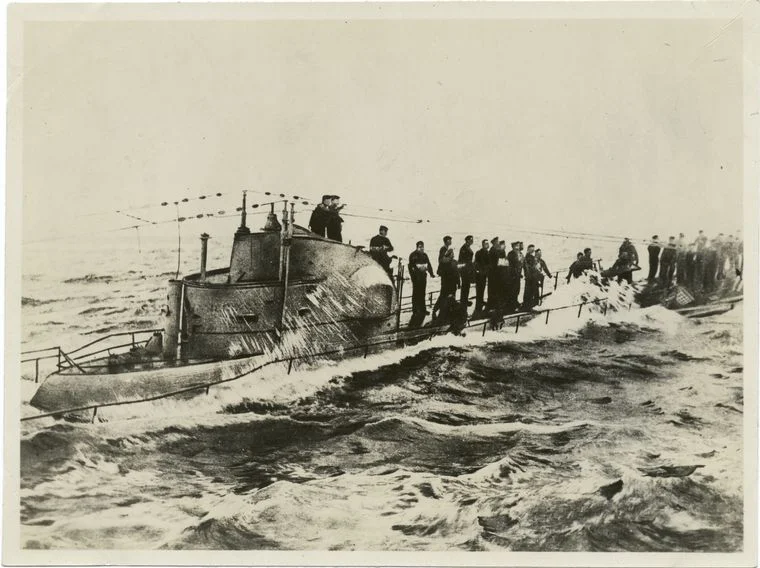

Action of 17 November 1917
It happened in twenty minutes. At 4:10 in the afternoon, off the southwest approaches to the British Isles, a coxswain on USS Fanning spotted a periscope sliding through the grey Atlantic chop. By 4:30 the German submarine that owned that periscope - U-58, under Kapitänleutnant Gustav Amberger - was on the surface, holed near her diving planes, surrendering to two American destroyers based out of Queenstown, Ireland. It was the first time a U.S. Navy warship sank an enemy submarine in combat, and one of only a handful of U-boats sunk by American ships in the entire war.
The Queenstown Destroyers
By late 1917 the United States had been at war for seven months. American destroyers were based at Queenstown - now Cobh - on the south coast of Ireland, escorting convoys across the most dangerous stretch of the Atlantic. Two of them were USS Fanning (DD-37), commanded by Arthur S. Carpender, and her sister USS Nicholson (DD-52), commanded by Frank Berrien. Both ships were on escort duty with convoy OQ-20, an eight-vessel formation heading eastbound. The convoy carried the British merchant steamer SS Welshman among its members. Convoy escort was tedious and exhausting work in November in the Western Approaches: wet decks, low cloud, short days, the constant scanning for the thin line of a periscope feather.
Twenty Minutes
Coxswain Daniel David Loomis saw it first. U-58 had come up just enough to extend her periscope, lining up a shot on the Welshman. Officer of the Deck Lieutenant William O. Henry ordered Fanning to swing into a tight circle and engage. The destroyer dropped three depth charges. The U-boat shuddered and broached. Nicholson came in and added another depth charge to the sequence. When U-58 surfaced, Fanning's stern gun fired three rounds and Nicholson's bow gun hit her at least once. The Americans' fire struck near the U-boat's diving planes, leaving her unable to maneuver. The German crew returned fire briefly without effect. By 4:30 Amberger had ordered the ballast tanks blown and surrendered. The Americans also paid a price: depth-charge concussion knocked out Fanning's main generator. If U-58 had surfaced ready to fight, Fanning could have been the one sunk.
The Prisoners
Thirty-eight of the forty men aboard U-58 survived. As Fanning maneuvered to take them off, the Germans opened the submarine's seacocks - scuttling her so she could not be captured intact. U-58 settled and sank in deep water; the wreck now lies at 270 feet off the coast of Cork, where divers visit her periodically. The thirty-eight survivors became prisoners of war in the United States - a circumstance that some of them, perhaps, came to count as fortunate. By November 1917 the German submarine service was suffering attrition rates that few branches of any military have ever matched. For Amberger and his crew, the war was effectively over.
Two Navy Crosses
Both Lieutenant William O. Henry and Coxswain Daniel Loomis received the Navy Cross for the action. The Navy Cross at that time was the second-highest naval decoration for valour in combat. Henry's order to engage had been instant and correct. Loomis's eye had caught a periscope that most men would have missed against November chop. The action made news immediately. The New York Times ran a long account on 30 December 1917 under the headline "Tells Whole Story of Sinking U-Boat," walking American readers through what their destroyer crews had done in the cold water off Ireland. The story mattered because U.S. Navy victories against U-boats were rare. The convoy system - the great Allied answer to the submarine threat - was working precisely because ships travelled in groups protected by escorts. Most U-boat losses came from mines, accidents, or British forces. November 17, 1917 was an exception.
What Came After
Fanning and Nicholson stayed on escort duty in the North Atlantic through the remainder of the war. They made several more inconclusive submarine contacts - the standard pattern of the work, hours of nothing punctuated by minutes of doubt. Neither ship matched their 17 November performance. After the Armistice, Fanning returned to the United States and was eventually decommissioned in 1919. Nicholson went on to serve in the interwar years and was finally struck from the navy list in 1936. Carpender, the Fanning's commander, rose to become a vice admiral and led the U.S. Seventh Fleet in the Southwest Pacific during the Second World War. Loomis and Henry, the two Navy Cross recipients, made the action a permanent part of their service records and a footnote in the broader naval history of the war.
From the Air
The action was logged at approximately 51.53 N, 5.35 W in the Western Approaches off the Pembrokeshire and southern Irish coasts - a stretch of sea where dozens of WWI engagements took place along the convoy routes. The actual sinking site, where U-58 rests today, is closer to the south coast of Cork. Best aerial appreciation comes from 3,000 to 5,000 feet over the Western Approaches with low cloud and grey sea below, giving a sense of the constant North Atlantic conditions destroyer crews faced. Nearest aerodromes: Haverfordwest (EGFE), Swansea (EGFH), and Cork in Ireland.
Nearby Stories
- Ambleston 4.5 km away
- Ramsey Island 7.5 km away
- Pembroke, Pembrokeshire 9.4 km away
- Lighthouses on Lundy 25 km away
- HMHS Glenart Castle 36 km away
- Johnstown Castle 61 km away
- Hook Lighthouse 88 km away
- 1979 Fastnet Race 111 km away