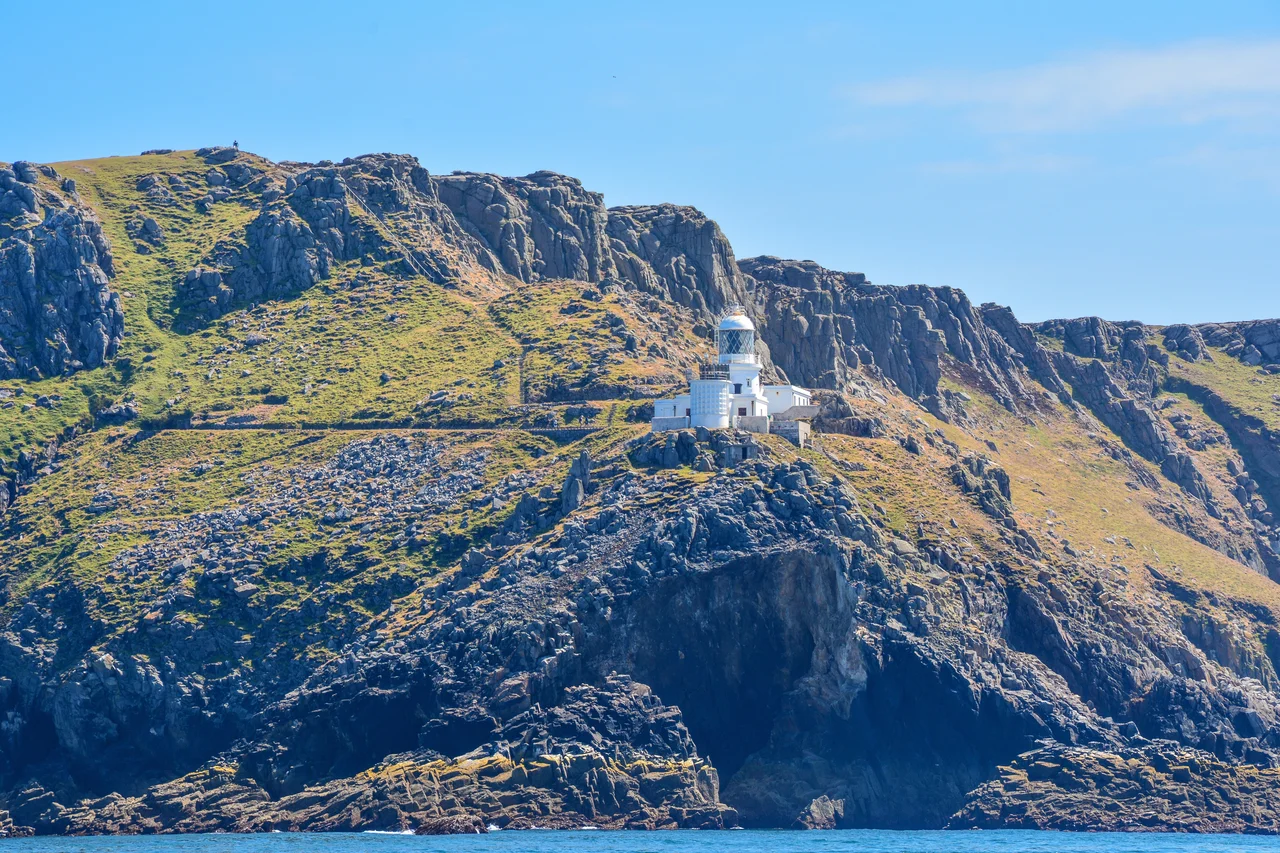

Lighthouses on Lundy
The Old Light on Lundy stands on Beacon Hill, four hundred and sixty-nine feet above the Bristol Channel. When Trinity House built it in 1819, that elevation was meant to be its great advantage: a beam visible from horizon to horizon, the highest lighthouse base in Britain. In practice, the height became the problem. The fog that haunts the Bristol Channel does not crawl along the surface of the sea. It rises. On most foggy nights, the island below the lighthouse was clear, and only the lighthouse itself, perched on its hill, was wrapped in cloud — entirely invisible to the ships it was supposed to save. "The lighthouse stands so high," one nineteenth-century report observed, "that it is capped by fog." Sailors died because of this geometry.
The Architect and the Cost
Daniel Asher Alexander designed the Old Light. He had previously designed Dartmoor Prison and the warehouses at the London Docks — a man with a particular feel for severe, functional, granite-and-fortress architecture. The tower is ninety-seven feet of granite, square-shouldered at the base, slightly tapered, finished in a circular lantern. Joseph Nelson built it for thirty-six thousand pounds. Trinity House had paid for a nine-hundred-and-ninety-nine-year lease of the land in 1819, which suggests considerable confidence in the design. The first warning that something was wrong came almost immediately. La Jeune Emma, bound from Martinique to Cherbourg, ran aground at Cefn Sidan on the Welsh coast in 1828. Thirteen of the nineteen people aboard drowned, including Adeline Coquelin — twelve years old, niece of Napoleon Bonaparte's discarded empress Joséphine de Beauharnais. The Old Light had not warned her. The fog had been too high.
Cannon, Then Guncotton
Around 1861, Trinity House conceded the lighthouse alone was inadequate and built a Fog Signal Battery on the west cliff. Two eighteen-pound guns fired once every fifteen minutes when fog rolled in — later increased to every ten minutes. The sound of muzzle-loading cannon firing into the Atlantic became, for decades, the second voice of Lundy's warning system. Guncotton rockets replaced the guns in 1878, then in 1889 the flash rate of the main light was doubled. None of it solved the underlying problem. The light was simply too high. As early as 1857 a perceptive observer had written that the island would be better served "by provision of low lighthouses on north and south extremities of island, one with bell, the other with gong or cannon." It took another forty years for Trinity House to act on the recommendation.
Two New Lights
In 1897 the Old Light was decommissioned. Two new lighthouses, designed by Sir Thomas Matthews, opened at the north-west and south-east tips of Lundy — both close to sea level, where they could actually be seen from the water. The North lighthouse, at its opening, was described in the trade press as "at the present moment, the most scientific and most advanced lighthouse in the world." It flashed twice every twenty seconds, lit originally by a five-wick Trinity House oil burner, later upgraded to a Matthews triple-mantle petroleum vapour lamp, then a Hood single-mantle. The oil was hauled up from the quay by sled-and-winch and then carried along the cliff on a tiny winch-powered railway, the remains of which can still be seen. The South lighthouse used the old 1857 revolving optic from the Old Light, recycled into a working tower. The lights had ranges of nineteen to twenty-four nautical miles. They could no longer be capped by fog.
Foghorns and Explosives
Lundy's fog problem demanded fog signals as much as it demanded lights. The North lighthouse got a two-tone siren — four blasts, low-high-low-high, every two minutes, powered by sixteen-horsepower Hornsby oil engines, sounded through curved horns on the roof. In 1929 it was replaced with a more powerful twelve-inch siren and twin Gardner diesel engines. The South lighthouse went a different way entirely. It sounded an explosive fog signal: literal explosive charges, detonated from the lantern gallery on a manual schedule, then automated in 1908 by the Clockwork Explosive Fog Signal Company of Victoria. For decades, in thick weather, the south end of Lundy went off like artillery — bangs at fixed intervals, telling ships exactly how close they were to the granite. The explosive signal was retired in the twentieth century. The helicopter pad now occupies the small building that once housed it.
The Light That Stayed Off
The Old Light has stood disused since 1897, but it is still here. Trinity House sold the lease back, and the Landmark Trust now owns the tower and the keepers' accommodation. The accommodation is rented out as self-catering holiday lets — you can sleep in the rooms the lighthouse-keepers once occupied. The tower itself is a scheduled monument, and a Grade II* listed building, and on a clear day you can climb the spiral staircase to the lantern room and look out across Lundy to the Welsh coast forty miles away. The two working lighthouses below, at the north and south tips, are now fully automated — monitored over telemetry by Trinity House staff in Harwich on the Essex coast, three hundred miles away. The only people who turn the lights on and off no longer live within sight of them.
From the Air
Lundy lies at 51.17 degrees north, 4.67 degrees west, in the centre of the Bristol Channel. Recommended viewing altitude is 1,500 to 2,500 feet on a clear day. The Old Light sits in the centre of the island on Beacon Hill, its ninety-seven-foot tower visible from miles away on the rare days when the summit is clear. The two active lighthouses are at the extreme north-west tip (Lundy North) and the south-east tip (Lundy South), close to the water. Hartland Point on the Devon mainland is eleven miles southeast — a useful approach reference. Newquay (EGHQ) is roughly 50 nautical miles south. The fog that bedevilled the Old Light is still a hazard for low-altitude flight in the Channel; expect rapidly developing conditions in late spring and early summer.
Nearby Stories
- Horton and Port Eynon Lifeboat Station 5.1 km away
- Action of 17 November 1917 6.2 km away
- Ilfracombe Lifeboat Station 7.9 km away
- Caldey Island 15 km away
- River Tamar 22 km away
- Okehampton Castle 31 km away
- Skokholm 51 km away
- Tehidy Country Park 82 km away