.jpg)
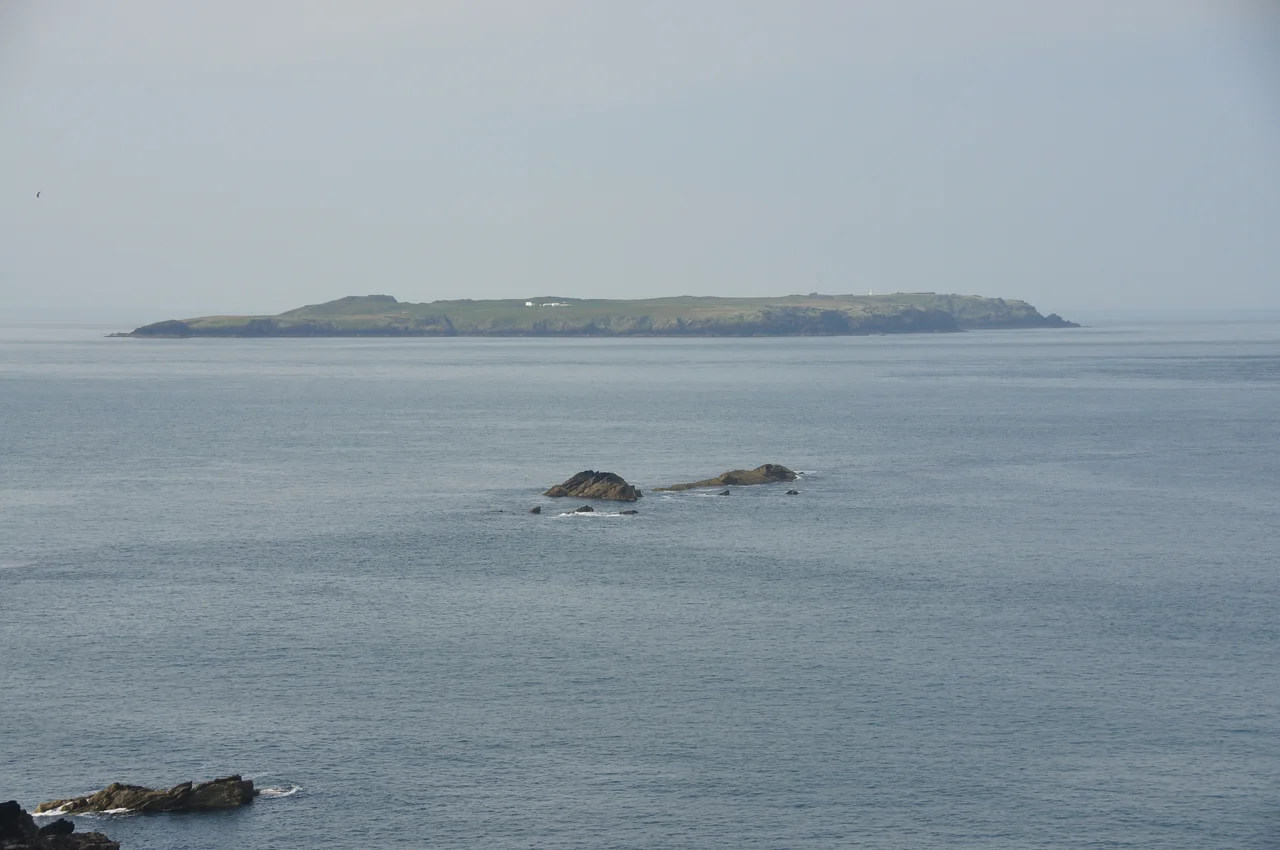
Skokholm
Ronald Lockley arrived on Skokholm in 1927 with a 21-year lease, a wife, and a plan to live on a treeless island in the Irish Sea by farming and writing. He stayed twelve years. From the kitchen of the restored farm cottage - now a Grade II listed building - he opened Britain's first bird observatory in 1933, started ringing the storm petrels that nested in the stone walls, watched the Manx shearwaters return at night, and wrote books that turned this tiny lump of Old Red Sandstone into one of the best-known small islands in the world.
A Norse Name on a Sandstone Island
Skokholm is two and a half miles off the Pembrokeshire coast, just south of Skomer. It runs about a mile long and half a mile wide - 106 hectares of grass-topped cliff. The cliffs climb from 70 feet on the northeast side to 160 feet on the southwest, where the Atlantic does most of its damage. The name is Norse: skogr meaning wood, holmr meaning small island - 'wooded island'. There are no trees on Skokholm now and probably none for centuries, but the Vikings who named it knew the place. A 1219-31 charter held in the British Museum, granted by William Marshal the Younger, Earl of Pembroke, refers to the island as Scogholm. Christopher Saxton's 1578 map of Pembrokeshire renamed it Sealine insul. Sir John Perrott, supposedly a natural son of Henry VIII, owned it in the 16th century. In 2021, a prehistoric stone tool was found down a rabbit hole, confirming what archaeologists had long suspected: people have used this island for several thousand years.
Lockley's Lease
Ronald Lockley took his lease from the Dale Castle Estate in 1927. He was twenty-three. He, his wife Doris, and later their daughter Ann lived on the island for twelve years, restoring the old farm cottage, raising chickens and sheep, and studying birds. In 1933 he opened Britain's first bird observatory in the cottage and began ringing seabirds at scale. He started the Pembrokeshire Bird Protection Society in 1938. His books - Dream Island, Letters From Skokholm, The Private Life of the Rabbit - made him one of the best-known naturalist-writers of his generation. His rabbit research at Skokholm later inspired Richard Adams to write Watership Down. The Lockley years ended with the war: the observatory closed in 1939, and the family left.
After the War
The bird observatory reopened in 1946 under John Fursdon as warden. Fursdon would later write: 'There can be few other islands anywhere in the world that can boast the continuity of biological recordings, save for wartime years, that has taken place on Skokholm.' In 1948 the West Wales Field Society took over the lease. Skokholm became one of the great research stations of British ornithology. Its long-term studies of the European storm petrel and the razorbill defined what was known about those species. Its tracking of Eurasian oystercatchers and northern wheatears among the landbirds produced data sets that few other places could match. Routine ringing on the island finally ended in 1976, after radar studies of migration in the 1960s had shifted the science elsewhere. In 2014, Skokholm was re-accredited as a bird observatory, and resident wardens Richard Brown and Giselle Eagle reopened the long record.
Puffins and Petrels
The island holds extraordinary numbers of breeding seabirds. In 2021 the puffin population exceeded 11,000 - the highest count since the 1940s. Lesser black-backed gulls, herring gulls, and great black-backed gulls nest in large colonies. Red-billed choughs, Eurasian skylarks, and northern wheatears breed across the grasslands. The Manx shearwaters - the species most associated with these Pembrokeshire islands - return at night, navigating to their burrow nests by smell and sound after weeks at sea. Skokholm and neighbouring Skomer together hold one of the largest Manx shearwater populations in the world. The island's geology helps: the strata of mudstones and sandstones, folded into a syncline with an east-west axis, have eroded into the cliff ledges and soft-soil slopes that the birds need.
Visiting the Island Today
The Wildlife Trust of South and West Wales bought Skokholm outright in 2006. In December 2008 it was designated a National Nature Reserve. The landing quay was improved in 2010. Today the island runs as a residential reserve: small groups come out for stays of a few nights, sleeping in the converted farm buildings and helping with surveys, or simply walking the cliff paths and watching the colony from the burrow edges. Skokholm is also the type locality for a corticioid fungus - Trechispora clanculare - first described from a specimen found in a puffin burrow on the island in the 1950s by Frederick Parker-Rhodes. The golden hair lichen, nationally scarce in Britain, survives here in numbers thanks to the island's isolation. The Lockley cottage still stands. The observatory log still runs. The shearwaters still come back in the dark, as they did when the first lease was signed.
From the Air
Skokholm sits at 51.70 N, 5.28 W in the Irish Sea, 2.5 miles off the Marloes Peninsula, with Skomer just to the north. Best viewed from 1,000 to 2,000 feet, low enough to see the cliff edges and seabird colonies but high enough to avoid disturbing them - the island is a national nature reserve and surrounded by a marine reserve. Nearest aerodromes: Haverfordwest (EGFE) just east, Withybush military aviation traffic, Swansea (EGFH) further east. Manx shearwaters fly inland to colony at dusk, so dawn and dusk overflights should be at higher altitude. Watch for sudden westerlies from the open Atlantic.
Nearby Stories
- Big House, Landshipping 2.7 km away
- St Andrew's Church, Bayvil 11 km away
- HMS H47 15 km away
- Lighthouses on Lundy 41 km away
- Johnstown Castle 46 km away
- HMHS Glenart Castle 51 km away
- Hook Lighthouse 76 km away
- 1979 Fastnet Race 127 km away