.jpg)
Okehampton Castle
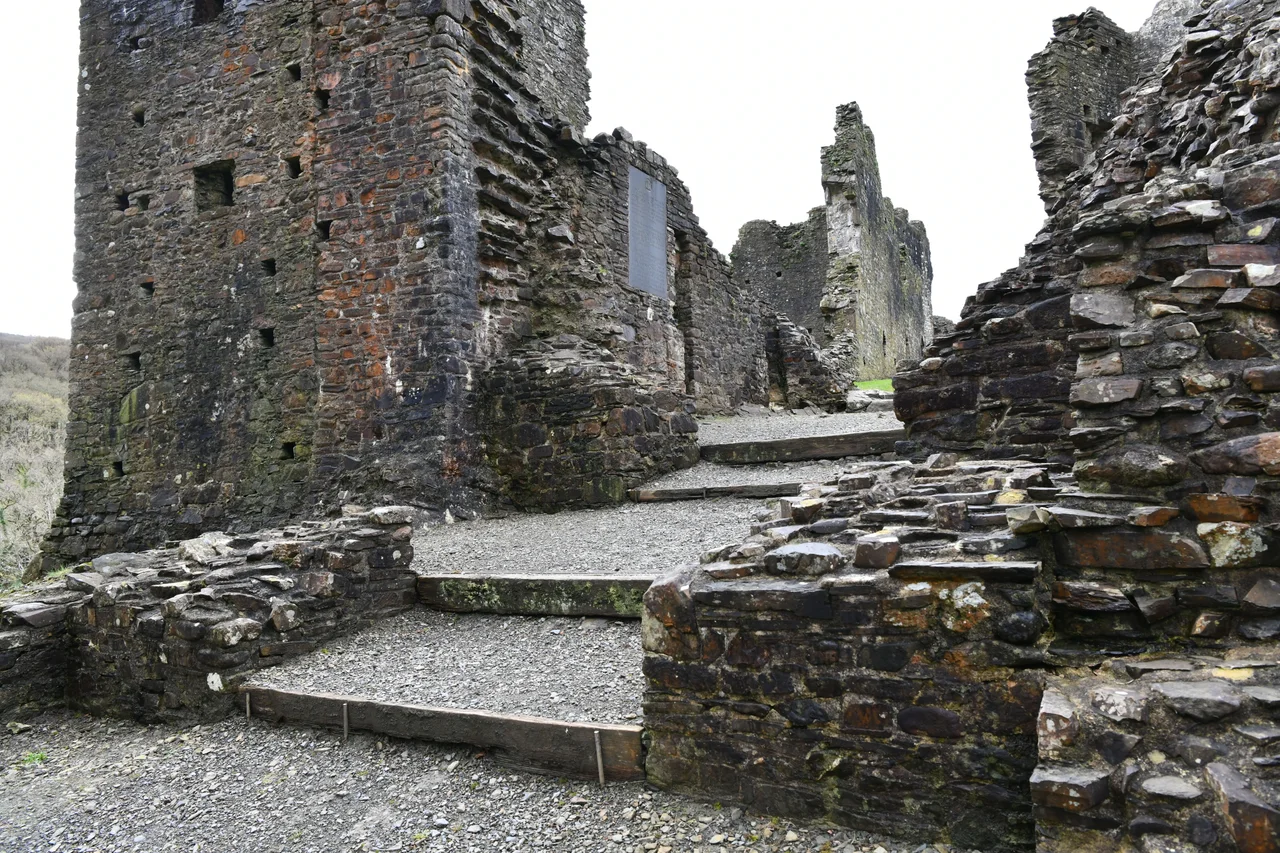
From the road north of the keep, Okehampton Castle still wears its medieval war face: narrow window slits, tall walls, defensive posture. Walk around to the south, however, and a different building reveals itself. Wide windows. Low walls. Lodgings that opened onto a hunting park large enough to swallow whole villages. The same fortress was performing two roles at once, and the trick was deliberate. The Courtenay family wanted travelers to see a stronghold from one side and an English country estate from the other, two centuries before that idea even had a name.
A castle with two faces
When the Redvers line ran out in 1297, Hugh de Courtenay inherited Okehampton along with the title of Earl of Devon. His main seat sat at Tiverton, so Okehampton became something rarer: a country retreat for the medieval rich. He and his son poured money into the conversion. The bailey gained a Great Hall lit by a decorative window, a buttery with a luxurious solar apartment above, eastern lodgings whose windows framed parkland views, a chapel painted with red lines mimicking cut ashlar stone. The 11th-century keep on its natural rock motte was rebuilt as a two-storey residence with a staircase turret. Oliver Creighton, the historian who has studied the site closely, calls the north elevation a 'martial facade.' Stephen Mileson, surveying the southern view from the eastern lodgings, simply called it 'stunning.'
Clearing the land for status
The deer park that made those southern views possible cost the surrounding countryside dearly. To create 690 hectares of enclosed hunting ground, the Courtenays cleared away whole settlements of long houses, hamlets that had grown up during the warmer climate of the 12th and early 13th centuries. By the time they were demolished, the Medieval Warm Period was already giving way to a colder era, so some of those communities may have been struggling. That was small comfort to the families who left. The new park brought intensively farmed fallow deer, plus wild boar, fox, and hare for the chase. Kennel Field, just outside the walls, housed the packs of dogs. Venison sat at the center of the castle's table as a prestige meat, and the haunches, the prized cuts, were brought in from other Courtenay estates entirely. Status had a taste, and the Courtenays made sure to serve it.
The artists arrive
By the 18th century the castle was a ruin, and that turned out to be its second career. Devon's landscape painters discovered Okehampton just as the Sublime and the Picturesque became fashionable, and they could not get enough of it. Richard Wilson painted the keep silhouetted against the sky in 1771, producing what historian Jeremy Black describes as a 'calm, entrancing and melancholic' effect. Thomas Walmesley took liberties in 1810, surrounding the castle with an imaginary Italianate lake. Thomas Girtin came in 1797. His friend J. M. W. Turner followed in 1824. The ruined keep on its granite outcrop, with the West Okement winding past, had become exactly the kind of subject the Romantic age craved. Art preserved what masonry could not.
Lady Howard's coach
Every good Devon ruin needs a ghost, and Okehampton has one of the best. Legend says the castle is haunted by Lady Howard, a 17th-century noblewoman accused of murdering three husbands and two of her children. Her phantom coach is built from the bones of her victims, drawn by horses, accompanied by a headless driver and a one-eyed bloodhound. An old ballad survives: 'My Ladye hath a sable coach, with horses two an four. My Ladye hath a gaunt blood-hound, that goeth before. My Ladye's coach hath nodding plumes, the driver hath no head. My Ladye is an ashen white - as one who is long dead.' Her penance is to collect every blade of grass from the castle ruins, one by one, until time ends or her soul finds peace. No historical record matches the tale. The story persists anyway, which is how legends work.
Saved by a Sydney
By the time Sydney Simmons bought the castle in the early 20th century, vegetation had nearly buried it. Between 1911 and 1913 he cleared the growth and stabilized the stonework, then passed the property to the Okehampton Castle Trust in 1917. The Ministry of Works took over in 1967 and English Heritage cares for it today. What survives is the largest castle ruin in Devon: the keep on its natural rock motte standing up to 32 metres above the surrounding valley, the gatehouse where a drawbridge once spanned the approach, the Great Hall's footprint, the chapel with its painted plaster, the bailey buildings now open to the sky. The deer park is farmland again. The road that once carried travelers past the martial facade still runs north of the ruin. Walk the path the medieval visitor walked, then circle to the south, and the two-faced castle reveals its old trick all over again.
From the Air
Okehampton Castle sits at 50.7306N, 4.0083W on the northern edge of Dartmoor, perched on a long granite outcrop above the West Okement River about a mile southwest of Okehampton town. The keep is the highest surviving point. Best viewed at 1,500 to 2,500 feet AGL with morning light, when the moorland to the south reveals the old deer park's terrain. Exeter Airport (EGTE) lies 28 nm east. RAF Chivenor (EGDC) is 26 nm northwest. Watch for low cloud across Dartmoor in any season.
Nearby Stories
- Boconnoc 4.7 km away
- Hemerdon Mine 4.9 km away
- Torbay Lifeboat Station 5.6 km away
- Powderham Castle 8.7 km away
- Davidstow Circuit 8.9 km away
- Manor of Orleigh 14 km away
- HMS Montagu 22 km away
- Cleeve Abbey 23 km away