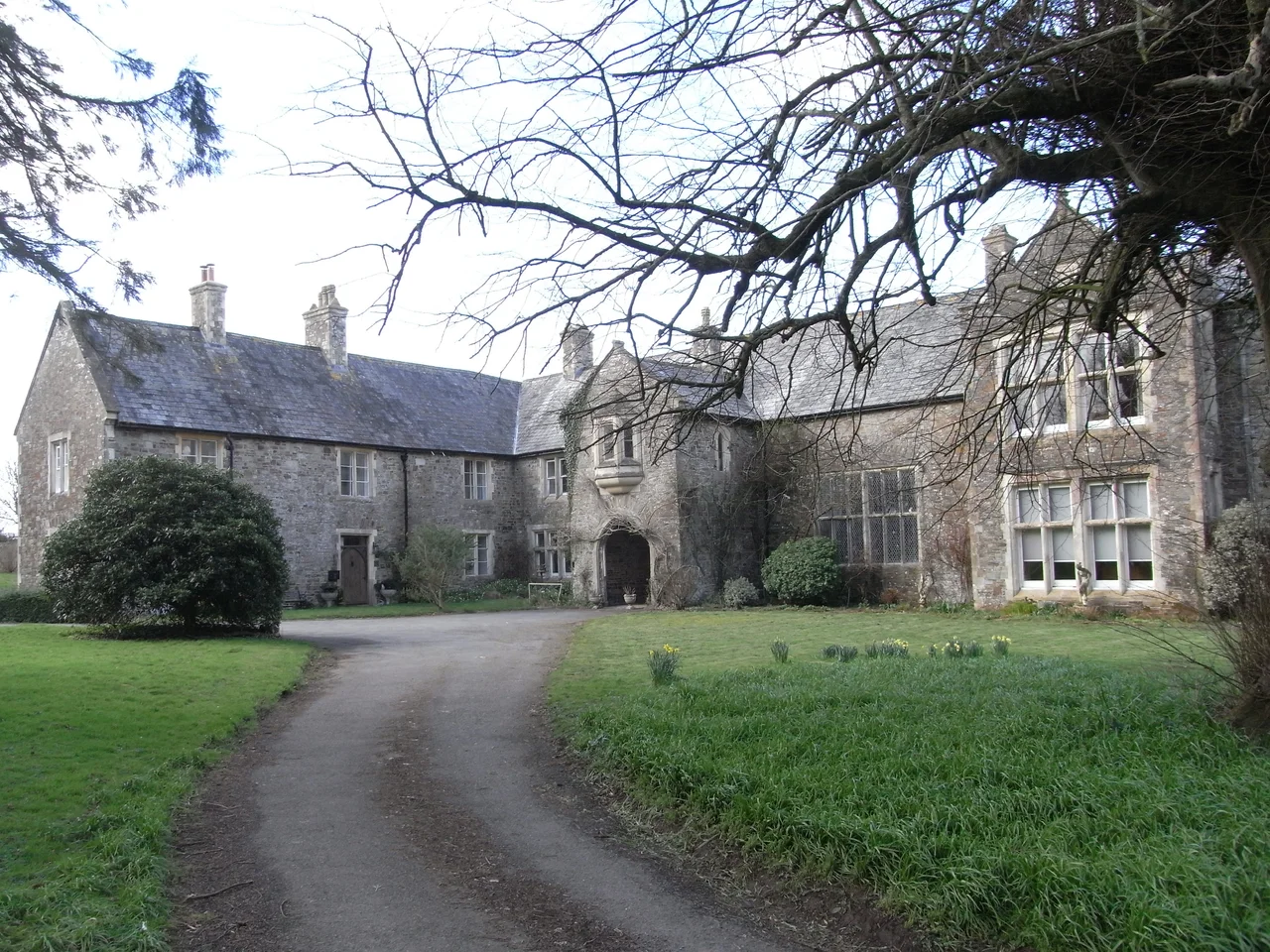

Manor of Orleigh
In the year 975, a Saxon nobleman named Ordwulf - son of the man who had founded Tavistock Abbey on the family's instructions - gave away a small estate four miles southwest of what would become Bideford. The estate was called Orlege. The gift was endowment for the abbey his father had planned and he had built. From that act of medieval piety, the manor of Orleigh begins a thousand-year paper trail of feudal tenants, heiresses, dissolutions, marriages, and inheritances, all attached to a manor house that still stands in the parish of Buckland Brewer.
From a Lost Cartulary
The manor is not in the Domesday Book of 1086, but historians have long suspected it was rolled into the adjacent manor of Abbotsham for administrative purposes - Abbotsham being a Tavistock holding listed in Domesday. The first clean record of Orleigh as its own thing comes in a charter from Pope Celestine III in 1193, confirming the abbey's right to it. Behind that is an older trail: Ordwulf's gift was recorded in a cartulary of Tavistock that has since vanished. The 17th-century antiquary William Dugdale quoted from it in his Monasticon Anglicanum, which is why the story survives at all. The manor changes hands across centuries in the dry language of medieval feudal returns, but its location and its name barely shift.
Four Centuries of Denys
From the late 12th century until 1641, Orleigh belonged to a family called Denys. Their first known holder, Josceline le Deneys, appears in the 1166 Cartae Baronum as a tenant of Henry de Pomeroy, the feudal baron of Berry Pomeroy down in South Devon. The Denys family held Pancrasweek as a knight's fee with military obligation, but Orleigh as a sub-manor on the gentler tenure of free socage - a heritable estate paid for in money rather than military service. The line ran for fifteen generations. Richard Denys married into the Bowhay family in the 15th century. William III Denys was Sheriff of Devon in 1466 and married a Stucley of Affeton. John V married into the Monck family, ancestors of George Monck who would later restore Charles II to the throne. William contributed 25 pounds to the defense against the Spanish Armada in 1588.
The End of the Male Line
Anthony Dennis, born 1585, was the last Denys male. He married twice. His first wife Elizabeth Wise gave him a son who died young and two daughters who died younger. His second wife was Gertrude Grenville, of the famous West Country Grenvilles - daughter of Sir Bernard, granddaughter of Sir Richard Grenville who died fighting the Spanish in the Azores aboard the Revenge, and niece of Sir Bevil Grenville who would fall leading the Cornish Pikemen at the Battle of Lansdowne in 1643. Anthony and Gertrude had eight children. Five died as infants. The three surviving daughters - Mary, Elizabeth, and Gertrude, all under 14 when their father died in 1641 - became co-heiresses. In 1661 the sisters conveyed the manor jointly to feoffees, who sold it in 1684 to a Bideford tobacco merchant named John Davie.
Tobacco and Smallpox
The Davie family bought Orleigh on the proceeds of Bideford's late-17th-century tobacco trade. John Davie's son Joseph married Juliana Pryce, daughter of a Welsh baronet, and rebuilt much of Orleigh Court. The arms of Davie impaling Pryce survive on lead hopper-heads in the roof guttering - a small heraldic flourish made permanent in cast metal. Juliana died of smallpox in 1720. Her husband followed three years later. The estate passed down through the Davie-Bassetts; one descendant began building Watermouth Castle near Berrynarbor in 1825. After the Bassetts came a Major Edward Lee, whose nephew John Hanning assumed the Lee name under the terms of the will, and the manor entered a long period of tenancies.
Birthplace of an Explorer
In the early 19th century the Lee family let Orleigh to William Speke of Jordans, near Ilminster in Somerset. Six of the Speke children were born at the manor. The eldest, born in 1827, was John Hanning Speke - the explorer who in 1858 became the first European to see Lake Victoria, and who argued, against Richard Burton, that it was the source of the Nile. Speke was killed in a hunting accident in 1864, the day before he was scheduled to debate Burton publicly on the question. The Speke family had given up Orleigh in 1845. The house ran through more tenants and was finally sold in 1869 to Thomas Rogers, whose descendant W.H. Rogers became the local historian who pieced this entire descent together in his 1938 book Buckland Brewer.
From the Air
Orleigh sits at 50.98 N, 4.24 W in the rolling countryside southwest of Bideford. The manor and surrounding parish of Buckland Brewer are best viewed at 1,500 to 2,000 feet on calm days, with the Torridge estuary and Bideford visible to the north and the Hartland peninsula to the west. Nearest aerodromes: Eaglescott northwest of Torrington, Dunkeswell to the southeast, Newquay (EGHQ) further south.
Nearby Stories
- HMHS Glenart Castle 11 km away
- Castle Drogo 12 km away
- Exmoor 13 km away
- North Cornwall Railway 14 km away
- Mumbles Lifeboat Disaster 21 km away
- Horton and Port Eynon Lifeboat Station 28 km away
- Padstow Lifeboat Station 29 km away
- Castlemartin Training Area 34 km away