
North Cornwall Railway
John Betjeman called the railway lines reaching out across North Devon and North Cornwall "the Withered Arm" - branches of the old London and South Western Railway stretched far past where the population could justify them, single tracks winding through nearly empty country to small fishing harbours at the end of the line. The North Cornwall Railway was the longest, thinnest finger of the arm. It opened in stages between 1886 and 1899, ran for sixty-seven years, and closed on 3 October 1966 in Dr Beeching's cull of British rural railways. Betjeman, who travelled it every summer of his childhood, summoned it back into being in his autobiographical poem Summoned by Bells: "On Wadebridge's platform what a breath of sea / Scented the Camel valley! Soft air, soft Cornish rains, / And silence after steam."
Why the Line Was Built
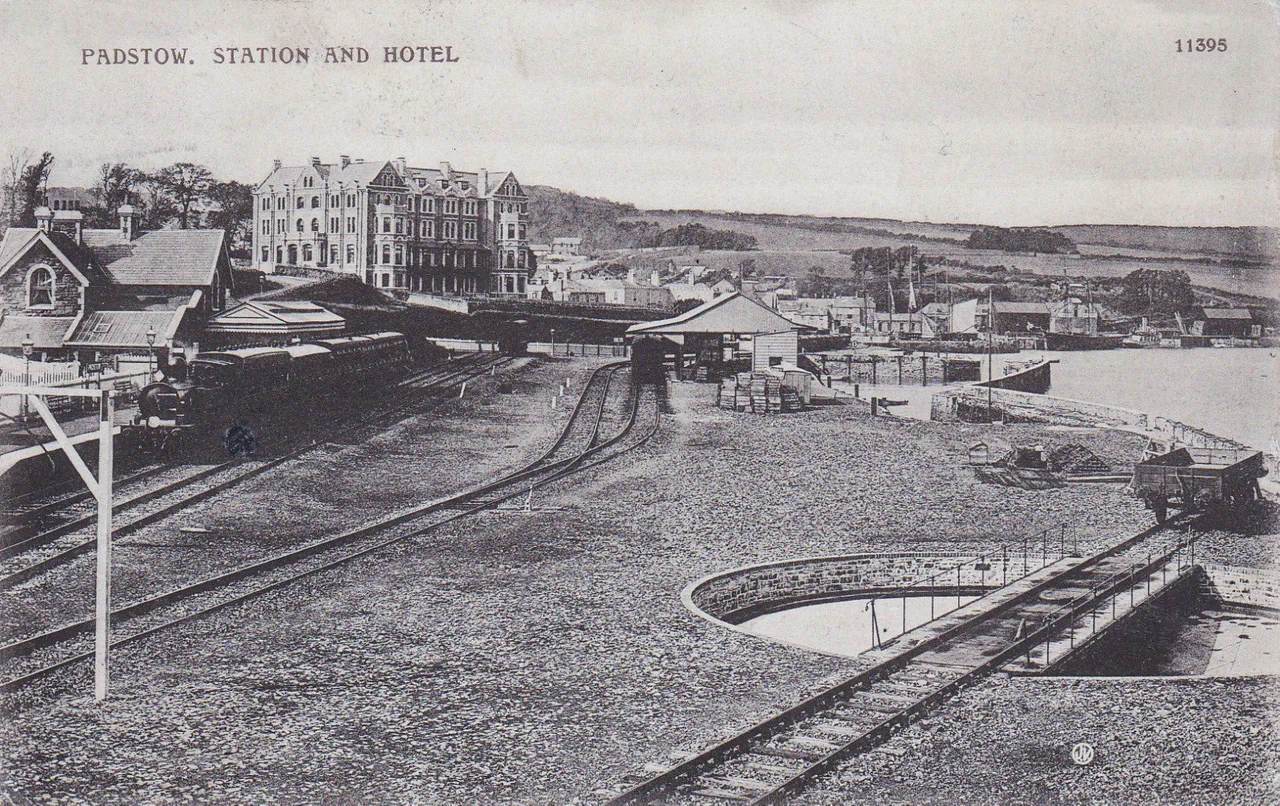
In the nineteenth century, Padstow was an important Cornish fishing port hampered by lack of land transport to its markets. The little Bodmin and Wadebridge Railway, opened in 1834, ran only from Wadebridge harbour into the immediate hinterland. The first mainline railway to reach Cornwall was the broad-gauge Cornwall Railway in 1859, allied with the Great Western Railway and running east-west through the southern part of the county. The rival London and South Western Railway, which used standard gauge, wanted in. It bought the Bodmin and Wadebridge Railway in 1847 and waited. By 1879 the LSWR had pushed its own line from Exeter as far as Holsworthy in Devon, and by encouraging the North Cornwall Railway Company - a nominally independent local venture - to build west from Halwill Junction, the LSWR could finally reach Padstow with a continuous standard-gauge line from Waterloo. The line was opened in six stages over thirteen years: Halwill to Launceston in 1886, then progressively westward through Tresmeer, Camelford, Delabole, and Wadebridge, reaching Padstow on 27 March 1899.
The Geometry of a Lost Cause
The North Cornwall line was not built for speed. It was a single track that climbed from sea level at Padstow to a summit of 860 feet between Camelford and Otterham, with several sections at gradients of 1 in 73 - severe by railway standards. To keep building costs down, the line curved constantly with typical radii of just 30 chains, following the contours rather than cutting through them. The maximum permitted speed was 55 mph. A typical Halwill-to-Padstow run took 90 to 100 minutes downhill, up to 110 minutes uphill. Otterham station, the highest on the line at 850 feet, sat in such exposed moorland country that the LSWR planted a row of Scots pines on the embankment above the down platform just to shelter passengers from Atlantic gales. The footpath to the actual village of Otterham was a mile away; by road it was two. Otterham returned the lowest ticket sales on the line in 1928. The North Cornwall Railway was an act of will more than commerce. Apart from Launceston and Wadebridge, it served small rural communities that could not, between them, fill a train.
The Atlantic Coast Express
The line's brief grandeur came at the height of pre-war summer holiday traffic. The 1938 Bradshaw's Railway Guide shows five down and six up trains a day Monday to Friday. The undisputed star was the Atlantic Coast Express - the 11:00 from London Waterloo, which ran non-stop to Exeter St Davids, then called only at Halwill, Launceston, Otterham, Camelford, Delabole, Port Isaac Road, and Wadebridge before arriving at Padstow at 4:24 in the afternoon. The journey was 260 miles. The train carried a restaurant car throughout, and through-carriages had been slipped at various points to serve other Devon and Cornwall resorts. For families like the Betjemans, going from London to a holiday cottage at Trebetherick on the Camel estuary, the slow last hour rocking through small Cornish stations was the proper beginning of August. The line was famous among enthusiasts for its motive power: Adams Jubilee 4-4-0s at first, then the elegant T9 "Greyhounds," then N class 2-6-0 Moguls, and finally the streamlined Bulleid Light Pacifics after the Padstow turntable was lengthened in the late 1940s.
Beeching
The 1963 Reshaping of British Railways report, written by Dr Richard Beeching, identified thousands of miles of rural single-track railway that no longer paid their way and could not, in his judgment, be made to. The North Cornwall line was an obvious candidate. Its summer holiday traffic was already migrating to roads, with families now driving down the A30 to their Cornish destinations. Even Padstow's fish traffic had long collapsed. The line had only its romance to offer, and romance does not pay for sleepers. Closure was announced. The last passenger train ran on Monday 3 October 1966. The Wadebridge-to-Padstow section was kept open a little longer, served by Bodmin trains, until it too closed on 28 January 1967. Within a few years the rails had been lifted, the stations sold off as private houses or demolished, the formations returned to pasture or repurposed as roads. Camelford station became a cycle museum, then a private house. Wadebridge station became, fittingly, the John Betjeman Centre.
What's Left to Walk and Read
The trackbed lives on as two of the best long-distance walking and cycling routes in Cornwall. The Camel Trail follows the line for seventeen miles from Padstow through Wadebridge to Bodmin and Wenfordbridge, threading the Camel estuary, crossing Petherick Creek on the original 1899 three-span iron bridge, and finally climbing into the woods around Bodmin. At the eastern end, the Launceston Steam Railway operates a 1ft 11.5in narrow-gauge heritage line along two and a half miles of the old formation, west from Launceston to Newmills. T. W. E. Roche, in his memoir of the LSWR routes west of Exeter, said "there are few more fascinating lines than the one which leads to North Cornwall from Okehampton." John Betjeman, who learned the line by heart as a boy, summoned its rhythm in Summoned by Bells: "The emptying train, wind in the ventilators, / Puffs out of Egloskerry to Tresmeer, / Through minty meadows, under bearded trees, / And hills upon whose sides the clinging farms / Hold Bible Christians." The poems outlived the line. So did the names of the stations. Egloskerry, Tresmeer, Otterham, Delabole, Port Isaac Road: a small litany of places it now takes a car or a walking stick to reach.
From the Air
The North Cornwall Railway formation ran from Halwill Junction in Devon (50.74N, 4.24W) west through Launceston (50.64N, 4.36W), then south-west across Bodmin Moor's northern edge through Tresmeer, Otterham, Camelford, Delabole, and on to Wadebridge (50.51N, 4.83W) and Padstow (50.54N, 4.94W). The total length was about 50 miles (49 miles 67 chains). From altitude on a clear day, the line's old formation is still visible in places as a green cycle path or sunken right-of-way through fields. The Camel Trail is the most photogenic surviving stretch, running along the Camel estuary west of Wadebridge. Cornwall Airport Newquay (EGHQ) is the nearest commercial airport, with Bodmin Airfield (EGLA) closer to the central section. The line is best flown along east-to-west, low and slow, at 1,500-2,500 ft.
Nearby Stories
- Clovelly 1.5 km away
- Castle Drogo 4.4 km away
- Cornwall Railway Viaducts 6.3 km away
- Trerice 11 km away
- Berry Pomeroy Castle 16 km away
- HMHS Glenart Castle 18 km away
- Padstow 20 km away
- Exmoor 21 km away