
Cornwall Railway Viaducts
The line had to cross 45 rivers and deep valleys in 70 miles. The money had run out. Isambard Kingdom Brunel sketched a solution: instead of stone arches all the way to the riverbed, plant compact masonry piers thirty-four feet below the rails and let fans of yellow-pine timber radiate from each one to support the deck. Cheaper to build, more expensive to maintain - he warned them about that explicitly, ten thousand pounds a year - and astonishingly graceful to look at. Forty-two wooden viaducts went up between Plymouth and Falmouth. The first opened in May 1859, with Brunel dying that September before seeing the full line in service, under the supervision of his lieutenant R. P. Brereton. The last of them stood until 1934. Today, all that remains of most are the stub piers, alone in the fields beside their stone successors, looking like the legs of some vast creature that walked across Cornwall and was never quite finished.
Five Designs for Five Valleys
Peter John Margary, the Cornwall Railway's engineer from 1868 to 1891, gave each design a letter. Class A, the workhorse, used three fans of timber struts spreading at angles of 55, 75, 105, and 125 degrees from horizontal off the top of each pier - the iconic backslash-slash form when viewed from the side, piers spaced about sixty-five feet apart. Class B doubled the central fan into a pair, creating a W-shape across the top of each pier for extra strength at the three tallest crossings - St Pinnock, Largin, and Ponsanooth. Class C dispensed with stone piers altogether, building vertical timber trestles on driven timber piles for the soft tidal mud of Weston Mill, Forder, Wivelscombe, and Nottar. Class D, used at Coombe and Moorswater, joined the bottoms of opposing fans with laminated beams to make a continuous strip along the deck. Class E, for the shallowest crossings, used three parallel fans in simple V shapes on dwarf piers. The timber was yellow pine, preserved by Kyanising with mercury chloride or Burnettising with zinc chloride at the workshops in Lostwithiel. Cast iron held the timbers in place. Wrought iron took the tension.
The Maintenance Problem
Brunel had been clear about the cost. The first decay always appeared where the legs sat in their cast-iron chairs, and around bolt holes, and under the decking that carried the ballast. Special gangs of men worked the viaducts year-round, replacing individual timbers without closing the line - a temporary ten mile per hour speed restriction was enforced during the work, and the heaviest moves happened on Sundays when traffic was light. The men reached the timbers below the deck by working from two-and-a-half-inch manila ropes, suspended over drops of a hundred feet or more. After the First World War, the preferred yellow pine became hard to source. Inferior timber went in, with shorter service lives. By then, only the viaducts on the Falmouth branch were still wooden. The mainline conversions had been progressing steadily since 1875, often by building a new stone viaduct alongside the old one and switching the trains across in a single weekend.
Coldrennick, 1897
On 9 February 1897, a gang of seventeen workmen were positioning a twenty-foot wrought-iron rail-bearer high in the seventh span of Coldrennick viaduct, near Menheniot. The platform they were standing on was supported by a second-hand timber beam, formerly used as a structural member elsewhere on the viaduct, now repurposed with several notches still cut into it from its previous service. There was decay at the slenderest point. Twelve men were carrying the rail-bearer on their shoulders, walking it forward. As they neared the cross-girder that would receive the far end, the beam beneath them gave way and collapsed. Twelve men fell one hundred and forty feet to the valley floor and died. At the inquest, the foreman and the ganger were found to have caused the deaths feloniously - the foreman for not using chains to support the centre, the ganger for selecting defective timber. A second accident at Trevido viaduct, nine months later during the same conversion programme, killed two more men when a hoisting rope was released too soon. The replacement viaducts they were building still carry the line.
Moorswater, the Most Spectacular
John Binding, who wrote the definitive study of Brunel's Cornish viaducts, considered Moorswater the most spectacular of all of them. It carried the line over a deep valley half a mile west of Liskeard, 147 feet high and 954 feet long, supported on fourteen buttressed piers. In 1855, two of the piers under construction collapsed before completion. Brunel himself came down, inspected them, and ordered them rebuilt the next year to his original design. They held. In 1881 the viaduct was replaced by a new eight-arch stone structure with cast-iron parapets. During the replacement, the resident engineer H. G. Cole was killed when a steam crane fell over. Six of Brunel's original piers were left standing alongside the new viaduct, where you can still see them - granite stubs in a quiet Cornish valley, holding nothing up, marking exactly where the railway used to run.
What Survives
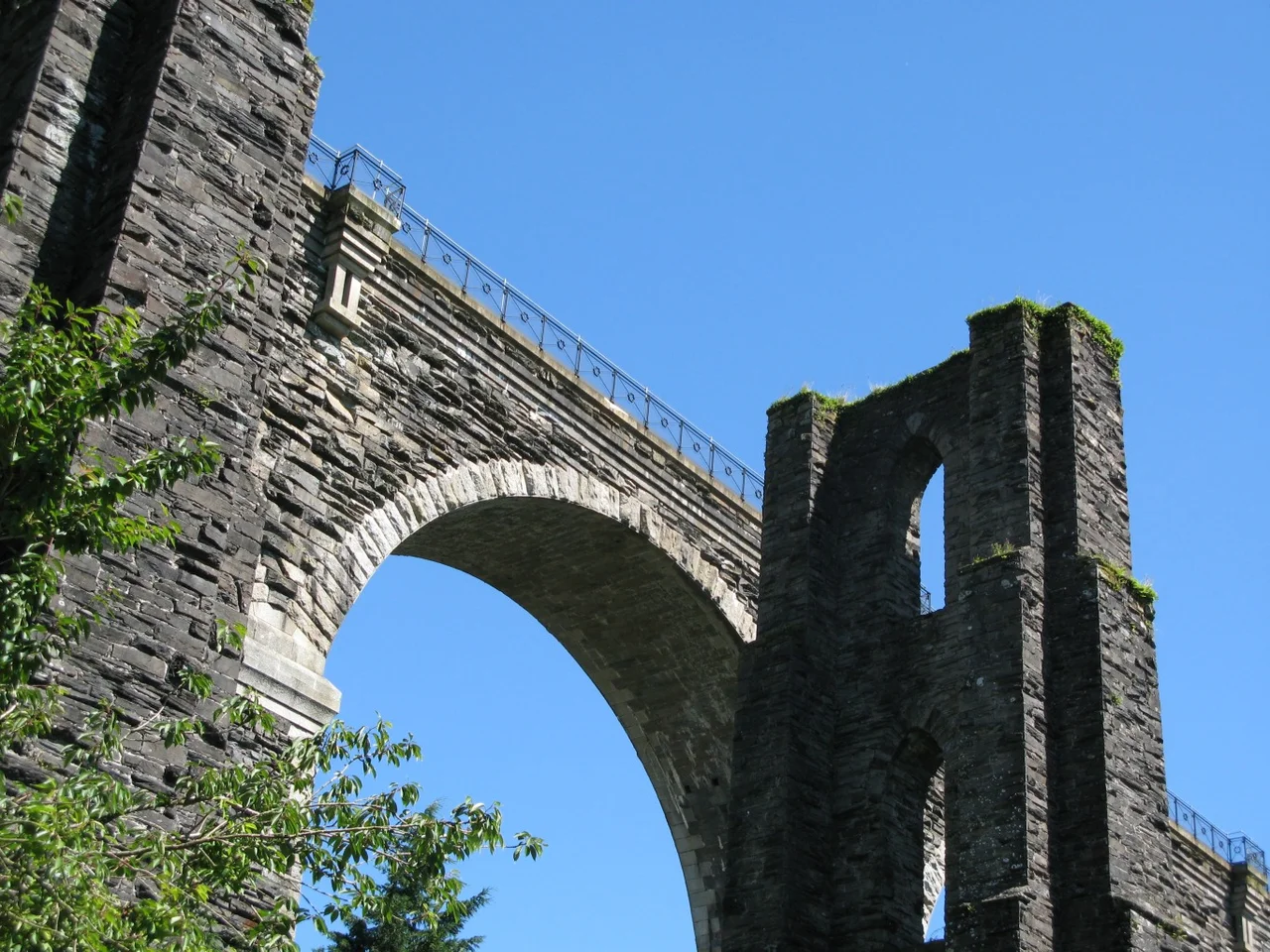
St Pinnock viaduct, at 151 feet, was the tallest on the line. It was converted in 1882 by raising the brick piers and replacing the timber with iron girders, and is still in service - though the line was singled across it in 1964 to reduce the load, and again across neighbouring Largin. Both are Grade II listed. So are the surviving original piers at West Largin, Penadlake, Clinnick, Gover, Coombe St Stephens, Truro, and Carvedras. Collegewood, south of Penryn, was the last timber viaduct in Cornwall - replaced in stone on 22 July 1934, almost three-quarters of a century after the line first opened. Its original piers also still stand, Grade II listed. Travel from Plymouth to Truro today and you cross at least a dozen Brunel viaducts, all of them stone, almost all of them flanked by ghost-piers from the wooden originals. Brunel built the line cheaply, and Cornwall paid for it slowly, and the result is one of the most quietly remarkable engineering landscapes anywhere in Britain.
From the Air
The viaducts run along the railway line between Plymouth (EGDP, no public ops) and Falmouth via Truro. Key landmarks at approximately 50.45°N, 4.48°W (central Cornwall mainline). Recommended viewing altitude 2,500-4,500 ft AGL for tracking the curving railway alignment and spotting paired old-and-new piers. Notable individual viaducts: Royal Albert Bridge at Saltash (50.41°N, 4.20°W) is the most dramatic single structure on the route; St Pinnock and Moorswater near Liskeard (50.45°N, 4.47°W); Collegewood near Penryn (50.18°N, 5.10°W). Nearest civilian airports: Newquay (EGHQ) for western viaducts, Exeter (EGTE) for eastern. Weather note: rain showers from the south-west reduce visibility in deep valleys quickly.
Nearby Stories
- Launceston Castle 2.7 km away
- East Wheal Rose 8.5 km away
- Castle Drogo 8.8 km away
- Hope Cove Lifeboat Station 13 km away
- Goonhilly Satellite Earth Station 19 km away
- Battle of Plymouth (1652) 20 km away
- HMHS Glenart Castle 55 km away
- HMS Affray 70 km away