
HMS Affray
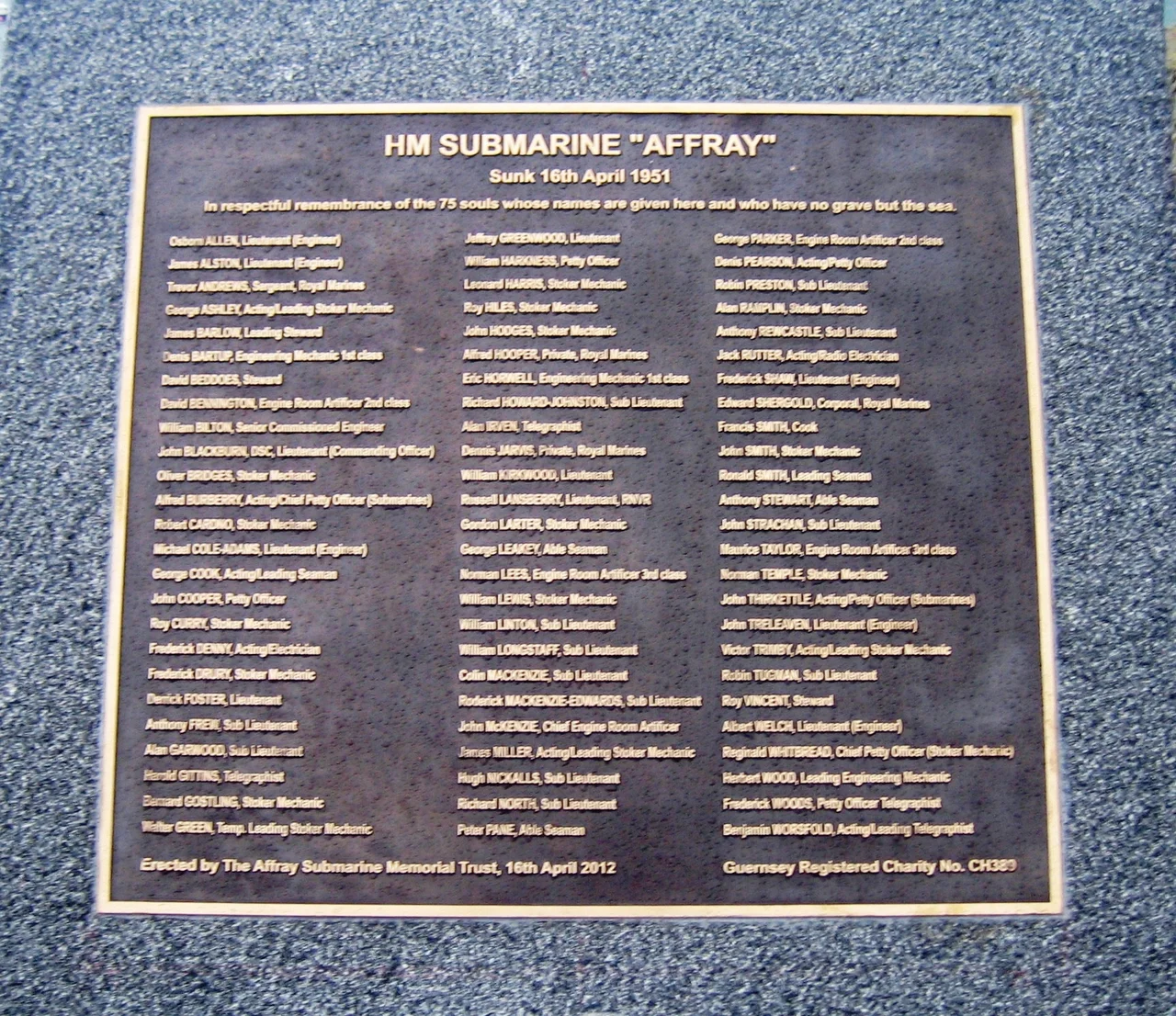
Seventy-five men went down with her. They were submariners and trainees, engineers and officers, most of them young, all of them aboard HMS Affray when she vanished beneath the English Channel on the night of 16 April 1951. The Royal Navy searched for nearly two months. Mothers waited. Wives waited. Children grew used to fathers who would not come home. When divers finally found her on the edge of Hurd's Deep, the hatches were sealed and the periscopes were up - she had been listening for the world above when whatever happened, happened.
State of the Art
Affray was a new kind of submarine for a new kind of war. Laid down at Cammell Laird in Birkenhead in January 1944 and commissioned the November after the war ended, she belonged to the Amphion class - sixteen boats designed to hunt the Japanese across the vast Pacific. Her builders borrowed from captured U-boats, gave her an all-welded hull and modular construction unlike anything that had come before, fitted her with refrigeration and two enormous air conditioners for tropical patrols. She carried ten torpedo tubes. For four restless postwar years she ranged across the world's oceans, calling at Singapore and Pearl Harbor, at Bergen and Cape Town, at Yokosuka and Casablanca. She was, by any measure, one of the most formidable submarines afloat.
The Snort
Then came the modification that would haunt her. In 1949 she went into drydock for a snort mast - the British name for a snorkel - a pneumatically raised steel tube that let a submarine breathe at periscope depth, running her diesels and charging her batteries without ever surfacing. It was the same technology the Germans had used to terrible effect in the last years of the war, and the Royal Navy wanted it on every postwar boat. Affray's snort served as both intake and exhaust. A float valve was supposed to snap shut if she dropped below periscope depth, sealing the hull against the sea. On Mediterranean deep-dive trials soon afterward, she was said to be leaking like a sieve. Her diesels began weeping oil. The signs were there, if anyone had been minded to read them.
Exercise Spring Train
By spring 1951 Affray was at Portsmouth, freshly recommissioned with a young crew under Lieutenant John Blackburn. On 16 April she sailed for an exercise called Spring Train, carrying not only her regular complement but a draft of trainee officers and Royal Marines learning their trade. She dived in the Channel that evening and was never heard from again. When she failed to surface, the search became Britain's biggest news. The first stirrings of what would become the Suez Crisis were pushed to page two. Rumours flew that she had been seized by the Russians, that the crew had mutinied. The wife of another submariner reported a dripping ghost in officer's whites who named the spot where Affray lay - and when divers finally got there, the position turned out to be right. The Channel held 161 known wrecks, most from the war just past. Affray would become one more.
YARFFA
On 14 June, two months after she vanished, HMS Loch Fyne picked up an asdic contact on the very edge of Hurd's Deep, an underwater valley off Alderney. It was the same patch where an oil slick had been seen the night she disappeared. HMS Reclaim came in with a new waterproof camera the divers had been sceptical of. The first thing the lens picked out was a long white handrail. Then, as the camera turned, letters resolved out of the dark: Y-A-R-F-F-A. Affray, read backwards. She lay 86 metres down, listing slightly to port, bows pointing northeast, seventeen miles northwest of Alderney and much closer to France than to England. Periscope up. Radar mast up. Every hatch shut. No sign of escape attempted. The bow planes were jammed at hard rise and the engine telegraphs read STOP. Only one piece of her was ever brought home: the snort mast, broken off and lying beside her, found to be of faulty manufacture.
War Grave
Half a century later, the technical diver Innes McCartney followed the coordinates the Ministry of Defence had finally released and descended into the dark of Hurd's Deep. At 83 metres the ambient light is almost nothing, and the wreck loomed out of the gloom only when their torches caught her - one of the largest submarine graves in the Channel, too long to swim around on a single dive. Sponges and anemones had brightened her hull. The bridge was intact, speaking tubes and binnacle still in place. Periscopes still standing. Conning tower ladder still rigged for a watch that never came back on deck. Since 2001 Affray has been a controlled site under the Protection of Military Remains Act, illegal to enter without permit. Seventy-five men lie inside her. They are not exhibits or evidence. They are sailors, asleep on the edge of an undersea cliff, where the seabed falls away into water deep enough to hide anything.
From the Air
HMS Affray rests at approximately 49.5 degrees N, 3.567 degrees W, on the northern lip of Hurd's Deep, roughly 17 miles northwest of Alderney in the Channel Islands. The wreck lies in 86 metres of water and is not visible from the air, but the position is between the Cherbourg Peninsula and the southern English coast, making it a natural reference for Channel transits. Nearest airports include Alderney (EGJA) about 17 miles southeast, Guernsey (EGJB) to the south, and Cherbourg-Maupertus (LFRC) on the French coast. Cruise altitudes of 3,000-5,000 feet on clear days give long views across the Channel approaches; expect frequent low overcast and occasional sea fog.
Nearby Stories
- Les Hanois Lighthouse 34 km away
- Battle of Plymouth (1652) 44 km away
- Eddystone Lighthouse 48 km away
- HMS Formidable (1898) 53 km away
- Spanish Armada 78 km away
- Mont Saint-Michel: The Abbey That Becomes an Island Twice a Day 137 km away
- Basilica of Sainte-Therese, Lisieux 286 km away
- Tito Bustillo Cave 644 km away