
Spanish Armada
On the morning of 29 July 1588, watchers on the cliffs of the Lizard in Cornwall lit the first warning beacon. By nightfall a chain of fires ran along the south coast of England all the way to the Sussex Downs and beyond, each beacon lit by the one before, the news of the Spanish Armada's arrival running faster than any horse could carry it. The fleet that had sailed from Lisbon eight weeks before was finally in English waters - 130 ships, more than 30,000 men, the largest invasion force ever sent against the British Isles. Philip II of Spain had named it the Enterprise of England. His goal was Catholic restoration, an end to English support for the Dutch revolt, and the overthrow of Elizabeth I. What followed was decided as much by wind and weather as by men.
The Enterprise of England
The Armada sailed on 21 July 1588 (New Style) from Lisbon, commanded by Alonso de Guzmán, Duke of Medina Sidonia. He was a competent administrator and a distinguished soldier, but he had no naval experience and he knew it. He wrote to Philip expressing grave doubts about the plan. Courtiers prevented the letter from reaching the king, on the grounds that God would ensure success. The fleet's mission was specific: sail up the English Channel, join the Duke of Parma's veteran Army of Flanders waiting in the Spanish Netherlands, and escort the army across the Channel in barges to land near London. Of the 137 ships that left for the Channel, only 24 were purpose-built warships. The rest carried supplies, troops, friars and 1,545 non-combatants. Parma had assembled an army of 60,583 soldiers from Spain, Italy, Burgundy, Ireland, Scotland, the Low Countries and Germany. The element of surprise had been lost a year earlier when Drake raided Cádiz in April 1587, captured or destroyed 30 ships and set the preparations back by twelve months.
Plymouth and the Crescent
The English fleet was trapped at anchor in Plymouth Harbour by an incoming tide when the Armada was first sighted off the Lizard. Spanish subordinates urged Medina Sidonia to enter Plymouth Sound and attack the ships before they could leave. He refused. His orders were to join Parma, not to fight side battles, and he held to them. As the tide turned, 55 English ships - commanded by Lord Howard of Effingham, with Sir Francis Drake as vice-admiral and John Hawkins as rear-admiral - put to sea. The Spanish formed their famous crescent: galleons and great ships in the centre and at the horns of the moon, supply ships in the shelter between them. At dawn on 31 July, off the Eddystone Rocks, the two fleets engaged. The English ships were smaller, faster and more manoeuvrable, and they kept beyond grappling range, bombarding the Spanish from a distance. The Spanish guns were heavy but poorly served - many gunners on Spanish ships were soldiers untrained in artillery, and the heavy cannons could not easily be reloaded because of the supplies stowed between decks. Both fleets sailed up the Channel with neither having lost a ship to enemy action.
Fireships at Calais
On 7 August the Armada anchored off Calais in a tightly packed defensive crescent, waiting for word from Parma. Parma's army was not ready. Communication had been slower than the campaign required - the Duke did not even receive Medina Sidonia's first report until 5 August - and the Dutch fleet of 30 flyboats under Justinus van Nassau blockaded Dunkirk, where Parma's barges sat waiting. The Spanish vulnerability was now total. They had no deep-water port to shelter in and no anchor cables to spare. That night the English sent eight fireships drifting downwind among the anchored Spanish ships - some of the eight were Drake's and Hawkins's own merchant ships, loaded with pitch and brimstone, set alight and pointed at the enemy. Three were intercepted and towed away. The rest forced the Spanish to cut their anchor cables and scatter. No Spanish ships burned, but the crescent formation was broken and the fleet was driven leeward of Calais in a rising south-westerly wind. The next morning, in the Battle of Gravelines, the English closed to within a hundred yards and fired broadsides into hulls that could no longer manoeuvre. Five Spanish ships were lost. Many more were severely damaged, with cannonballs in their hulls below the waterline.
Round Scotland, Round Ireland
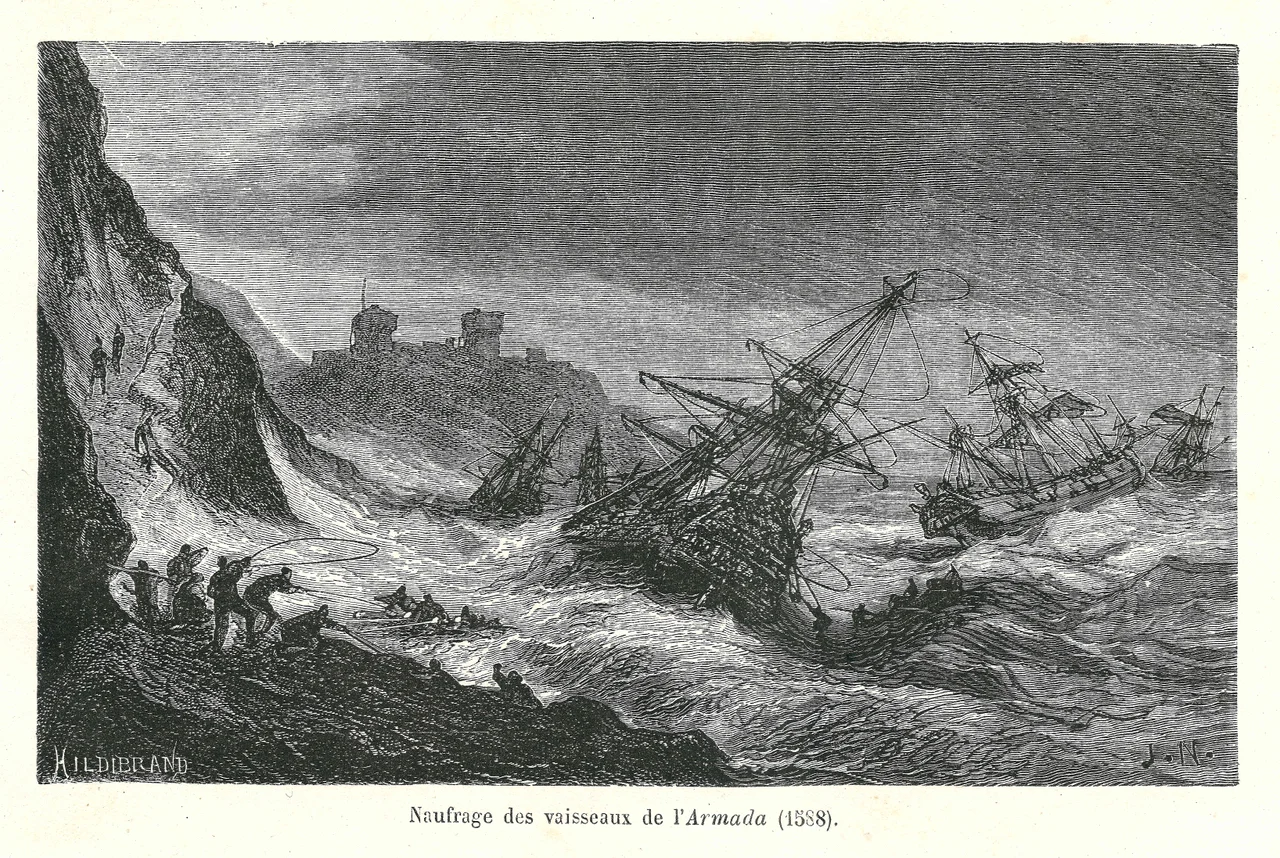
The wind that had broken the Armada's formation also drove it north into the North Sea, away from Parma forever. Howard pursued until 12 August, then broke off at the latitude of the Firth of Forth, his ships almost out of shot. The only way home for the Spanish was north around Scotland and south down the west coast of Ireland into the Atlantic. The late summer and autumn of 1588 were marked by unusually powerful North Atlantic storms - a feature of the so-called Little Ice Age, possibly associated with heavy polar ice off Greenland. The fleet's hulls were strained, its anchor cables gone after Calais, its food and water short. Because there was no accurate way to measure longitude, the Spanish were not aware that the Gulf Stream was carrying them north and east when they thought they were holding west. They turned south too soon and too close to land. About 28 ships wrecked on the jagged west coast of Ireland. Roughly 5,000 men died of drowning, starvation, or slaughter by local inhabitants or by English soldiers under Lord Deputy William FitzWilliam, who ordered Spanish prisoners killed rather than ransomed. The galleass Girona went on to Lacada Point in County Antrim on the night of 26 October. Nine of about 1,300 people aboard survived; 260 bodies came ashore.
What the Sea Decided
Estimates of total Spanish losses still vary - modern historians put the figure between 44 and 51 ships out of the fleet that entered the Channel, with around 11,000 to 17,000 men dead. The English losses in battle were almost nothing. Their losses afterward were enormous - typhus, scurvy and dysentery swept through crews that had been at sea for weeks, and more than 3,000 men died after landing at Margate, many discharged without pay. Howard wrote to Lord Burghley that it would grieve any man's heart to see them die so miserably. Philip received the news in his chambers and shut himself away for days. He is reported to have said: 'I sent the Armada against men, not God's winds and waves.' Spain remained the dominant naval power of Europe for another generation. England sent a counter-armada the following year under Drake and Norris that failed in nearly identical fashion. Three more Spanish armadas were sent against England and Ireland in 1596, 1597 and 1601, all of them defeated by storm or by failure. The war finally ended with the Treaty of London in August 1604. The story of the Enterprise of England outlasted any of its participants, partly because of Elizabeth's speech at Tilbury before she knew the outcome, partly because the weather had so plainly intervened. The Armada Portrait at Woburn Abbey shows the Queen with her hand on a globe and her ships in the background. The wreck-ribs of Spanish galleys still surface from time to time on the coast of Ireland.
From the Air
The Armada campaign was a south-coast English Channel running battle, with the decisive Battle of Gravelines fought at approximately 51.0°N, 2.1°E off Gravelines in the Spanish Netherlands (modern France). The Eddystone Rocks (50.18°N, 4.27°W) marked the first engagement; the Isle of Wight (50.7°N, 1.3°W) the second; Calais Roads (50.96°N, 1.85°E) the fireship attack. The Armada's storm-wrecked retreat ran north past the Orkneys, west of Ireland's wild Atlantic coast, and down the Mayo and Galway shore where many of the wrecks occurred. Cornish viewers, looking south from the Lizard or Land's End, can imagine where the Armada first entered the Channel; Plymouth Sound is the obvious landmark on the English side. For pilots flying the south coast of England, the south Devon and Dorset cliffs are the front row to the action.
Nearby Stories
- Liskeard 5 km away
- Hope Cove Lifeboat Station 6.3 km away
- St Mawes Castle 8 km away
- Buckfast Abbey 8.1 km away
- Carnewas and Bedruthan Steps 8.9 km away
- Battle off Lizard Point 24 km away
- HMS Affray 52 km away
- SS Irma (1905) 106 km away