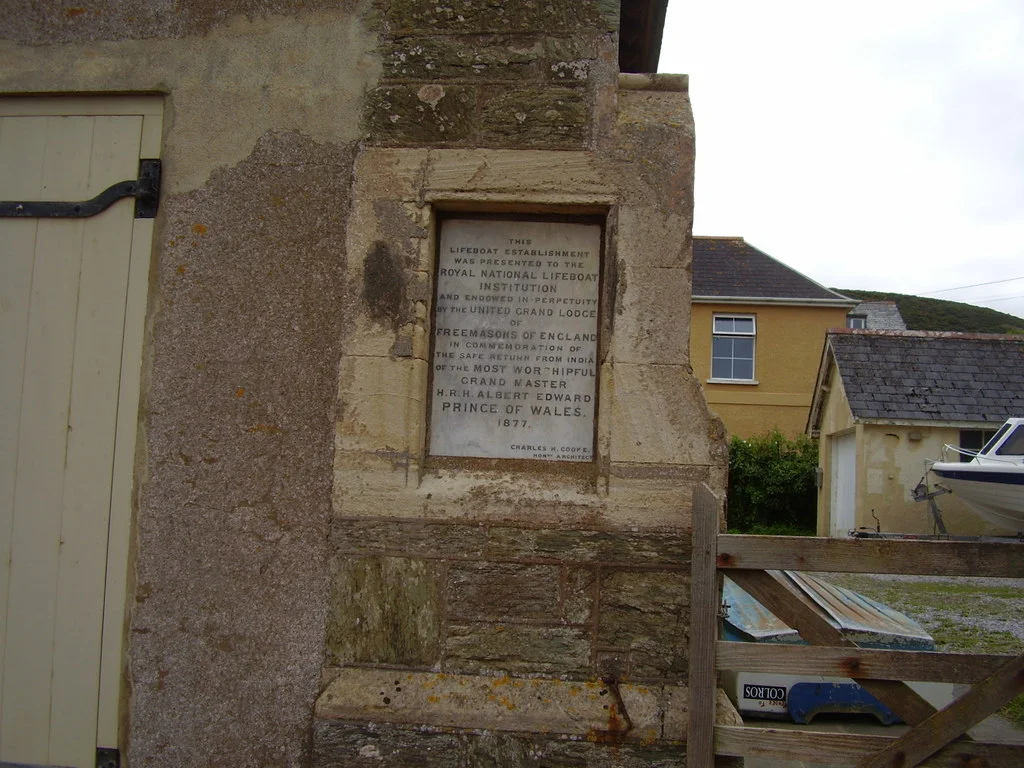

Hope Cove Lifeboat Station
Eight horses pulled the Alexandra through Kingsbridge on her first day, a thirty-five-foot pulling and sailing lifeboat draped in flags, with the streets given over to a general holiday in her honour. It was 13 June 1878. The Freemasons of England had paid for her - four thousand pounds split between Hope Cove and Clacton - to thank the Prince of Wales for coming home safely from India. The villagers of Hope Cove waited on the beach for their gift. Over the next fifty-two years their four lifeboats, all named Alexandra after the Princess of Wales, would launch just ten times. They would save sixty-four lives.
A Gift from the Brotherhood
It started with a visit from the RNLI Inspector of Lifeboats in early 1877. Local residents in this little fishing hamlet a few miles west of Salcombe had asked for a station, and on 1 March the committee in London agreed. The funding came that September, in a way the RNLI had not expected. The United Grand Lodge of Freemasons of England voted four thousand pounds - a fortune - to be split between two new stations as a thank-offering for the safe return of their Most Worshipful Grand Master, Albert Edward, Prince of Wales, from a tour of India. One station, at Clacton, would receive the Albert Edward, named for the Prince. The other, at Hope Cove, would have the Alexandra, named for his Danish-born wife. The Earl of Devon granted a site on the cliff above the beach. A new boathouse went up. A plaque went into the gable. By the time the horses pulled the Alexandra into the village from Kingsbridge, the local children had been waiting for weeks.
Ten Launches in Fifty Years
The work was sparing but heavy. In fifty-two years the four successive Alexandras launched on service only ten times. Each replacement bore the same name - the Freemasons had asked it. The first Alexandra was condemned as unfit in 1887 and replaced with a slightly smaller boat, ON 143. She would not be called away on her one real rescue until 1896 - nine years of drill and waiting. A temporary boat called Willie Rogers, renamed Alexandra on arrival, never launched on service at all. The numbers sound thin until you remember what each launch meant: a hand-pulled boat under oar and sail, ten men at the oars, going out from a beach into the kind of weather that had put a ship on the rocks in the first place. Ten launches. Sixty-four lives saved. By 1930 the motor lifeboats at Salcombe could cover this coast more effectively, and the RNLI closed Hope Cove on 10 April that year.
The Blesk
The one rescue that everyone remembers came on the night of 1 December 1896. The Russian steamship Blesk - among the first vessels in the world built specifically to carry crude oil - was running from Odessa to Hamburg with 3,180 tons of petroleum in her tanks. Her captain mistook the loom of the Eddystone Lighthouse for La Corbiere on Jersey, far to the east, and put the ship straight onto Greystone Rock off Hope Cove at her full speed of ten knots. The Alexandra launched into the dark and, in two trips, pulled all forty-three of the Russian crew off the ship before she broke up. They survived. What did not survive was the coast. The Blesk poured her cargo into the sea - probably the first large-scale ecological disaster ever to hit the British shore. People first came to look at the strange black slick on the water. Then the smell drove them indoors; you could catch it twenty miles inland. The fish died. Crabs and lobsters washed up dead with every tide. The fishery around Hope Cove and Salcombe took years to recover.
Albert Medals
Eleven years later two Hope Cove men received the Albert Medal for Lifesaving - Isaac Jarvis and Jack Argent, in 1907, for actions during the rescue of the Elder Dempster steamer Jebba, which had run ashore at Bolt Tail. The Jebba carried more than 150 people. The Hope Cove and Salcombe boats together brought everyone off in seas that should not have allowed it. Jarvis and Argent went out in their own rocket lines and boats, beyond what duty required. The Albert Medal was a rare award - eventually replaced by the George Cross - and it was given for civil heroism of an extreme order. Two of them came to one small Devon fishing village in a single year. The plaque the Freemasons had set into the boathouse was still there. The Alexandras were still being replaced. The work was still being done.
Independent and Still There
Hope Cove went sixty-two years without a lifeboat after the 1930 closure. In 1992 the villagers - tired of waiting for the Salcombe boat to make the long pull around Bolt Tail every time - re-established their own independent service, outside the RNLI but answering the same emergencies. Since 2013 the village has run a fast rigid inflatable named, of course, Alexandra. The original boathouse is still there above the beach, dedication stone still readable, and the Cottage Hotel up the lane still holds the salvaged chart room of the Herzogin Cecilie that wrecked off Bolt Head in 1936 - a different ship, a different decade, but the same coast and the same people doing the same work. Coastguard, lifeboat, fisherman, hotelier - in a village this small the roles tend to be the same people, generation after generation, watching the same water.
From the Air
Hope Cove sits at approximately 50.242 degrees N, 3.859 degrees W on the south Devon coast, a small twin-beach hamlet about 15 nautical miles southeast of Plymouth and a few miles west of Salcombe. Bolt Tail rises immediately to the west and Bolt Head to the east - both dramatic dark headlands with deep water close in. The Eddystone Lighthouse stands about 12 miles offshore to the southwest, the same light that confused the Blesk in 1896. Nearest airports today are the closed Plymouth City Airport (EGHQ) about 13 miles northwest and Exeter (EGTE) about 35 miles northeast; Newquay Cornwall is the alternative for the western approach. Cruise altitudes of 1,500-3,000 feet over the South Hams coast give superb views of the cliffs and the run from Prawle Point west past Bolt Tail. Devon coastal weather changes fast - low cloud and sea fog are persistent year-round.
Nearby Stories
- Dartington Hall 0.3 km away
- Eddystone Lighthouse 3.4 km away
- Cotehele 5.2 km away
- HMS Formidable (1898) 7.8 km away
- Lyme Bay Canoeing Disaster 34 km away
- HMS Affray 48 km away
- Casquets Lighthouses 61 km away
- Battle off Lizard Point 72 km away