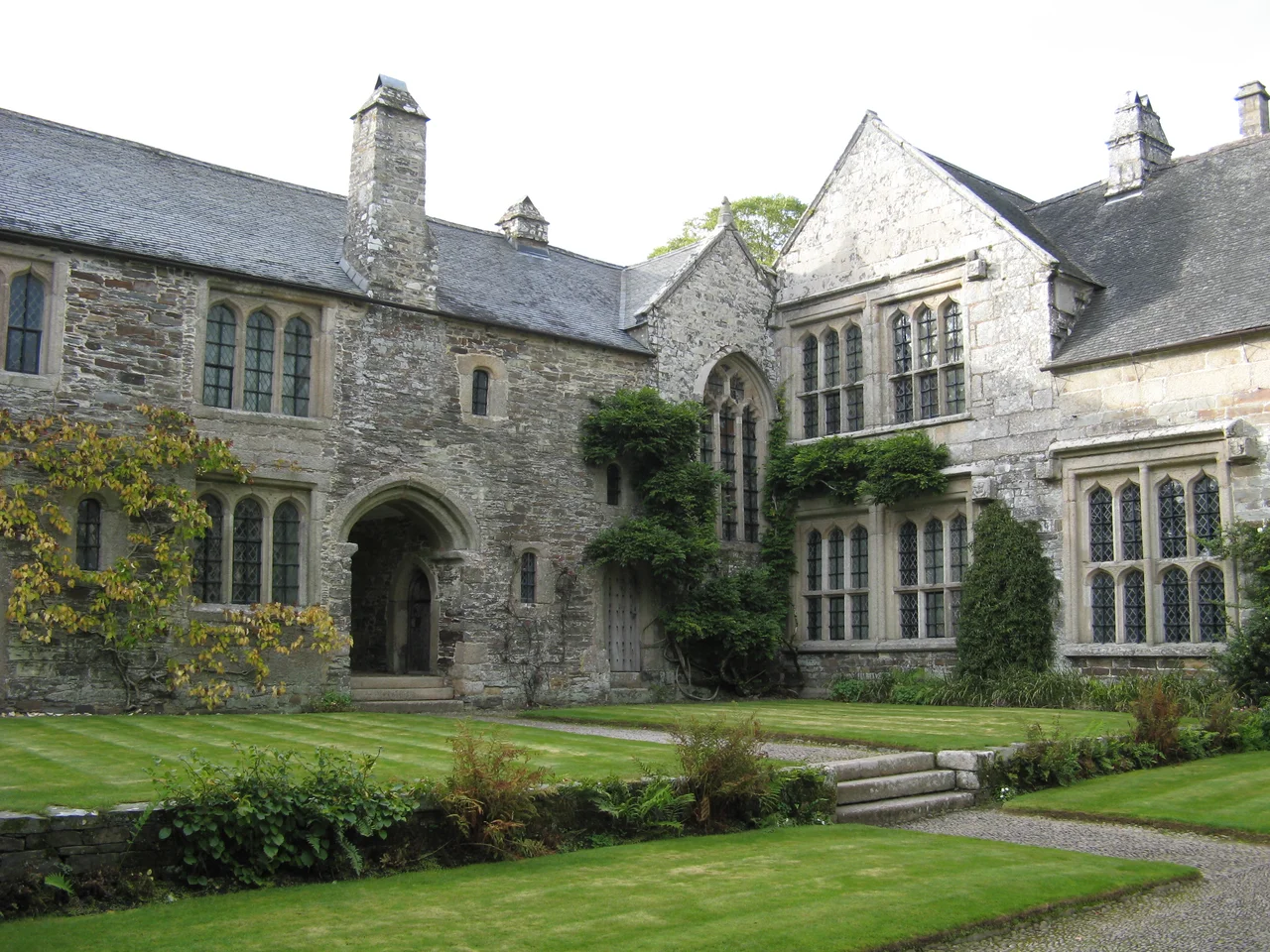

Cotehele
In 1483, Sir Richard Edgcumbe was being hunted through these Cornish woods by forces loyal to Richard III. He escaped - by some accounts, by stuffing a stone into his cap and dropping it into the Tamar so his pursuers heard a splash and assumed he had drowned. Two years later, after fighting for Henry Tudor at the Battle of Bosworth, he came back to Cotehele with the new king's favour, knocked down the old manor house, and started building. The chapel he raised in the woods east of the house, with its patron saints St George and Thomas Becket, was a thanksgiving for that escape. The house his family went on to build, finished by his son Sir Piers between 1489 and 1520, has been called the least-altered Tudor house in the United Kingdom. Granite, slate-stone, dovecote, mill, formal gardens stepping down to a quay on the Tamar - barely a stone of it has moved in five centuries.
The Edgcumbe Inheritance
Cotehele came to the Edgcumbe family by marriage. William Edgcumbe wed Hilaria, heiress of Cotehele, and the estate passed into the family that would build the house. The earliest structure on the site dates from around 1300, and various alterations were made in the early fifteenth century - so when Sir Richard returned from Bosworth, he was not starting from nothing. He spent the years from 1486 to 1489 on the first phase of rebuilding, and his son Piers continued the work for another three decades. The result is a rambling granite manor house, organised around three small courtyards, that looks as though it grew organically over time rather than being designed. It probably did. King George III visited in 1788, finding it as it now is - dim, beam-ceilinged, hung with tapestries. Most of the family moved their main seat to Mount Edgcumbe House across the Tamar in the sixteenth century, leaving Cotehele as a second home that nobody got around to modernising. That neglect saved it.
The Tudor Clock That Still Runs
In the chapel on the west side of Hall Court, dedicated to St Katharine and St Anne, hangs a clock that is among the oldest still-functioning mechanical clocks in England. It dates from the Tudor period and has run, with maintenance, for more than five hundred years. The chapel itself is among the oldest rooms in the house, alongside the Great Hall. A small passageway connects it to the main building, joining the dining room. The other chapel - the woodland chapel built by Sir Richard between 1485 and 1489 as thanksgiving for his escape - sits east of the house, close to the Tamar. Inside, pews run around the walls; two ministers' benches face each other; an ornate table stands in the centre. The patron saints, St George and Thomas Becket, are an oddly specific pair, perhaps chosen because Sir Richard's escape involved a kind of martyr's narrow survival. A third Edgcumbe chapel exists at nearby St Andrew's Church in Calstock, holding two seventeenth-century monuments to family members but no longer used for worship.
Down to the Quay
The gardens at Cotehele step down a steep wooded valley from the house to a quay on the River Tamar. Formal terraces near the top give way to a richly planted lower garden, with features that range across centuries: a medieval dovecote in remarkable condition, a stewpond, a Victorian summerhouse, and an eighteenth-century Prospect Tower built so the family could enjoy the view. The gardens and parkland are Grade II* listed on the Register of Parks and Gardens of Special Historic Interest. At the quay itself, the National Trust has placed an outpost of the National Maritime Museum. Across the valley to the south-west, the Morden stream joins the Tamar, and on its run it feeds the estate mill - a Grade II listed building, restored to working order, that grinds flour for the National Trust restaurant and for sale to visitors. The mill used to grind grain brought up the Tamar by barge from Plymouth on a vessel called the Myrtle, and also drove a sawmill and a generator that produced the estate's electricity.
Two Hundred and Fifty Apple Trees
In 2008, the National Trust planted a Mother Orchard at Cotehele - more than two hundred and fifty apple trees, mostly West Country varieties, divided across eight acres into eating, culinary, and cider sections. The orchard is intended as a living genetic library of regional apples, many of them rare cultivars that nearly vanished during the twentieth century's drift toward commercial monocultures. The trees are still young by orchard standards, but in autumn they bear: Slack-ma-Girdle, Tregonna King, Pendragon, and dozens of others with names you have probably never heard. The chapel and the clock and the granite walls of the house are the postcard images, but the orchard is in some ways the most quietly ambitious thing on the estate. It is a Tudor manor planting trees with names from before the Industrial Revolution, betting that someone in 2100 will want to taste them.
Condy's Watercolours, Nunn's Twelfth Night
The artist Nicholas Condy (1793-1857) spent years painting Cotehele in watercolours and oils, patronised by the second and third Earls of Mount Edgcumbe. His painting The Court Dinner at Cotehele, along with various exterior views of the house, hangs at Mount Edgcumbe rather than Cotehele itself. More recently, the house served as a film location for Trevor Nunn's 1996 adaptation of Twelfth Night - Cotehele stood in for both a quayside tavern and the interior of Orsino's castle, its dim halls and stone passageways doing the work that any film set would have struggled to fake. The tapestries that hang throughout the house were brought from Mount Edgcumbe in the nineteenth century. Some have had pieces cut out to make them fit their new walls - a small Tudor cruelty, repaired with care. Most of them still hang. The Edgcumbes still hold the title. The National Trust holds the keys.
From the Air
Located at 50.496°N, 4.226°W on the west bank of the River Tamar, parish of Calstock, east Cornwall. Recommended viewing altitude 1,500-3,000 ft AGL. Visual landmarks: the house sits on a wooded ridge above the Tamar, with the Prospect Tower visible on a knoll to the south; the Tamar runs eastward to the Plymouth Sound. Plymouth (no civilian field) lies 12 nm south. The Calstock Viaduct - a fine stone railway viaduct over the Tamar - sits 1 nm east. Nearest civilian airports: Exeter (EGTE) 38 nm east-north-east, Newquay (EGHQ) 32 nm west. Wooded valleys can trap mist in early morning; best viewing is mid-morning to mid-afternoon for the play of light on the Tamar.
Nearby Stories
- Padstow 1.1 km away
- Hope Cove Lifeboat Station 3.5 km away
- Holsworthy 3.6 km away
- The Great Thunderstorm 6 km away
- Prehistoric Cornwall 9.2 km away
- Eddystone Lighthouse 14 km away
- Tiverton Castle 29 km away
- HMHS Glenart Castle 36 km away