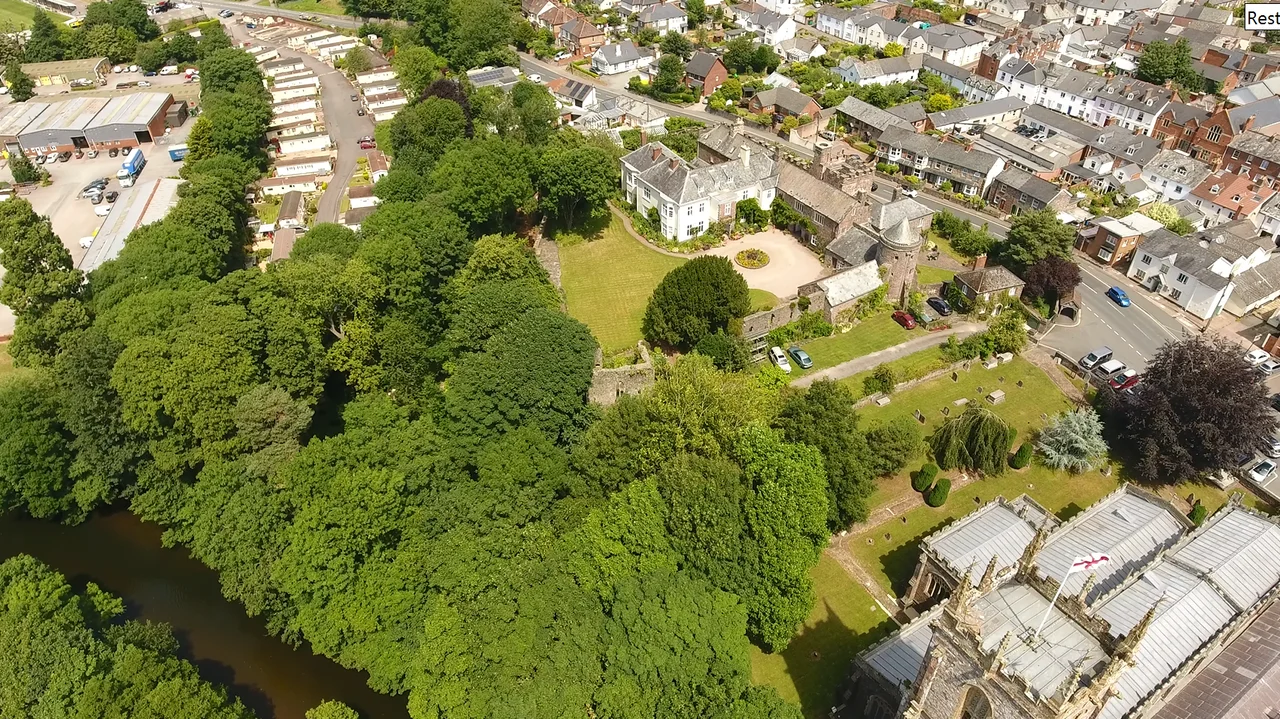

Tiverton Castle
At seven o'clock on the morning of Sunday, 19 October 1645, the New Model Army's gunners began firing at Tiverton Castle from a low ridge above the town. They were still finding their range when one cannonier, almost by accident, sent a single ball through the chain holding up the castle's drawbridge. The bridge dropped. Parliamentarian soldiers, in the words of their chronicler, were "loth to lose such an opportunitie" and rushed across without waiting for orders. By breakfast the Royalist garrison - 200 soldiers, a knighted governor, and a small fortune in treasure - was taken. The siege had ended almost before it began, and one of Devon's great medieval castles was on its way to becoming a ruin.
The Manor That Built a Dynasty
The story starts in 1106, when King Henry I granted the manor of Tiverton - one of the largest and richest in Devon - to Richard de Redvers, a Norman magnate who had backed the king in his quarrel with his brother. Richard built a motte above the steep red banks of the River Exe, the standard Norman recipe: a mound of earth, a wooden tower, walls of timber that would be replaced with stone as the family's fortunes grew. His son Baldwin de Redvers picked the wrong side in the civil war between Empress Matilda and King Stephen, was driven into exile, and emerged a few years later created the 1st Earl of Devon by his queen. For a century and a half the Redvers held Devon from this rock above the Exe, until the line ran out and a remarkable woman - Isabella de Forz, the last Redvers heir - held the earldom in her own right until her death in 1293.
Courtenays and Towers
Isabella's heir was a second cousin once removed named Hugh de Courtenay, who became 1st Earl of Devon under a new creation in 1335. The Courtenays raised the castle that visitors see today: the great south-east tower with its arrow loops, the gatehouse, the Solar Tower whose ruined upper storey still stands. For nearly two centuries the Courtenays were one of the most powerful families in the west of England, hosting royalty and feuding with rivals. Then the Tudor century turned against them. After Henry VIII's death, the castle passed briefly to the Lord Protector Edward Seymour, who was executed by his nephew Edward VI in 1552. It went next to Sir Henry Gates, whose brother had backed Lady Jane Grey - and when Queen Mary took the throne the following year, Henry Gates was tried for treason, attainted, and only narrowly escaped the block.
The Royalist Stronghold
By the time Civil War broke out in 1642 the castle had passed through several more hands. Devon was largely Royalist country; Tiverton became a garrison for King Charles. Sir Thomas Fairfax, commanding the New Model Army, swept westward through Devon in the autumn of 1645, taking the town of Tiverton without much resistance. The garrison retreated into the castle and the parish church beside it. Fairfax set up his headquarters at Blundell's School and dragged his guns - including a culverin capable of throwing a ball two thousand yards - onto Skrink Hills. For two days the batteries fired. Then came that lucky shot, the chain, the dropped bridge, the four men killed in the assault. Fairfax, mindful of his reputation for clemency, ordered that quarter be given to all who were still alive. The treasure inside was divided among the soldiers.
A Castle Becomes a House
What Fairfax could not entirely undo by storm, Parliament finished by demolition. Like dozens of Royalist strongholds across England, Tiverton Castle was slighted - deliberately broken down so it could never again serve as a military base. The great curtain walls came tumbling into the courtyard; the keep was reduced to a stump. In the calmer years that followed, the surviving range was rebuilt as a country house, a comfortable home with mullioned windows pieced into medieval stonework. Owners came and went: Mohuns, Carews, the eccentric West family. Today the castle is privately owned and open to visitors, the ruins kept as ruins. Standing in the courtyard, you can still trace the line of that broken chain - up from the gatehouse, across the empty air where the drawbridge used to hang, to the spot on Skrink Hills where the lucky gunner fired.
From the Air
Tiverton Castle stands at 50.91 degrees north, 3.49 degrees west, on a bluff above the River Exe in mid-Devon. The castle and adjacent St Peter's parish church form an easily identified pair just north of the town centre. Cruising altitude 2,500-4,000 feet gives a clear view of the Exe Valley running south toward Exeter. Exeter International (EGTE) lies about thirteen nautical miles south-southeast; Bristol (EGGD) is forty-eight nautical miles north. The Exe Valley channels morning fog in autumn and spring - best viewing usually comes after mid-morning lift.
Nearby Stories
- Cleeve Abbey 1.7 km away
- Glastonbury Lake Village 6.1 km away
- Wistman's Wood 8.5 km away
- Montacute Castle 9.3 km away
- South Devon Railway sea wall 11 km away
- Ilfracombe Lifeboat Station 19 km away
- Okehampton Castle 20 km away
- Weymouth 25 km away