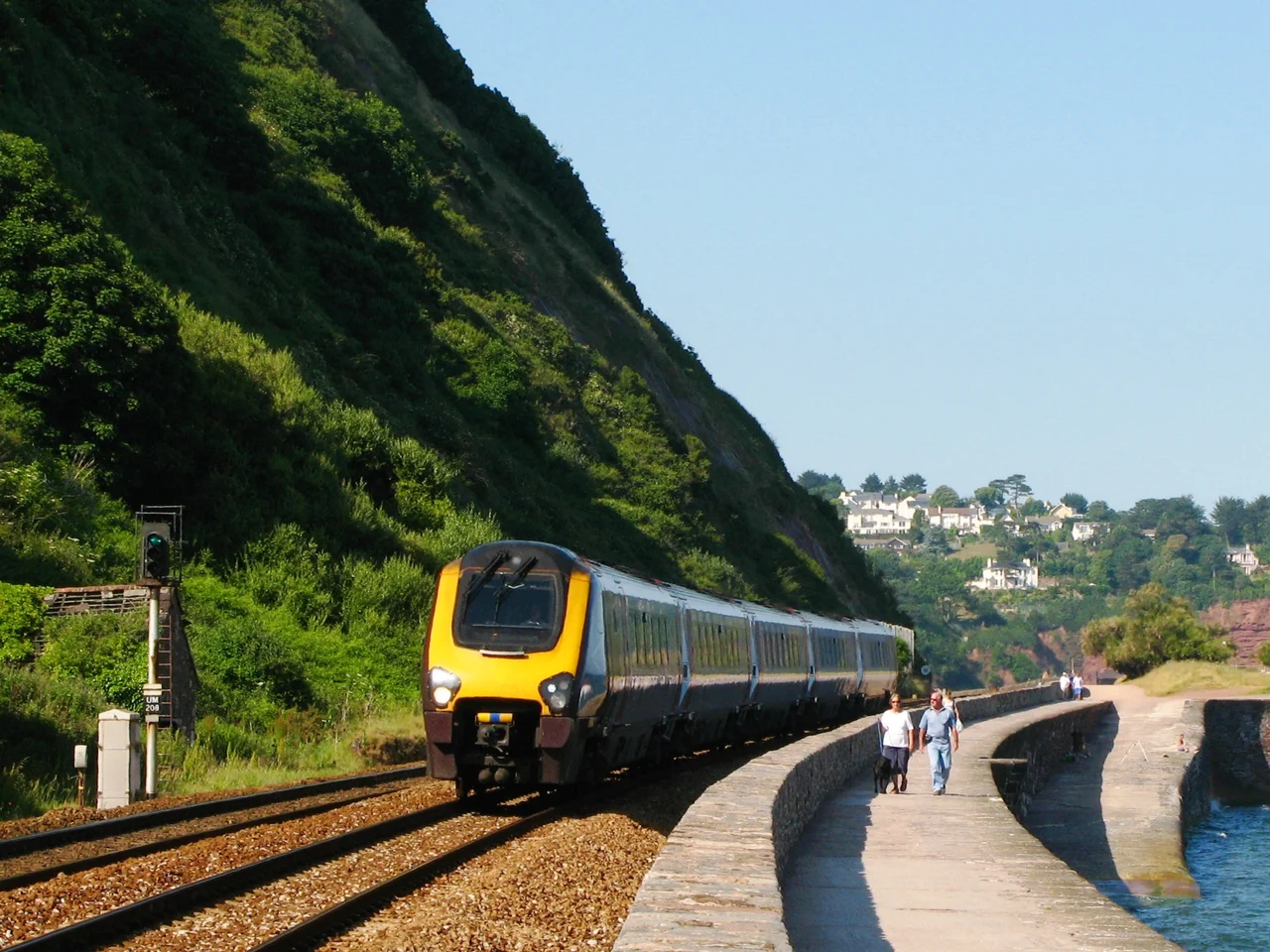

South Devon Railway sea wall
Five months after Isambard Kingdom Brunel's railway from Exeter to Teignmouth opened to traffic in May 1846, the storms of October broke through the new sea wall in several places and washed out the line. Repairs took fifty hours. The trains then ran again, alongside the open Channel, on a four-mile section of track that has been at war with weather and water ever since. The South Devon Railway sea wall is one of the most photographed pieces of railway infrastructure in Britain, partly because the engineering is dramatic, and partly because the dramatic part keeps repeating itself. A train comes around the cliffs at Dawlish in a winter storm. Waves break clean over the locomotive. Sometimes the wall holds. Sometimes a piece of it falls into the sea, taking the track with it, and the country south of Exeter is cut off from the rest of the rail network until Network Rail can put the line back together. The line has always done this. The line has never stopped running.
Brunel's Choice
The Exeter to Newton Abbot line was the southern half of Brunel's broad-gauge railway from London to Penzance. From Exeter it follows the River Exe estuary south to Dawlish Warren. Then, for four miles, it runs along the open coast at the foot of red sandstone cliffs, ducking through five tunnels at Kennaway, Coryton, Phillot, Clerk's, and Parson's, before turning inland again along the Teign estuary to Newton Abbot. Brunel chose the route over inland alternatives because it was cheaper and more direct, and because his original concept used atmospheric power: pipe-driven traction through partial vacuum, with no locomotives. Atmospheric trains actually ran on the sea wall section between 13 September 1847 and 9 September 1848, before failures in the leather seals doomed the experiment and conventional steam took over. The South Devon Railway was amalgamated into the Great Western Railway in 1876, converted from broad to standard gauge in 1892, and nationalised into British Railways in 1948. The Dawlish Warren station finally opened in 1905. The other stations on the sea wall were there from the beginning.
A Hundred Years of Breaches
On 24 December 1852 a rockfall at Breeches Rock blocked the line. Passengers walked past the rubble to join trains on the other side. In February 1855 large portions of the wall washed away and the resident engineer built a temporary viaduct within two weeks so coaches could be pulled across by hand and rope. In October 1859 came the largest storm in 35 years. The line flooded between Dawlish and Kennaway tunnel and the sea poured through Eastcliff tunnel into Teignmouth station. In January 1869 an 80-yard collapse north of Dawlish sent passengers to Starcross by road. The Christmas and New Year storms of 1872 to 1873 produced three breaches within ten days, totalling 200 yards of wall, and engineers laid extra horses on by special train from Plymouth. Then for fifty years the wall mostly held. A cliff fall near Sprey Point closed the line in 1923. A 25-foot chasm opened beneath the track in January 1930. In November 1965 a 60-foot gap opened between Dawlish and Dawlish Warren and trains ran through at ten miles an hour while repairs took three weeks. The sea is patient and the cliff is patient and the line has been built and rebuilt to outlast both of them.
February 2014
On the night of 4 February 2014, during the worst storms to hit the south coast in decades, the sea wall at Dawlish was breached. Around 40 metres of the wall, and the ballast under the railway immediately behind it, were torn out. The line dangled in the air, the rails suspended over empty space, the photograph that travelled around the world. It was initially hoped the line would only be closed for a short time. Further storms prevented work to repair the railway, and the eventual repair and resumption of train service took two months. Powerful waves caused additional damage to the track, the sea wall, and Dawlish station on 6 February. The Department for Transport said the most pressing issue was to get the line running again, but equally that it was important to look at the long term. The first train, the 05:34 Exeter St Davids to Paignton, ran on schedule on Friday 4 April 2014. The image of the suspended track had by then become a symbol of climate vulnerability, of brittle Victorian infrastructure, and of the impossibility of separating Cornwall and South Devon from their single rail link to the rest of Britain.
What Comes Next
Network Rail set up the South West Rail Resilience Programme after the 2014 storm. Government funding of 80 million pounds was approved in February 2019 to raise the sea wall south of Dawlish station by 2.5 metres. A 109-metre rockfall shelter at the northern end of Parsons Tunnel near Holcombe was completed between 2021 and 2023 at a cost of 48 million pounds. The plan to extend the wall further into the Channel at Teignmouth, passing through Sprey Point, was eventually abandoned in favour of targeted solutions including soil nailing, netting, and groundwater management. In January 2026, Network Rail issued a black alert, suspending services between Exeter and Newton Abbot ahead of predicted four-metre waves and 60 mile-per-hour winds. The storm threw sea water onto the tracks at Dawlish and knocked over a section of the wall between the footpath and the railway. A limited service was restored on the morning of 25 January. The 109 m rockfall shelter held. The Parliament Under-Secretary of State for Transport said in 2010 that even if there were one day to be an inland alternative, in our view it would not be a substitute in any shape or form for the main line along the coast. Brunel's choice still defines what the line is. The sea still defines the cost of keeping it. The trains still run.
From the Air
The South Devon Railway sea wall runs along the coast at approximately 50.569N, 3.469W, from Dawlish Warren south through Dawlish and on to Teignmouth. From 2,000 to 4,000 feet the four-mile coastal section is clearly visible, the rails running between the red sandstone cliffs and the open Channel, ducking into the dark mouths of the five tunnels. Exeter Airport (EGTE) lies about 7 nautical miles to the north and is the natural arrival point. Look for the Exe estuary opening to the north of Dawlish Warren, the long curve of beach at Dawlish, the iconic Parson and Clerk rocks just south of Hole Head, and the harbour at Teignmouth at the southern end of the run.
Nearby Stories
- Childe's Tomb 5.7 km away
- Coldharbour Mill Working Wool Museum 11 km away
- Montacute Castle 18 km away
- Action of 18 June 1793 18 km away
- Portland Bill 25 km away
- Eddystone Lighthouse 30 km away
- Manor of Orleigh 33 km away
- German Submarine U-672 33 km away