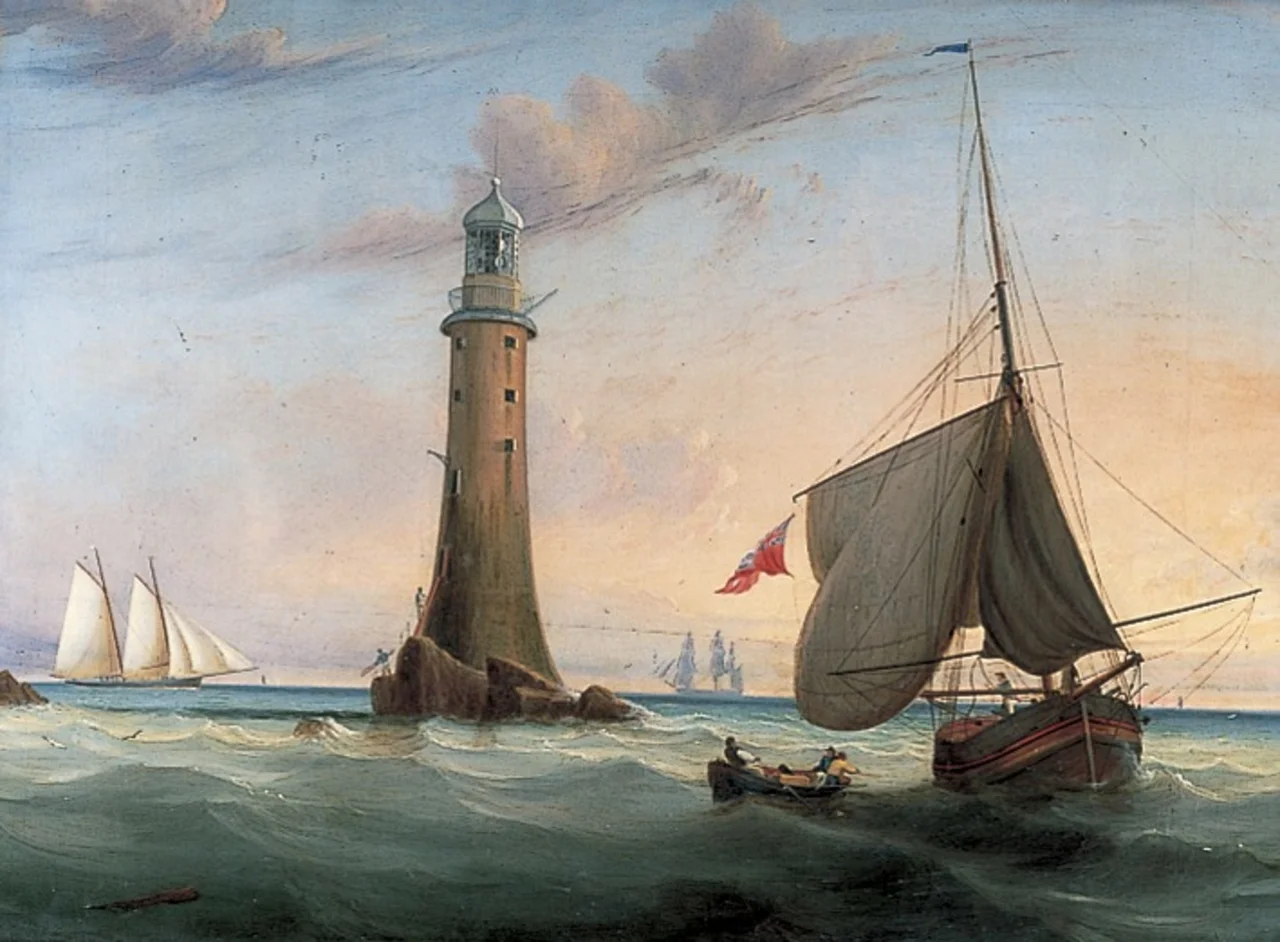

Eddystone Lighthouse
Henry Winstanley was a Restoration showman - a manufacturer of mechanical toys and clockwork wonders, a designer of waterworks, a man who loved to astonish people. He owned a hat with a feather and he made his money entertaining London society. In 1696 he started building the world's first open-ocean lighthouse on a half-submerged reef twelve miles south-west of Plymouth, where ships had been wrecking for centuries. By 1699 his light was working. In late November 1703, he travelled out from shore to make repairs, and he was inside his lighthouse when the Great Storm of 1703 hit - the worst meteorological event in English recorded history. By morning nothing was left of either the tower or the men inside it. The reef was empty again. The work began again.
Winstanley's Octagon
The Eddystone Rocks lie nine sea miles south-west of Rame Head in Cornwall, a submerged reef of Precambrian gneiss that disappears under spring tides. Twelve miles from Plymouth Sound - one of the most important naval harbours of England - the reef sat directly across the approach route from the Channel. Mariners feared it so much they hugged the French coast to avoid it, only to wreck themselves on Brittany or the Channel Islands instead. Winstanley's first attempt at a lighthouse was octagonal, made of wood, completed in 1698 and modified the following winter into a dodecagonal stone-clad structure on a timber frame. The lantern at the top was 15 feet high and 11 feet across, with eight windows of 36 panes each. It burned sixty candles at a time, plus a great hanging lamp. Winstanley reportedly said he wanted to be inside his lighthouse during the greatest storm there ever was. He got his wish, and it killed him. The Great Storm of 1703 destroyed his tower so completely that no trace was found of him or of the five other men who were inside.
Rudyard's Cone
Captain John Lovett bought the lease of the rocks and commissioned John Rudyard - a silk merchant who had never built anything like this before - to design the replacement. Rudyard's lighthouse, completed in 1709, was the opposite of Winstanley's. Where the first had been ornamented and angular, the second was smooth and conical, shaped to offer the least possible resistance to wind and wave. It rested on a base of layered timber beams stepped down to fit the sloping rock, anchored to the reef with 36 wrought-iron bolts forged to fit deep dovetailed holes in the stone. Above the timber base rose four storeys of wood, sheathed in vertical planks installed by master shipwrights from Woolwich Dockyard and caulked like the hull of a ship. The light came from twenty-four candles. It worked for forty-six years. On the night of 2 December 1755 the top of the lantern caught fire, probably from a spark in the chimney that ran through it. A keeper named Henry Hall, looking up at the burning roof, swallowed a slab of molten lead that dropped from the lantern. He died twelve days later; the slab of lead, autopsied from his body, is now in the National Museums of Scotland.
Smeaton's Stone
The third Eddystone Lighthouse was a turning point in engineering. After Rudyard's tower burned, Robert Weston asked the Earl of Macclesfield - President of the Royal Society - for advice on rebuilding. Macclesfield recommended John Smeaton, a Yorkshire instrument-maker turned civil engineer. Smeaton designed a tower of granite, dovetailed block to block and bonded with a hydraulic lime mortar he developed specifically for the job - a mortar that would set underwater. The shape he chose was the trunk of an oak tree, broad at the base and tapering upward. Work began on the reef in August 1756 with the cutting of dovetail recesses in the rock. The workers stayed ashore through the winter dressing the granite, and resumed laying courses the following June. Smeaton's tower stood from 1759 to the 1870s. It survived storms that Winstanley's and Rudyard's lighthouses could not have imagined. Its hydraulic lime mortar was the direct ancestor of Portland cement, and the modern concrete industry traces its lineage to the Eddystone reef. When erosion of the rocks beneath finally forced its replacement, the people of Plymouth refused to let Smeaton's tower be demolished. The upper portion was dismantled and re-erected on Plymouth Hoe, where it still stands as a public monument.
Douglass's Tower
James Douglass - engineer-in-chief of Trinity House and one of the great Victorian lighthouse builders - designed the fourth and current Eddystone Lighthouse, which began operation in 1882. Douglass's tower is built of granite, 49 metres high, containing 62,133 cubic feet of stone weighing 4,668 tons. Its biform Fresnel optic was six-sided and twelve feet high - the tallest in existence at the time, achievable only by using extra-dense flint glass in the upper and lower lens panels. The optic was made by Chance Brothers of Smethwick and designed by John Hopkinson FRS, their chief engineer. The original light flashed twice every thirty seconds, with a range of 17 nautical miles. From 1858 the outside was painted with broad red and white bands to make it more visible by day. In 1894 an explosive fog signal was installed on the gallery. The light was electrified beginning in 1959. The lighthouse was automated in 1982 - the first Trinity House 'Rock' lighthouse to be converted - and a helipad was built above the lantern in 1980 for maintenance access. Since 1999 it has run on solar power.
The Most Famous of All Lighthouses
Herman Melville mentions Eddystone twice in Moby-Dick. The English pop group Edison Lighthouse took its name from the rock - though they later dropped 'Lighthouse' and called themselves Edison. The third chapter of Mary Ellen Chase's 1965 book The Story of Lighthouses is titled 'The Most Famous of All Lighthouses', and is about Eddystone. In the Goon Show episode Ten Snowballs that Shook the World, Neddie Seagoon is dispatched to Eddystone to warn the inhabitants that Sterling has dropped from F-sharp to E-flat. The Hoad Monument in Ulverston, Cumbria, is an 1850 replica of Smeaton's tower used as a memorial to the naval administrator Sir John Barrow. The lighthouse on the Eddystone reef tonight flashes twice every ten seconds, visible 22 nautical miles, supplemented by a foghorn of three blasts every 62 seconds. Four towers have stood there. The fifth, when it comes, will stand on the bones of the rest.
From the Air
Eddystone Lighthouse sits at 50.18°N, 4.27°W on the Eddystone Rocks, nine sea miles south-west of Rame Head and twelve miles south-south-west of Plymouth Sound. Plymouth City Airport closed in 2011, so the nearest active airfield is Exeter (EGTE), about fifty miles east. Royal Naval Air Station Culdrose (EGDR) lies further west in Cornwall. The lighthouse sits alone in open water - approach in clear weather to see the white tower with its red helipad above the lantern, and beside it the dark stump of Smeaton's original tower, left standing on the reef when Douglass's lighthouse was built nearby. Plymouth Hoe to the north holds the upper portion of Smeaton's original lighthouse, re-erected as a monument and visible from the air as a slender stone tower on the city's seafront.
Nearby Stories
- Liskeard 5 km away
- Hope Cove Lifeboat Station 6.3 km away
- St Mawes Castle 8 km away
- Buckfast Abbey 8.1 km away
- Carnewas and Bedruthan Steps 8.9 km away
- Battle off Lizard Point 24 km away
- HMS Affray 52 km away
- SS Irma (1905) 106 km away