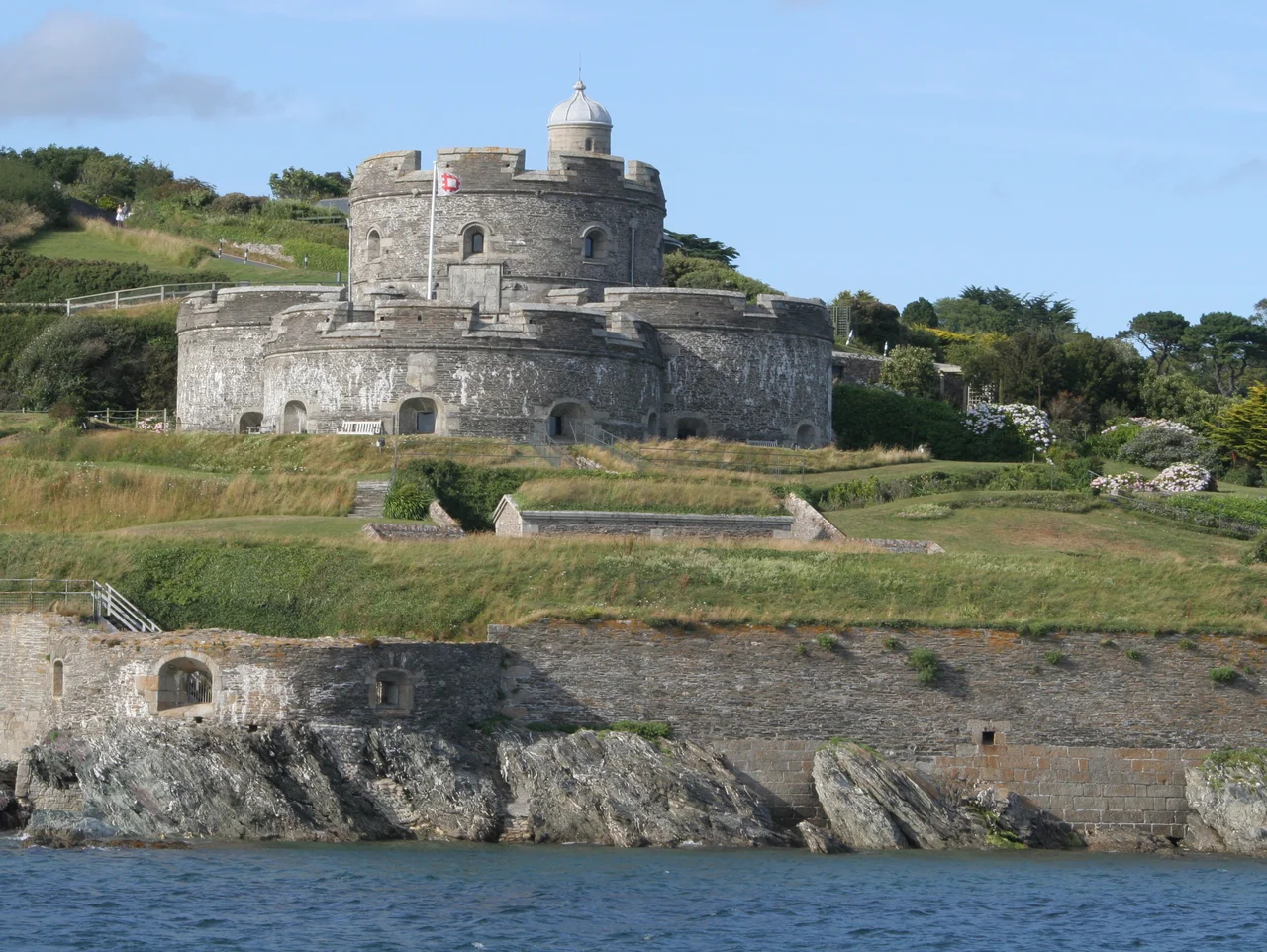

St Mawes Castle
Look closely at the stone and you will find Latin verses praising a king who has been dead for nearly five centuries. "Henry, thy honour and praises will remain forever," reads one inscription, carved at the order of an antiquarian named John Leland. Sea monsters glower from the walls. Gargoyles peer down over heraldic shields that once blazed with paint, designed to be read from passing ships. St Mawes Castle was built to sink French and Spanish vessels, but no enemy fleet ever sailed up the River Fal to test it. Instead, the guns sat silent through four centuries, and the castle aged into the most decorative survivor of Henry VIII's coastal fortresses.
The King's Device
In 1533, Henry VIII set aside Catherine of Aragon and broke with Rome. Catherine was the aunt of Charles V, Holy Roman Emperor, and he did not forget the insult. By 1538, France and the Empire had allied against England, the Pope was urging them to invade, and Henry needed a wall of guns along his coastline. He issued an order in 1539 called a device, which gave instructions for the defence of the realm in time of invasion. Carrick Roads, the great anchorage at the mouth of the Fal, was to be sealed by five castles. Only two were ever built. Across the water from St Mawes sits Pendennis, its twin, and the two were designed to throw overlapping fire across the channel. By 1542 Thomas Treffry's clover-leaf design here stood largely complete, armed with nineteen guns ranging from a demi-cannon down to seven small bases, plus a dozen long-barrelled hagbusshes for the militia.
Stone Praise for a Tudor King
Most of Henry's forts were strictly functional. St Mawes is not. The walls bristle with carved sea monsters, gargoyles, and shields that would once have flashed with painted heraldry. Latin verses by John Leland salute the king and his line, including the line "Let fortunate Cornwall rejoice that Edward is now her Duke," honouring Henry's young heir. The historian A. L. Rowse called it the most decorative of all the king's building works. From the gatehouse, with its gunloops and murder holes and slot for a drawbridge that may never have hung, you cross into a four-storey central tower joined to a forward bastion eighteen metres across and two flanking bastions slightly smaller. A 17th-century cupola tops the lookout turret, doing double duty as a daymark for ships. Inside the tower stands the Albergheti gun, a bronze saker of 1560 dragged up from a shipwreck off the Devon coast.
A Surrender, A Long Career
When the Civil War tore through the West Country in the 1640s, St Mawes flew Royalist colours and Falmouth's harbour fed Charles I's supply lines from the Continent. After Naseby the wave broke against them. In March 1646 the garrison surrendered to a Parliamentary army with barely a shot fired, the captain dismissed by some historians as Parliament-sympathetic and by others as simply weary. From there the fort served on quietly. Captains argued with their counterparts at Pendennis about who had the right to stop and search ships. By the 1730s the castle held seventeen guns. By 1797, an inspector found only a single twenty-four pounder still serviceable. In the 1850s, fearing France again, engineers cut a new battery from the rock below the Henrician tower and called it the Grand Sea Battery. In the 1880s they laid an electrically operated minefield across Carrick Roads, controlled from St Mawes and Pendennis together, illuminated at night by electric searchlights.
Last Watch
Brought back into service in 1939, the castle hosted twin six-pounder guns north-west of the keep and a Bofors anti-aircraft gun closer in. The battery finally closed in 1956. A bronze cannon from 1815 still sits on a replica carriage in the eastern emplacement. The Engine House of 1902, which once held an internal combustion engine to power the searchlights, has become a storeroom. The custodian's bungalow at the high-level battery is from the same era. The historian Paul Pattison calls St Mawes "arguably the most perfect survivor of all Henry's forts," and standing on the terraced site as it slopes down to the water, looking across to Pendennis on its own headland, you understand the claim. The guns that were never fired in anger have left the carved stone intact, the sea monsters unworn, the verses still legible: a king's vanity preserved by the very peace it was meant to enforce.
From the Air
St Mawes Castle sits at 50.155 N, 5.024 W on the eastern headland of Carrick Roads, directly opposite Pendennis Castle at Falmouth. From altitude the two forts and the mouth of the River Fal form an obvious gateway shape, with the wide anchorage opening inland. Nearest airport is Newquay (EGHQ), about 27 nautical miles to the north. Land's End Airport (EGHC) is roughly 35 nm west-southwest. Best viewing 1,500 to 3,000 feet AGL on clear days.
Nearby Stories
- Morvah 2.9 km away
- Carnewas and Bedruthan Steps 6.1 km away
- Liskeard 7.5 km away
- Battle off Lizard Point 14 km away
- Polperro 17 km away
- MV Cita 47 km away
- HMS Affray 86 km away
- 1979 Fastnet Race 96 km away