
Polperro
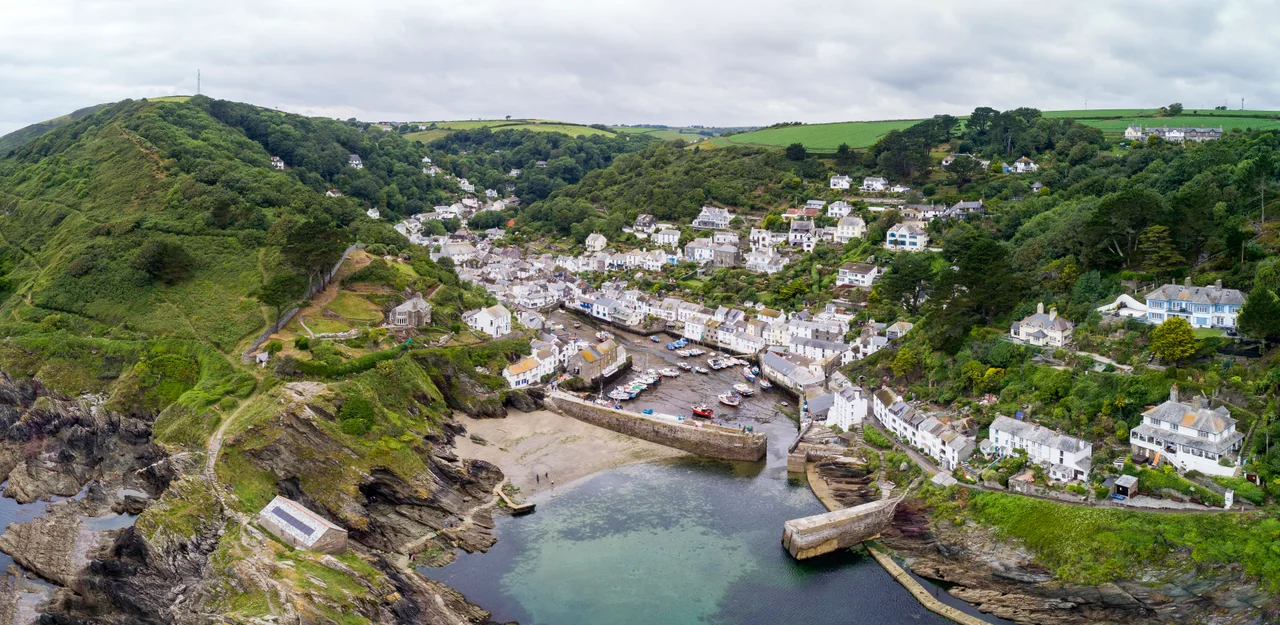
Half a mile of village clings to the sides of a single steep combe, the River Pol running down its centre, and at the bottom is a harbour barely wider than a city street. No cars are allowed past the car park at Crumplehorn at the top. Visitors walk down, or take a horse and cart, or ride one of the milk floats disguised as small trams. By the time they reach the water, the cottages have closed in around them - whitewashed walls, slate roofs, fishermen's stores at ground level and living rooms above, packed so tightly that the streets become more like staircases. In the 1970s, Polperro received about twenty-five thousand visitors a day during summer. The houses have been there since the thirteenth century, the smuggling tradition since around the same time, and the harbour since at least the early 1500s when John Leland first described it.
Pyra's Cove
The name comes from the Cornish Porthpyra - the harbour named after Pyran, possibly the same saint who gave his name to St Piran's flag of Cornwall. The linguist Eilert Ekwall doubted the personal-name origin and suggested Perro might simply be a name for the stream. The earliest recorded form is Portpira, from 1303, followed by Porpira in 1379. By the reign of Henry VIII, Cornish scribes were writing Polpyz, Poulpirrhe, Poul Pier, and Poulpyrre - John Leland used the last in his account. The village fell under two ancient manors: Raphael, in the parish of Lansallos west of the river, and Killigarth, in the parish of Talland to the east, both mentioned in Domesday. A Royal Ordinance of 1303 records Polperro as a working fishing settlement. It has been one ever since.
The Smugglers' Banker
By the late eighteenth century, Britain was at war with America and then France, and the taxes on imported goods had risen so high that smuggling became almost rational economics for any fisherman with a boat and nerve. Brandy, spirits, tobacco, tea, silk - all of it landed on Cornish beaches and worked its way inland through networks of villages, with Polperro near the centre. The mastermind was Zephaniah Job (1749-1822), a local merchant who started life in St Agnes, Cornwall, moved to Polperro, and became known as the Smugglers' Banker. Job financed runs, settled accounts, managed the credit of dozens of fishermen-smugglers, and accumulated a personal archive of correspondence with Guernsey suppliers that survives today. He acted as the village's de facto financial centre. When the more organised nineteenth-century Coast Guard arrived with stiffer penalties, the trade declined - though the South West Coast Path that now runs through the village was originally a Revenue Officers' patrol route. The Polperro Heritage Museum, on the harbourside in an old fish-processing warehouse, tells the story with surviving artefacts.
The Storms of 1817 and 1824
On 19 and 20 January 1817, a hurricane-force storm tore through the south coast. At Polperro, thirty large boats, two seine-netters, and many smaller craft were destroyed. The village green and Peak Rock were partially consumed. Houses were swept away. Damage was estimated at two thousand pounds - an enormous sum for a fishing village - though, remarkably, nobody died. Seven years later, in November 1824, an even worse storm hit. Three houses were destroyed. The whole of one pier and half of the other were swept away. Of fifty boats in the harbour, only six survived, and only one of those was a Polperro Gaffer. The new pier was rebuilt to a more protective design. The fishermen rebuilt their boats. The villagers rebuilt their houses. And the East Indiaman Albemarle, lost off the coast in December 1708 with a cargo of diamonds, coffee, pepper, silk, and indigo, was rediscovered exactly nowhere - the wreck site has never been located.
Couch's House and Kokoschka
Jonathan Couch was Polperro's village doctor for decades in the early nineteenth century. He wrote a natural history of British fish, two series of articles for Notes and Queries titled The Folklore of a Cornish Village, and a history of his village that his son Thomas Quiller Couch published posthumously in 1871 as the History of Polperro. Couch's house on Lansallos Street still stands; it belonged before him to generations of the Quiller family, who had grown prosperous on smuggling and buccaneering. The Austrian Expressionist painter Oskar Kokoschka discovered Polperro in 1939 and spent a year living and working in the village, painting its harbour and slopes with the same intensity he had once brought to Vienna and Dresden. In the late nineteenth century, Sir Francis Galton came here to study fingerprints, choosing the village because it was so isolated - only reachable by sea or coastal path - that intermarriage was common and family trees were unusually complete. His genealogies of Polperro families are held at the College of Arms in London.
Marooned
In 1807, a man from Polperro named Robert Jeffery served aboard HMS Recruit under Commander Warwick Lake. Jeffery had been born in Fowey, moved to Polperro, joined the merchant navy, and been press-ganged into the Royal Navy. One night he stole his midshipman's beer. Lake, in a fit of pique, ordered him marooned on Sombrero, an uninhabited island off Anguilla. Some months later, Lake's commanding officer Sir Alexander Cochrane learned what had happened and ordered Recruit to retrieve Jeffery. When the ship arrived, the island was empty. The story eventually got out and Lake was court-martialled and discharged from the Royal Navy. Three years after he had been marooned, Jeffery was discovered alive in Massachusetts, working as a blacksmith - rescued by an American ship and quietly delivered to a new life. He was repatriated to Britain and given compensation. The seven pubs of modern Polperro have all heard the story. Some of them tell it. Most of them simply pour the beer.
From the Air
Located at 50.331°N, 4.520°W on the south Cornwall coast, 4 nm west-south-west of Looe. Recommended viewing altitude 1,500-3,000 ft AGL. Visual landmarks: the village fills a narrow combe running south to a tidal harbour; the harbour entrance is protected by two stone piers; the South West Coast Path traces the cliffs east toward Talland Bay and west toward Lansallos. The A387 connects Polperro to the inland village of Crumplehorn and onward to Looe. Nearest civilian airports: Newquay (EGHQ) 30 nm west, Exeter (EGTE) 51 nm east-north-east. Approach photography is best on falling tide when the harbour bed is partially exposed and the boats sit cleanly on the sand.
Nearby Stories
- Launceston Castle 2.7 km away
- East Wheal Rose 8.5 km away
- Castle Drogo 8.8 km away
- Hope Cove Lifeboat Station 13 km away
- Goonhilly Satellite Earth Station 19 km away
- Battle of Plymouth (1652) 20 km away
- HMHS Glenart Castle 55 km away
- HMS Affray 70 km away