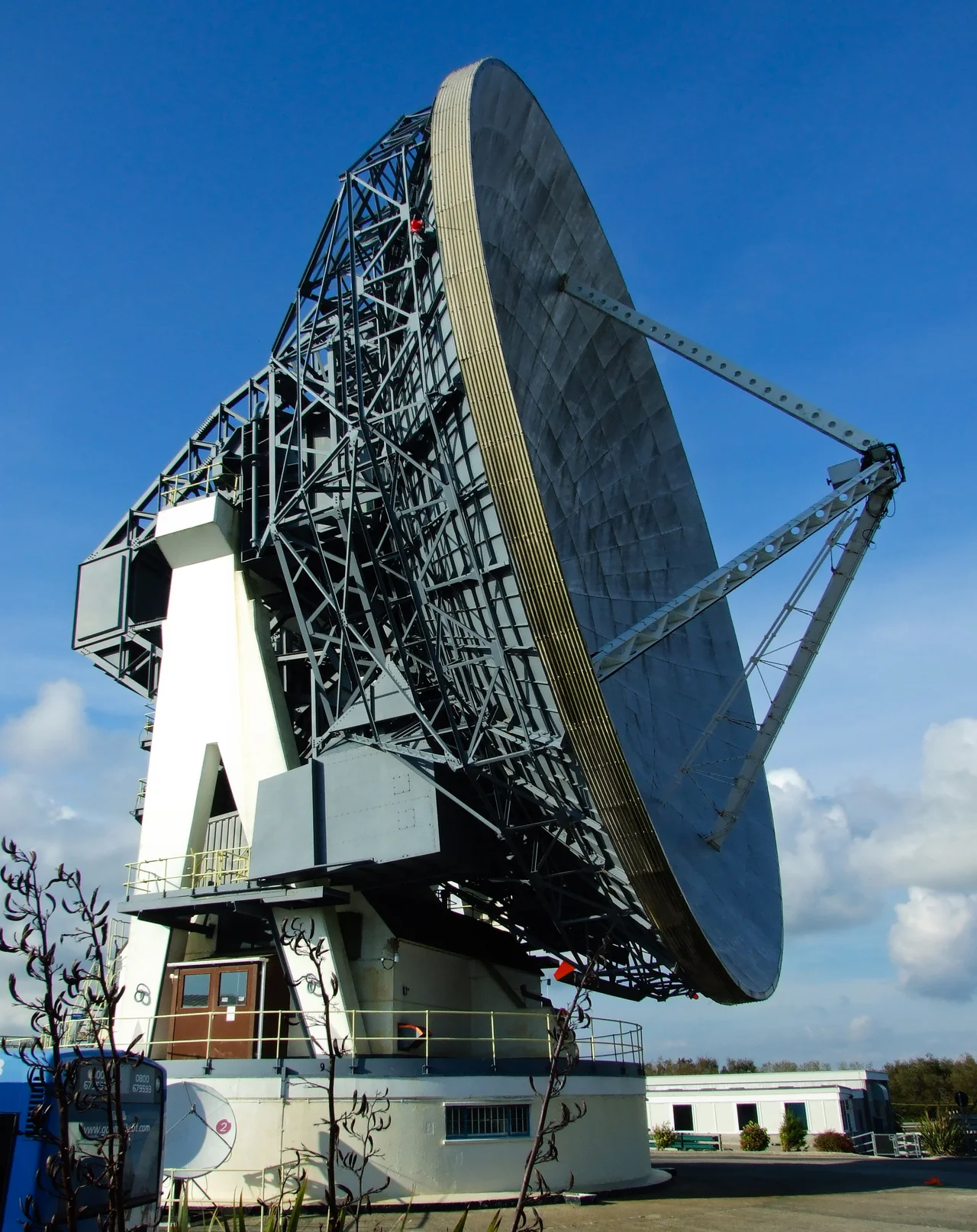

Goonhilly Satellite Earth Station
On the morning of 11 July 1962, a 25.9-metre parabolic dish on a windswept Cornish heath swung skyward, locked onto a metal sphere arcing through low Earth orbit, and pulled down something humanity had never seen before: live television from across the Atlantic. The dish was called Antenna One. Its operators, looking at its lattice ribs and steel armature, had already given it another name. They called it Arthur. Cornwall's Arthurian legends were about to get a new chapter, one written in microwaves.
Why Goonhilly
The choice of site was geology, not poetry. Beneath Goonhilly Downs lies thousands of feet of serpentine, a hard metamorphic rock that does two things engineers prized: it bears tremendous weight without subsiding, and it stays radio-quiet, interfering little with the faint signals coming down from space. The downs are flat, treeless, and far from urban electrical noise. The site had already served as RAF Dry Tree, a Second World War early-warning radar station - it was used to listening. When BT, then the General Post Office, needed somewhere to plant a 1,118-tonne dish that would track a satellite called Telstar across the sky, the answer was a peninsula already pointed at the Atlantic. Arthur weighed more than a fully loaded jumbo jet. The serpentine held it without complaint.
Arthur's First Picture
Telstar launched on 10 July 1962 and made its first usable pass the following morning. France beat Britain to the headline: the Pleumeur-Bodou station in Brittany caught the very first transatlantic broadcast at 0H47 GMT. But Arthur received its own video a few hours later, and from that day forward Goonhilly was wired into the story of nearly every signal moment the rest of the century would produce. The Muhammad Ali fights came through here. So did the Olympic Games. Apollo 11's footprint on the Moon was relayed, in part, through Arthur. When Live Aid asked the planet to watch Wembley and Philadelphia at the same time in 1985, Goonhilly was one of the points where the planet did. Other dishes joined Arthur over the decades, named for Merlin, Guinevere, Tristan, and Isolde - a literal Round Table of antennas on the moor where Arthurian legend itself was said to roam.
Decommissioned, Then Reborn
At its peak, Goonhilly ran more than 30 antennas and drew 80,000 visitors a year to a centre that walked them through the history of satellite communications. Then, in 2006, BT announced it would close satellite operations and move them to Madley in Herefordshire. By 2010 the visitor centre was shuttered. The dishes, including Grade II-listed Arthur, stayed standing - too historic to scrap, too quiet to use. The reprieve came from space itself. In 2011 a new company, Goonhilly Earth Station Ltd, took over with the audacious plan of refitting the dishes for deep-space communication. The 30-metre and 32-metre antennas were upgraded, tested, and certified to CCSDS standards, meaning they can now plug directly into NASA's Deep Space Network and the European Space Agency's ESTRACK. On 22 February 2024, Goonhilly served as the Earth station for Intuitive Machines' IM-1 spacecraft, the first American mission to land on the Moon since Apollo 17 in 1972. A site that began by catching television is now talking to the lunar surface.
The Sound of Wind, and Microwaves
From the air, Goonhilly looks like nothing so much as a field of giant white flowers tilted toward the sky. Some lean east, some south, some straight up, each chasing a different point in the sky where a satellite or spacecraft passes overhead. Nearby, a wind farm spins on the same downs - unrelated to Goonhilly's operations but part of the same Cornish pact with the elements. The moor is quiet in the human sense, but loud in the electromagnetic one. Every signal that has shaped modern broadcasting - from the first grainy faces beamed across the ocean to commands sent to landers crawling across the lunar regolith - has at some point touched this patch of serpentine. It is, in a real sense, where the world started to talk to itself.
From the Air
Goonhilly Satellite Earth Station sits on Goonhilly Downs at 50.05 degrees north, 5.18 degrees west, about 11 km north of Lizard Point. The cluster of large white parabolic dishes is unmistakable from cruise altitude on clear days - look for them on the open heath between Helston and the south coast. Nearest commercial airport is Newquay (EGHQ), about 60 km north. RNAS Culdrose (EGDR, military) lies only 8 km northwest, so expect Royal Navy helicopter activity in the area. Recommended viewing altitude 3,000 to 6,000 feet.
Nearby Stories
- Logan Rock 3.6 km away
- Polperro 7.4 km away
- Great Wheal Charlotte 10 km away
- Battle of Plymouth (1652) 26 km away
- SS Irma (1905) 30 km away
- Black Swan Project 75 km away
- HMS Affray 77 km away
- 1979 Fastnet Race 100 km away