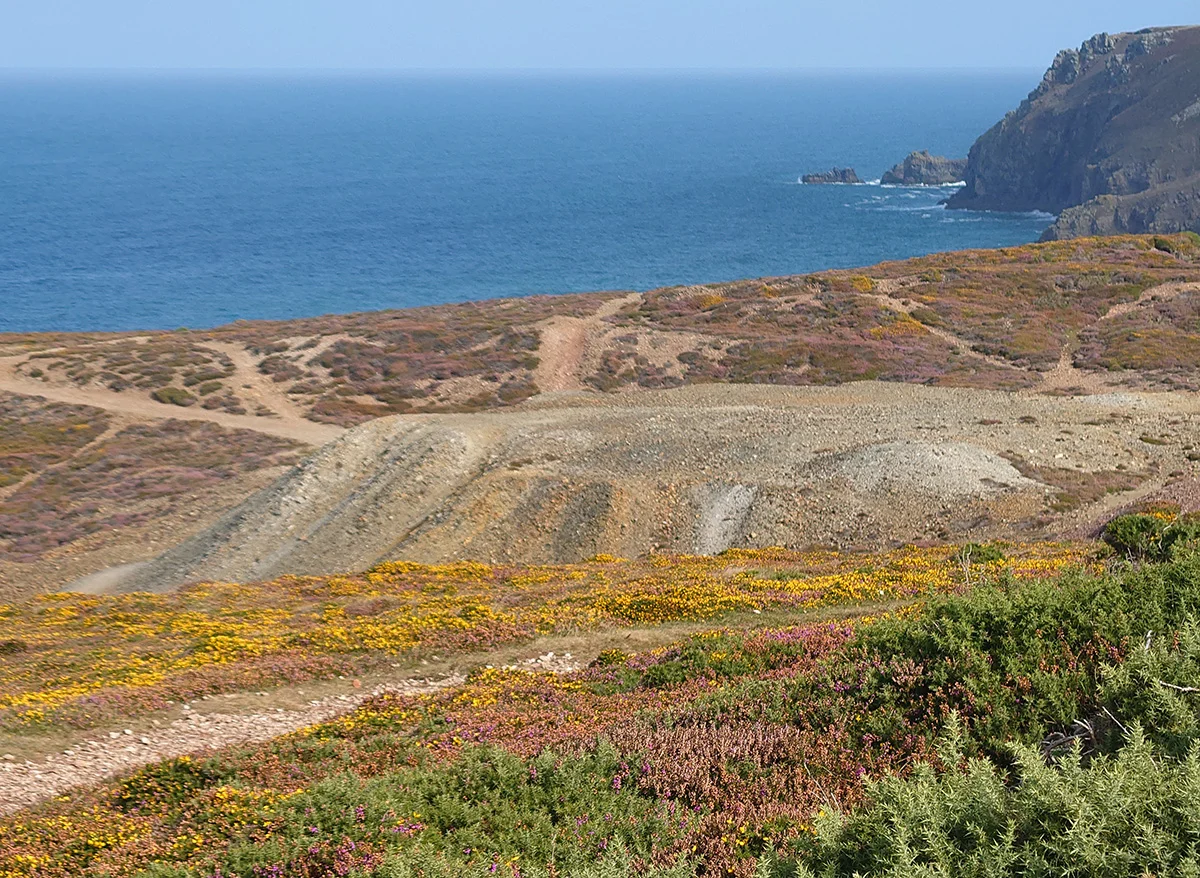

Great Wheal Charlotte
Walk the cliffs above Chapel Porth and Porthtowan and you cross a clifftop carpeted in late summer with purple heather and yellow gorse. Then you reach the spoil tips of Great Wheal Charlotte and the colour stops. The heaps of crushed rock here are bare. Nothing grows on them, two centuries after the last ore was hauled up the shafts. The lingering heavy metal concentration in the waste, copper and arsenic and cassiterite tin, has kept the slopes sterile while everything around them has greened over. All that stands of the mine itself is the bob wall of one engine house and a fenced shaft, but the bare ground tells you how much rock came out of this hillside.
Above Chapel Porth
Great Wheal Charlotte sits on the South West Coast Path between St Agnes and Porthtowan, a stretch of north-Cornish coast where the cliffs drop sharply to small coves of dark sand. The mine was certainly working by 1820 and probably earlier. In its 1830s heyday it was extracting ore that ran at 7.25 percent copper, an exceptionally rich grade, the kind of figure that 19th-century mining engineers wrote up in their statistics with audible pleasure. Annual production reached 2,800 tons of ore in three different years during the 1830s and again in 1840. That put Great Wheal Charlotte at nearly two percent of total Cornish copper-ore production in 1834 to 1836 and again in 1840, a remarkable share given that Cornwall had over 160 working copper mines in the same period. The principal lode was simply called the Main lode. At least six shafts pierced it. The deepest, Engine Shaft, ran 150 metres straight down.
Up the Ladder
There were no cages or hoists for the miners here. Access in and out of Cornish copper mines in this period was by ladder. After a long shift in tunnels hundreds of metres below the cliffs, often soaked, often hot, often working ore by candlelight, miners had to climb the ladders back up to the surface. The full climb out of a 400-metre mine could take more than an hour. Men who lost their grip fell to their deaths. Men who reached the surface exhausted from the climb did so before walking home, sometimes miles. The hope of mechanisation, of man-engines and steam-hoists, was real by 1838 but slow to spread. By the 1840s the long-term future of Cornish copper was already shadowed by deeper mines in Wales, Spain, and Chile. From 1860 onwards, Cornish miners emigrated in waves to Australia, the Americas, and South Africa, taking their hard-rock skills with them. The phrase "a mine anywhere in the world is a hole in the ground with a Cornishman at the bottom of it" dates from this exodus.
Women and Children at the Surface
A workforce of perhaps 350 men, women, and children worked at Great Wheal Charlotte in some of the busier 1830s years. The estimate is reasonable because nine kilometres away at Consolidated Mines, which produced about six and a half times as much ore, the 1837 statistics record 2,387 workers. Of Great Wheal Charlotte's workforce, the men largely worked underground. The women and children worked at the surface, on the dressing floors. Their job was to break the lumps of mined ore into smaller pieces with hammers called bucking irons, then to sort the pieces by hand into grades of richness. The work was outdoors year-round, in Cornish wind and rain, often dusty with arsenic-bearing rock. Women were known as bal maidens, from the Cornish bal meaning mine. Children, sometimes as young as eight, did the lighter sorting. Pay was a fraction of what the men underground earned. They were not visible in the mine's own accounts as separate workers, but they were the reason the ore left this hillside ready for the smelters.
Stone and Sterile Ground
All that remains of the surface buildings is the bob wall of one engine house, which once held a 60-inch pumping engine installed in 1828. The engine had two boilers and a chimney. The bob wall is the section that bore the weight of the great beam as it rocked up and down to drive the pumps. A 36-inch pumping engine put up for sale in 1828 may have stood above Cock's Shaft, 77 metres deep. The wider mine landscape is geological theatre. The underlying rocks are Devonian mudstones metamorphosed into slate during the Variscan orogeny, when granite intrusions rose into the sediments around 295 million years ago and powered the hot-water circulation that precipitated copper and tin into the veins. Recent specimens recovered from the site include chalcopyrite, malachite, cuprite, cassiterite and arsenopyrite, a small mineralogical museum lying in scree. The National Trust bought the mine in 1956. The bare spoil heaps are now Sites of Special Scientific Interest. Two centuries on, the rock has not forgotten.
From the Air
Great Wheal Charlotte sits at 50.296 N, 5.235 W on the cliffs between St Agnes Head and Porthtowan, on the north Cornwall coast. The bare spoil tips are visible from altitude as pale patches on otherwise heather-covered cliffs. Wheal Coates, with its more famous Towanroath engine house, stands just to the north across Chapel Porth. Nearest airport is Newquay (EGHQ), about 11 nautical miles to the northeast. Best viewed below 2,000 feet AGL.
Nearby Stories
- Brane Barrow 0.7 km away
- Polperro 4.9 km away
- Goonhilly Satellite Earth Station 8.2 km away
- Launceston Castle 15 km away
- Pendeen Lighthouse 22 km away
- St Materiana's Church, Tintagel 24 km away
- Battle of Plymouth (1652) 30 km away
- SM U-27 123 km away