
Brane Barrow
It is roughly twenty feet across, and it has been sitting in a low Cornish pasture for somewhere between three and four thousand years. The farmer in 1863 told the archaeologist that he had not knocked it down because the little stone chamber inside made a useful shelter for his sheep and pigs. That practical kindness, repeated through generations of west Penwith farmers, is the reason Brane Barrow survives at all. It is now considered one of the smallest and best-preserved Neolithic and Bronze Age burial monuments in Britain, a perfect miniature of a form that was once common across western Cornwall and the Isles of Scilly and now exists in only a handful of recognisable examples.
The Smallest Survivor
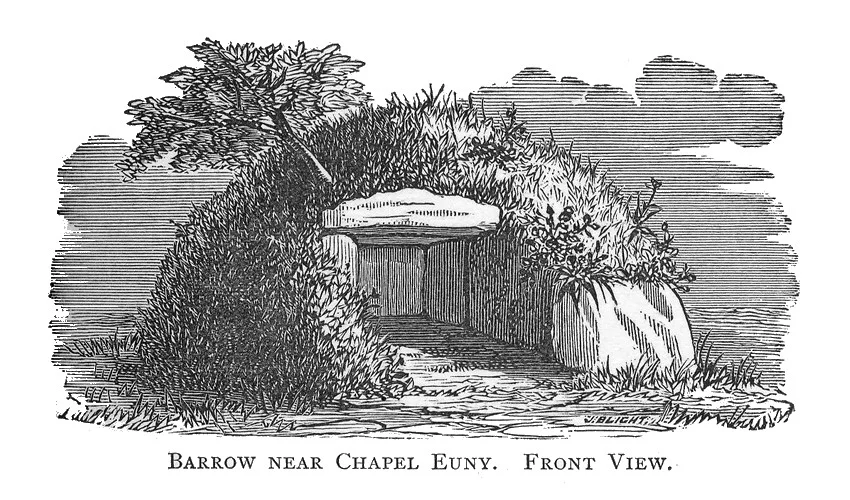
Brane Barrow sits 290 metres southwest of Brane End Farm, near a low-lying patch of pasture close to the upper Lamorna River. The mound is a circular cairn of earth and stones about 20 feet across, retained at its edge by a kerb of large granite blocks. Inside is a single rectangular chamber, lined with stone slabs, that measures 7.5 feet long, 4 feet wide and 3 feet high. Two granite capstones still roof the chamber; a third was prised off and removed at some unknown date. An entrance passage faces southeast, opening directly into the chamber from the kerb. Most entrance graves of this type were built up to 25 metres across. Brane is barely six. The mound was constructed only just thick enough to cover the chamber, and on the south side a section has been dug away, exposing the slabs directly to the weather. It looks less like a monument than like something the landscape itself shrugged up.
An Old Tradition of Reuse
Entrance graves of the Scillonian type date to the later Neolithic and Bronze Age, roughly 2500 to 1000 BC. They are characteristic of a small zone of western Cornwall and the Isles of Scilly and almost nowhere else. The basic recipe is consistent: a low circular mound of rubble and soil, a stone kerb to hold it in, and a single chamber accessible through an opening in the perimeter, used for collective deposition of cremated remains and grave goods over time. Brane Barrow's combination of survival and miniaturisation makes it unusually informative. You can stand at the kerb and take in the whole monument in a glance. You can also see, from the way the slabs are set and the cap stones balanced, that the builders knew exactly what they were doing. This is not a hasty grave. It is a small, carefully made house for the dead.
Borlase, the Pigs, and the Farmer
The barrow was formally recorded in 1863 by William Copeland Borlase, a Cornish antiquarian following in his great-grandfather's footsteps. Borlase was actually in the area to investigate the underground passages of Carn Euny, the nearby Iron Age fogou and courtyard-house village. He noted the barrow as the one near Chapel Euny, after the local farmstead. The owner of the land told him what every archaeologist hopes to hear and rarely does: the structure had been left undisturbed because it was useful. The stone-lined chamber made a snug, dry shelter, well-suited to penning livestock through bad weather. That casual utility had probably preserved Brane through centuries while neighbouring monuments were dismantled for field walls or quarried for road metal. Borlase published the discovery in his Naenia Cornubiae in 1872, and the barrow has been a protected scheduled monument ever since.
Visiting the Stones
Today Brane Barrow can be visited with permission from Brane farm. There are no information boards, no fences, no ticket office. You walk down a Cornish lane between high hedge banks, past granite gateposts and clumps of foxgloves, and the barrow appears in a paddock looking, if anything, like an unusually tidy heap of rocks. The Lamorna River chatters not far away. The fogou at Carn Euny is only a short walk further on. From the air the site is barely a freckle in the green Penwith landscape, but on the ground, kneeling at the small entrance and peering into the chamber, you are looking through a door that someone propped open more than three thousand years ago and that one west Cornish farmer, in 1863, was thoughtful enough not to close.
From the Air
Brane Barrow lies at approximately 50.10 degrees north, 5.64 degrees west, in the Penwith peninsula about 2 kilometres southwest of the village of Sancreed and roughly 5 miles west-northwest of Penzance. From the air it is essentially invisible, a low mound in a small field; navigate instead to the nearby village of Sancreed or the prominent Iron Age fogou at Carn Euny just to the south. The closest airfield is Land's End Airport (EGHC) at St Just, about 3 nautical miles to the west. The granite uplands of the Penwith moors rise immediately to the north and west.
Nearby Stories
- Mullion Cove 1.3 km away
- Great Wheal Charlotte 3.7 km away
- Castle Down 5.3 km away
- SS Georgia (1890) 30 km away
- Wheal Coates 41 km away
- 1979 Fastnet Race 55 km away
- HMS Affray 126 km away
- Routes of Santiago de Compostela: Camino Frances and Routes of Northern Spain 713 km away