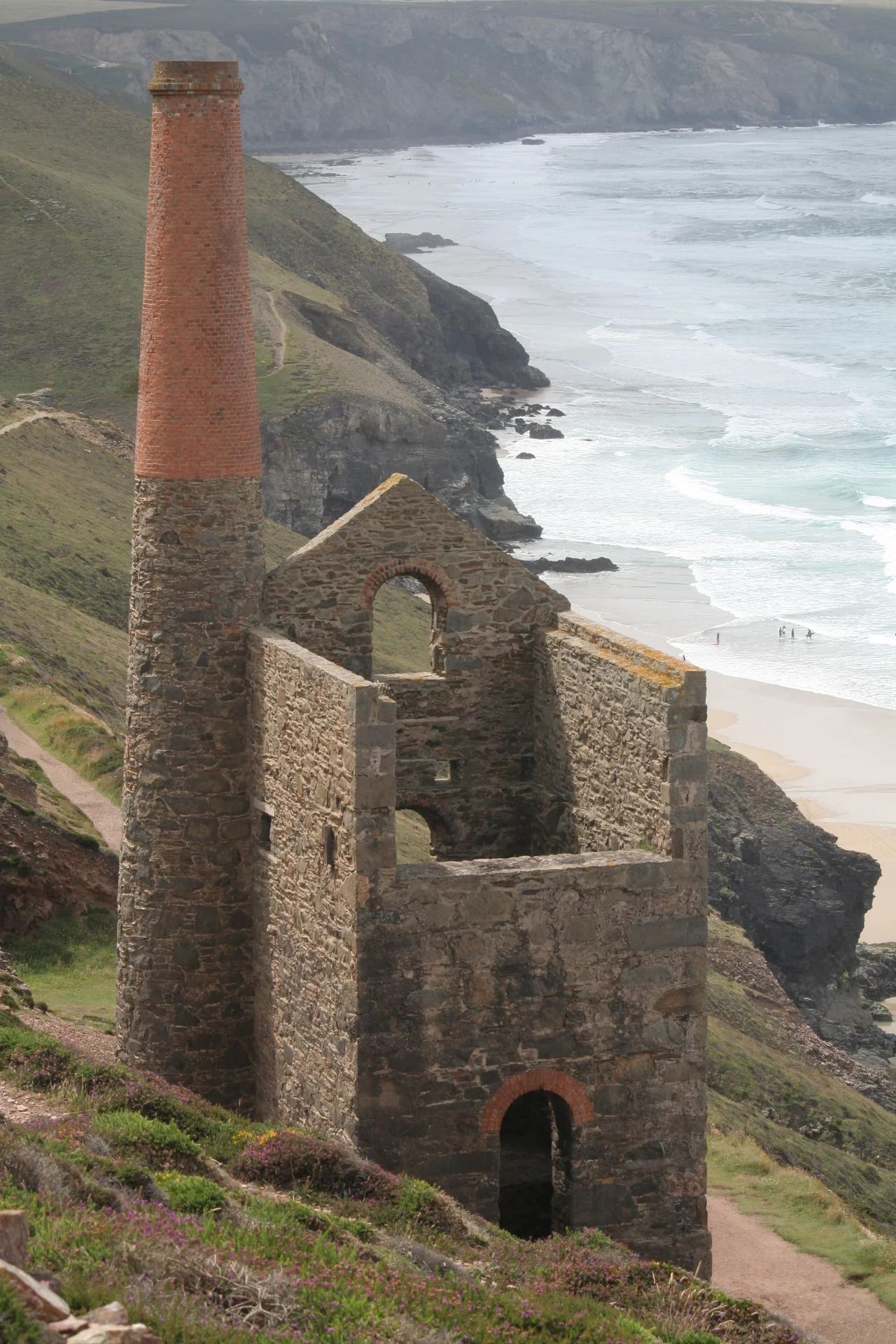

Wheal Coates
Stand at Towanroath on the cliffs between Porthtowan and St Agnes, and the shaft beneath your feet drops six hundred feet into the dark. The mine workings extended out under the sea. The pumping engine house that survives at the cliff edge - granite walls, narrow chimney, a roof gone to sky - was built in 1872 to fight what the miners called the great enemy: water. It is one of the most photographed industrial ruins in Britain, the kind of place where Cornwall stops looking like a county and starts looking like a parable about labour and weather. Wheal coates means simply 'Coates Mine' in Cornish-English mining argot. The men who worked it called it home.
Tin Beneath the Ocean
Wheal Coates came into full production in 1815, when steam power was finally reliable enough to drain a coastal mine. Without it the seawater would have won. The Towanroath shaft drops 600 feet through Devonian slate to follow a tin lode that runs out beneath the Atlantic, and from the surface you can see the line of the cliff dropping away exactly where the shaft was sunk. At its peak the mine employed 140 people on the surface and underground. The work was rough and the hours long, but the lode produced steadily until a slumping tin price forced the sale of the mine in 1844, after which the workings were simply allowed to flood. A new owner reopened the mine in 1872 - the year the Towanroath engine house was built - but work after that came in fits, and the mine closed for good in 1889.
Three Engine Houses and a Calciner
Three engine houses still stand at Wheal Coates, and each one did a different job. The Towanroath Pumping Engine House, perched at the very edge of the cliff, contained a Cornish engine whose beam rocked night and day to keep the shaft below it dry. A short walk uphill, the Old Whim and New Whim engine houses crushed tin ore for processing. 'Whim' was the local word for a winding engine that hauled material up from underground - the same word from which Cornish miners gave the wider language a vocabulary for sudden, mechanical motion. A calciner built between 1910 and 1913, when a final attempt was made to work the mine, roasted the tin to drive off impurities including arsenic. The chimney of the calciner still stands east of the New Whim, the tallest finger of stone on the headland.
World Heritage
Wheal Coates is part of the Cornwall and West Devon Mining Landscape, inscribed as a UNESCO World Heritage Site in 2006. The reasoning is broad: between roughly 1700 and 1914, Cornish mining technology - especially the Cornish engine and the deep-shaft methods needed to chase tin and copper through hard rock - spread from the duchy to almost every metal mining region in the world. Cornish miners and engineers emigrated to Mexico, South Australia, Wisconsin, Montana, South Africa, Tasmania. Wherever the Cornish went, they took their language of shaft, lode, adit and whim. The engine houses at Wheal Coates are the same template, in miniature, as the giant engine houses that pumped out the Real del Monte mines in Mexico or the deep copper workings of Burra in South Australia.
The Cliff That Will Win
Cornwall's north coast is winning a slow argument with everything humans have ever built on it. The cliffs at St Agnes are erosional - they retreat a little each century under storms that arrive directly off the Atlantic with three thousand miles of open water behind them. The Towanroath engine house has been stabilised by the National Trust, but standing inside its empty granite walls you understand that the building's relationship with the cliff is temporary on a geological scale. Below the engine house the rocks are dark with iron, and the sea pulls back at low tide to reveal black-and-orange streaks of mineral that hint at why anyone bothered to put a shaft here in the first place.
What You Hear
Wheal Coates is quiet now, but the quiet has a particular Cornish texture. Wind comes up the cliff and through the missing roof, and on a wild day the engine house breathes like a flue. Choughs - the red-legged, red-beaked Cornish crow that vanished from the county for fifty years - have been back since 2001, and pairs often nest in the broken stonework along this coast. The footpath, part of the South West Coast Path, runs past the engine houses and continues north toward Chapel Porth, where surfers chase the waves that mining once tried to keep out. The mine is dead. The headland is alive.
From the Air
Wheal Coates sits at 50.30°N, 5.23°W on the north Cornish coast between Porthtowan and St Agnes. The nearest airfield is Perranporth (a small grass strip, ICAO EGTP) about five miles to the north; larger services run from Newquay Cornwall (EGHQ) ten miles north-east. The Towanroath engine house is unmistakable from the air - a single stone tower at the cliff edge with three more engine house ruins arrayed inland up the slope of the headland. Approach along the coast for the cleanest view; the cliffs drop straight to the sea, and on a clear day the chimney of the calciner casts a long shadow across the heather.
Nearby Stories
- Brane Barrow 0.7 km away
- Polperro 4.9 km away
- Goonhilly Satellite Earth Station 8.2 km away
- Launceston Castle 15 km away
- Pendeen Lighthouse 22 km away
- St Materiana's Church, Tintagel 24 km away
- Battle of Plymouth (1652) 30 km away
- SM U-27 123 km away