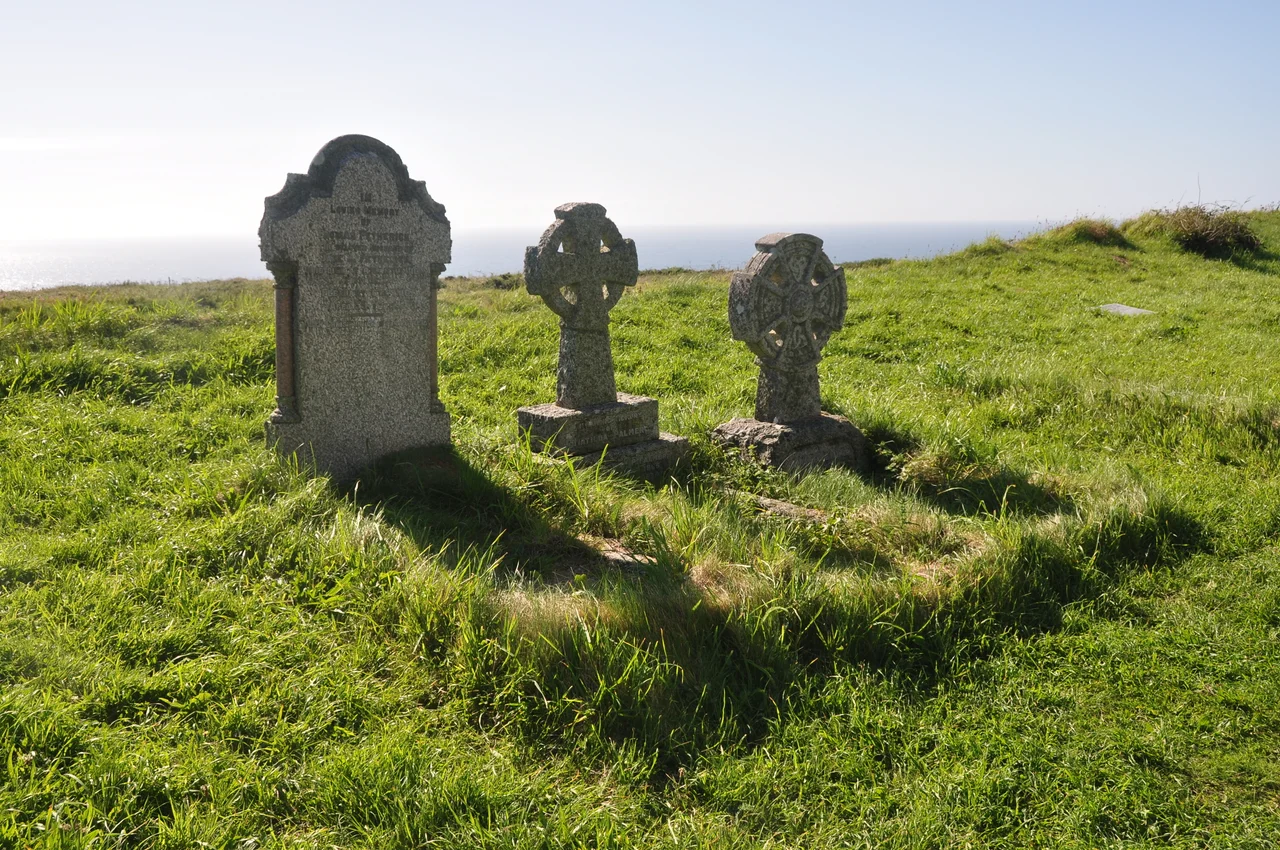

St Materiana's Church, Tintagel
Park at the gate. The church stands by itself on Glebe Cliff, half a mile west of the village of Tintagel, on a grass headland that drops straight into the Atlantic. There is nothing around it but wind, gorse, and the ruins of Tintagel Castle visible on the next headland. The walls are Norman, possibly with Saxon foundations. The font is carved with snakes. Built into the south transept is a Roman milestone bearing the name of Emperor Licinius, who died in 324. Outside, in the unusually large churchyard, lies a fourteen-year-old Italian sailor named Domenico Catanese, washed up here after a shipwreck in 1893, beneath a wooden cross marked with the lifebuoy that failed to save him.
Materiana
The church is named for a saint barely anyone has heard of - and that is part of the point. St Materiana, sometimes identified with Madryn, a sixth-century princess of Gwent in what is now South Wales, has just two churches dedicated to her in the world, both in this corner of Cornwall: this one at Tintagel and the mother church at Minster, three miles north-east. An alternative tradition claims the dedication might actually be to St Marcellina, the sister of St Ambrose of Milan. Nobody is certain. The first church on the cliff was probably erected in the sixth century, around the same time as the trading settlement on Tintagel Island next door was bringing in pots of Mediterranean wine and oil. The current building dates to the late eleventh or early twelfth century. Nikolaus Pevsner, visiting in 1950, thought the Norman work might preserve Saxon features.
What's Built Into the Walls
In 1889 a Roman milestone was discovered built into the western gateway of the churchyard wall. The inscription reads I-mp C G Val Lic Licin, referring to Emperor Licinius (died 324). The stone has been moved inside, into the south transept; it sits there in plain sight, a fourth-century imperial waymarker repurposed by medieval builders. The church holds a second Roman stone at Trethevy, nearby. The font is Norman, crudely carved in elvan stone, with snakes on each of its four faces and a human head at each corner. The north and south doorways are both Norman, the north cruder and probably earlier. The rood screen is fifteenth century, missing its canopy, probably removed at the Reformation. The east window is a memorial to Father Canner, vicar from 1950 to 1976; a recent statue of St Materiana in the chancel honours Parson Chapman, vicar from 1894 to 1916.
The Tower and the Bells
The tower at the west end was built in the fourteenth century, with battlements added in the fifteenth. It holds six bells. Five are old - cast in 1735, 1785, 1828, and two more in 1868 - and one was added in 1945, the year the Second World War ended. The tenor weighs seven hundredweight and ten pounds. The earliest recorded vicar of Materiana's is Gervase de Truueru in 1259. The longest-serving was Gerance Davye, in post from 1581 to 1629, through the reigns of Elizabeth I and James I. Since 1534 the patrons of the benefice have been the Dean and Canons of Windsor. In the thirteenth and fourteenth centuries the patronage belonged to the French abbey of Fontevrault in Anjou, the same Plantagenet abbey that holds the tombs of Henry II and Eleanor of Aquitaine. The church on the Cornish cliff and the great royal abbey in France were once part of the same ecclesiastical structure.
The Sailor Boy
The churchyard is unusually large for Cornwall and has been extended three times. The earliest pre-Victorian gravestones, all of local slate, date from 1690 to 1710. Among the most striking memorials, on the east side, is a simple wooden cross marking the grave of Domenico Catanese. On 20 December 1893 the Italian barque Iota was driven onto Lye Rock, just north of Tintagel, in heavy weather. The crew managed to climb onto the rock, and four men from the shore - three of them Tintagel men, including Charles Hambly, who received a vellum testimonial and three medals for bravery - reached the rock and helped them down. All were saved except Domenico Catanese, aged fourteen. He is buried here under his name written in the Italian bureaucratic order, surname first: "Catanese Domenico," with a small lifebuoy carved alongside. To the north-west of the church lies John Douglas Cook, founding editor of the Saturday Review, died 1868.
What the Land Remembers
Excavations in 1990 and 1991 turned up early graves to the north-west of the church, dating to between 500 and 1000 AD - confirming that people have been buried on this headland for fifteen centuries. The Trecarne Lands to the north-east, ploughed in the 1950s, gave up more early graves still. The illustration on the jacket of J. L. Carr's novel A Month in the Country - a book set in Yorkshire - shows the tower of Tintagel parish church, because the grave that opens the story, just outside the churchyard wall, was inspired by the early Cornish graves Carr remembered from here. The wind never quite stops. The chough wheels and clatters. The Atlantic moves in slow, hugely patient waves twenty metres below the cliff edge. The church door has been locked at sunset and opened at sunrise for nine hundred years. It is one of the most isolated parish churches in England, and one of the most quietly furnished with history.
From the Air
St Materiana's Church sits at 50.663N, 4.760W on Glebe Cliff, half a mile west of Tintagel village and a short walk south of Tintagel Castle. From altitude the church is unmistakable: a small grey building alone on grass headland, its tower battlements just visible above sea cliffs, the larger Tintagel Castle ruins on the dramatic island headland to the north-west. The South West Coast Path runs along the cliff edge. The closest commercial airport is Cornwall Airport Newquay (EGHQ), about 30 km south-west. Best photographed at 1,500-3,000 ft in late afternoon light when the slate cliffs glow warm and the church and castle catch the western sun together.
Nearby Stories
- Lanhydrock House 3.5 km away
- Tamar Bridge 4.7 km away
- Appledore Lifeboat Station 9 km away
- Okehampton Castle 15 km away
- Hartland Point Lighthouse 16 km away
- Tehidy Country Park 23 km away
- Godrevy Lighthouse 53 km away
- Action of 17 November 1917 62 km away