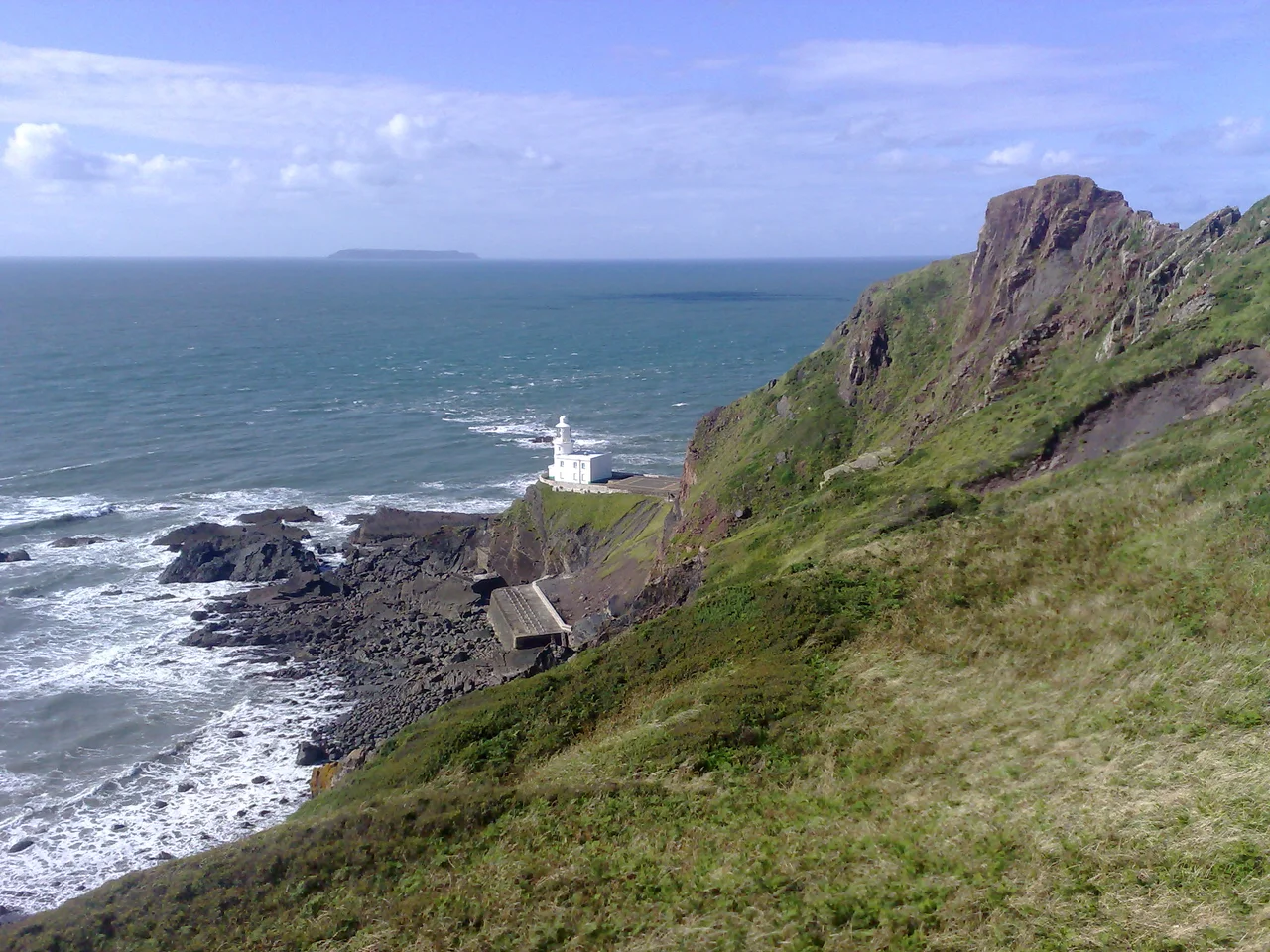

Hartland Point Lighthouse
On 1 July 1874, Lady Stucley of Hartland Abbey climbed the new tower at Hartland Point and lit the lamp for the first time. A bishop blessed it; a small crowd watched. The light flashed alternately red and white - two white pulses, then one red, every thirty seconds - and reached 25 miles out across an empty Atlantic. The pattern was designed to be unmistakable for ships rounding the most exposed corner of the English coast, where the Bristol Channel ends and the open ocean begins. For 138 years it burned there. In 2012, Trinity House switched it off.
An Engineer's Lighthouse
Sir James Douglass designed it, with resident engineer Henry Norris running the build. The pair had just finished Souter Lighthouse on the Northumberland coast in 1871, and Hartland Point was their next problem. Construction began in November 1873 under a Welsh contractor named Yerward. The finished tower stood 18 metres tall, with the lamp 37 metres above mean sea level - low for a major light, but the cliff did most of the work of getting it high. The original optic was a biform construction with ruby glass panels mounted over three of its nine lens panels, the red panels widened to compensate for the loss of intensity when light passes through colored glass. It was clever engineering for the era, and as far as anyone knows, unique.
Voices in the Fog
The fog signal began as a reed horn that sounded once every two minutes, replaced later in the 19th century by a two-tone siren - both powered by caloric engines, a Victorian heat-engine technology that ran on hot air rather than steam. In 1911 the reed came back, this time driven by oil engines. The 1927 modernization brought a diaphone, that distinctive low-pitched signal heard up and down British coasts, sounding three blasts every 75 seconds. Some years after the lighthouse joined mains electricity in 1959, the diaphone was replaced with an LIE300 electric horn. The fog signal went silent for good in 2010, two years before the light itself.
Keepers and Cliffs
The lighthouse was built with accommodation for four keepers and their families - a small community living on a shelf of cliff above the boiling water at the point. A 30-metre sea wall went up in 1925 to slow the erosion of the rocks beneath the tower. The large concrete structures just south of the lighthouse held fresh water for the keepers, hauled up from below. The light was electrified in 1927, with two 3-kilowatt filament lamps, one on each tier, and a turntable changer that automatically switched to a standby lamp - electric or acetylene - if one failed. When the keepers' dwellings were eventually demolished to make space for a helipad, vehicular access along the cliff road had already become unreliable, prone to landslips and rockfalls.
Decommissioned and Sold
After a full assessment of navigation requirements off the point, Trinity House decided the location only needed a light visible for 8 nautical miles - a range that a modern LED beacon, mounted in front of the old tower, could provide more cheaply and just as safely. The original light was decommissioned in 2012. The lighthouse went on the market at a 500,000-pound guide price: tower, three-bedroom living quarters over two storeys, stores, helipad, and 16 acres of cliff and coastline reached by a surfaced road that climbs the cliff to a gated entrance. Trinity House described the views, with restraint, as the best in the area.
The Stolen Optic
The strangest chapter came in 2022. During restoration work on the tower, the unique biform optic - the one-of-a-kind ruby-paneled lens that had defined the light's signature flash for 148 years - was placed in storage in Ilfracombe. It was due to go back into the lantern when the works were done. Sometime in late 2021 or early 2022, someone broke into the storage facility and stole it. A 5,000-pound reward was offered. The Coventry Telegraph reported the optic might have been moved into the West Midlands. As of writing it has not been recovered, and the value of the missing glass was estimated at around a million pounds.
From the Air
Hartland Point Lighthouse sits at 51.02 N, 4.53 W, on the cliff at the western end of the Bristol Channel. The most dramatic approach is from the north or east at 1,500 to 2,500 feet, with Lundy Island 10 nm to the northwest and the Devon AONB cliffs running south toward Bude. Watch for sudden coastal turbulence in westerly winds rolling off the Atlantic. Nearest aerodromes: Eaglescott to the southeast, Newquay (EGHQ) to the south across the bay, Haverfordwest (EGFE) and Swansea (EGFH) across the Bristol Channel to the north.
Nearby Stories
- HMHS Glenart Castle 11 km away
- Castle Drogo 12 km away
- Exmoor 13 km away
- North Cornwall Railway 14 km away
- Mumbles Lifeboat Disaster 21 km away
- Horton and Port Eynon Lifeboat Station 28 km away
- Padstow Lifeboat Station 29 km away
- Castlemartin Training Area 34 km away