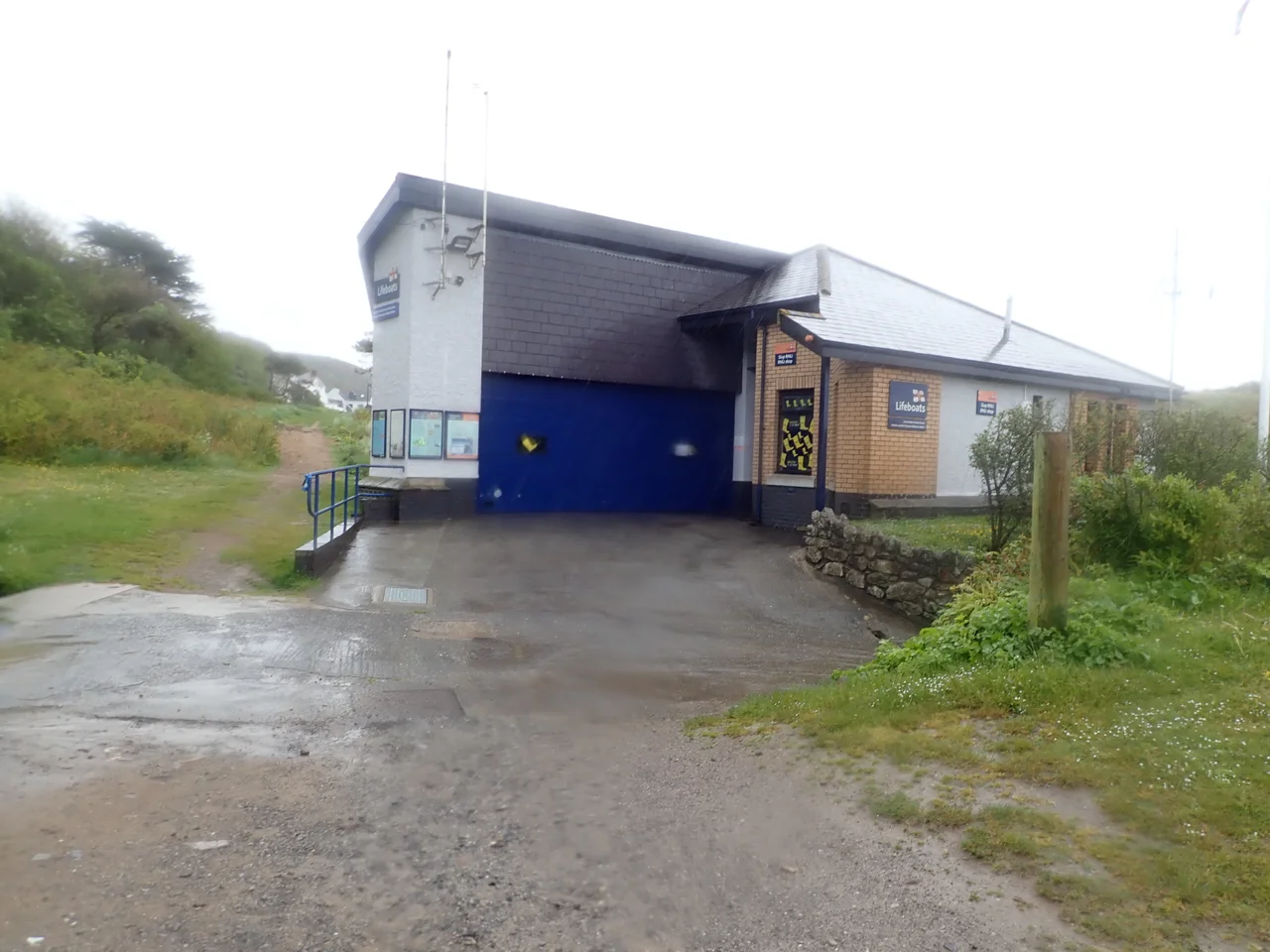

Horton and Port Eynon Lifeboat Station
On the south coast of the Gower Peninsula, just off Underhill Lane at Horton Beach, a small boathouse holds an inshore lifeboat called Barbara Jane. She is a fast inflatable hull capable of being launched in minutes, designed to reach swimmers and capsized kayakers and people cut off by the tide. She is the latest in a line that goes back more than 140 years, and the people who maintain her remember the names of the ones who did not come back.
Two Shipwrecks in Two Weeks
In January and February 1883 two ships came to grief at Port Eynon Point within eleven days of each other. The steamship Agnes Jack grounded on 27 January, and villagers stood on the cliffs and watched eighteen men drown. They could do nothing. On 7 February the schooner Surprise was wrecked just north of the same point, and all seven hands aboard her died. The Royal National Lifeboat Institution decided that the existing station at The Mumbles, fourteen miles to the east, sat too far away to help when Gower's western tip got into trouble. A 34-foot self-righting boat with ten oars and a small sailing rig was dispatched to Port Eynon. The villagers had built a boathouse for £400. A bequest from a Lancaster woman named Maria Jones paid for the boat itself, and at her family's request the lifeboat was christened A Daughter's Offering. She launched on 10 May 1884.
The Janet
A Daughter's Offering served for 22 years and saved 39 lives before she was replaced in 1906 by a slightly larger boat named Janet, paid for by a bequest from a colonel in Cheltenham. For ten years Janet pulled men off wrecks along the Gower cliffs. Then came 1 January 1916. A distress signal flashed from the S.S. Dunvegan and Janet launched into a violent winter sea. As the crew rowed toward the stricken steamer a wave capsized the lifeboat. She righted herself, as her self-righting design promised, but one man could not get back aboard and drowned. Another wave capsized her again. Two more men were lost in the water. The remaining ten crew had no oars left and could only drift. Thirty hours later, what was left of Janet ran ashore near Mumbles, having travelled the length of the Gower coast in the dark. The station closed temporarily that year and permanently in 1919.
The Names
A sculpture in the churchyard of Port Eynon Church remembers the three men lost from Janet on New Year's Day 1916. William Gibbs, coxswain, was sixty-six years old, a man who had spent his life on this coast. William Eynon, second coxswain, was forty-six. George Harry was also forty-six. A plaque inside the church carries their names. In a fishing village of that era, three men of those ages meant three families without husbands or fathers, and a small community absorbing a loss that took a long time to settle. The station that bears their hometown in its name still trains volunteers who, when their pagers go off, know what coast they are putting to sea on, and what it has cost others before them.
Quieter Decades, Still Watching
After half a century without a station, the western Gower coast got a new kind of lifeboat in 1968. Small fast inflatables, light enough to launch from a beach with just a few volunteers, had been introduced across Britain in 1963 in response to a growing tide of weekend swimmers, surfers, and small-boat sailors. The new Horton and Port Eynon Lifeboat Station took one of these. In 1973 helmsman John Grove drove the boat through broken water past jagged rocks to reach three people on Worm's Head who had decided to swim against a flood tide rather than wait for the causeway to clear. He brought them out alive and was awarded the RNLI Bronze Medal. The Bronze Medal is not given often. A new boathouse went up in 1992 with a galley, a lookout tower, and room for the tractor that hauls the boat down the beach. The work continues, the way it has for 140 years.
From the Air
Horton and Port Eynon Lifeboat Station sits at 51.5481 N, 4.20083 W on the south coast of the Gower Peninsula, about 14 nautical miles west of Swansea. The boathouse is just inland from Horton Beach, on the eastern shoulder of Port Eynon Bay. Approaching from the east along the Gower coast you'll cross Oxwich Bay, then a stretch of cliff, then the wide pale sand of Port Eynon Bay opening out before Worm's Head a few miles further west. Swansea (EGFH) is the closest airfield, 13 nautical miles east-northeast. Cardiff (EGFF) is 36 nautical miles east. The Bristol Channel here has very large tides; recommended viewing altitude is 1,500 to 2,500 feet to see the bay and the cliff line.
Nearby Stories
- Dinefwr Castle 2.9 km away
- Cymmer Colliery Explosion 7.7 km away
- Brecon Beacons National Park 8.5 km away
- Caldey Abbey 9.4 km away
- Preseli Transmitting Station 12 km away
- Minehead Lifeboat Station 13 km away
- Ilfracombe Lifeboat Station 14 km away
- Lundy 19 km away