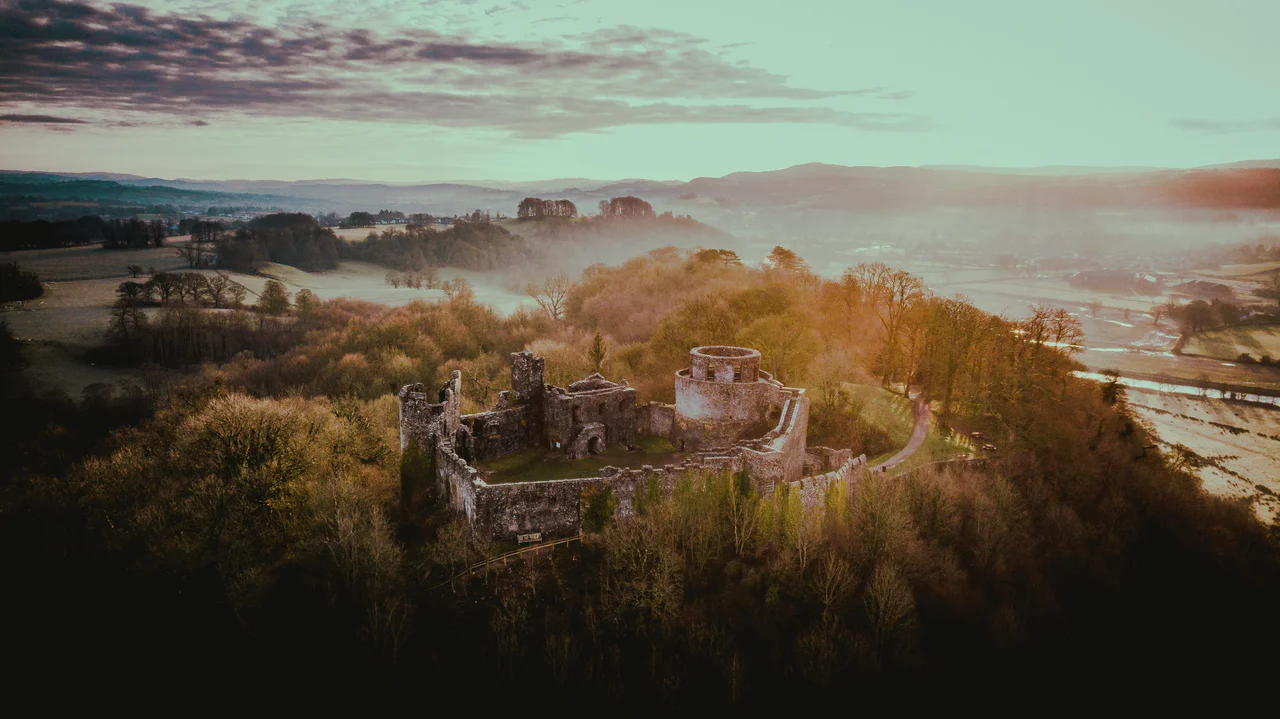

Dinefwr Castle
When Giraldus Cambrensis tells the story it has the polish of a folktale, but it almost certainly happened. Henry II of England was planning to assault Dinefwr Castle during a campaign against Rhys ap Gruffydd in the late twelfth century. One of his most trusted men was sent to scout the route, and a local Welsh cleric was assigned as guide. The cleric agreed, then led the Englishman by the most difficult path he could find, through bog and forest and over crag. At the end of the performance he stopped and ate a handful of grass, explaining politely that this was what the local people lived on in times of hardship. Henry called off the attack. The chief seat of Welsh Deheubarth stayed Welsh for another generation - because somebody chewed grass and meant it as a joke and a warning at once.
The Seat of Deheubarth
Dinefwr sits on a ridge along the northern bank of the Tywi near Llandeilo, with a hundred-foot drop to the river. Tradition says Rhodri the Great built a castle here in the ninth century. No archaeological remains have been dated to that period, but tradition exists for a reason: defensible ground always gets used. Rhodri's grandson Hywel Dda - Hywel the Good, codifier of Welsh law and first ruler of Deheubarth, eventually king of most of Wales - made Dinefwr his chief seat. By the time we can date the standing masonry, the castle is the headquarters of the Welsh princes of southwest Wales: the House of Dinefwr, the dynasty that produced the figures who shaped medieval Wales as a kingdom rather than a province. Rhys ap Gruffydd (the Lord Rhys, ruler of Deheubarth 1155-1197) is thought to have rebuilt the castle in stone. He also built the spectacular cliff-top fortress at Carreg Cennen four miles to the south, founded Talley Abbey - the first Premonstratensian house in Wales - and supported Llanllyr, the second nunnery established in Wales and the first to flourish.
Welsh Princes, English Kings
On Rhys's death Dinefwr passed to his son Rhys Gryg, and the oldest stonework still visible probably belongs to that period. Llywelyn the Great of Gwynedd was extending his reach into Deheubarth by then. Rhys Gryg, recognising he could not resist, dismantled the castle himself. Llywelyn restored it and held it until his death in 1240. After him came the politics that made the thirteenth century what it was. In 1255 Llywelyn the Last gave Dinefwr to Rhys Fychan, then took it back, gave it to Maredudd ap Rhys, then gave it again to Rhys Fychan - the same Rhys Fychan whose attempted reinstatement triggered the English campaign that ended at the Battle of Cadfan in 1257. Maredudd, having lost his grant, switched sides to Edward I. His son Rhys ap Maredudd helped Edward capture Dinefwr in 1277, on the promise that the castle would be given to him. Edward did not keep the promise. Rhys ap Maredudd rebelled in 1287. Edward had him executed in 1292. The English crown kept the castle.
Glyndwr, Rhys ap Thomas, and the End of an Era
In 1316 Dinefwr was burned during the rebellion of Llywelyn Bren. In 1317 it was handed to Hugh Despenser the Elder, the unpopular royal favourite who would lose his head a decade later in the upheavals around Edward II. In 1403 the forces of Owain Glyndwr besieged Dinefwr without success - one of the comparatively few major Welsh castles that did not fall in the great revolt. Toward the end of the fifteenth century the castle came into the hands of Sir Rhys ap Thomas, the Welsh magnate whose support helped put Henry Tudor on the English throne at Bosworth in 1485. Sir Rhys rebuilt extensively. His grandson, also Rhys ap Gruffydd, was executed in 1531 for treason - a charge that may have had more to do with the politics of Anne Boleyn than with anything he had actually done. The crown confiscated the castle. The family recovered it later, but Dinefwr's run as a working fortress was nearly over.
A Summer House on a Burnt-Out Keep
In 1660 the family built a new mansion nearby called Newton House, and modified the old castle keep into a summer house. You can still see the remains of large eighteenth-century windows knocked through the medieval masonry at the top of the keep, a strange wedding of Georgian leisure and Norman defence. The summer house burned down in the eighteenth century. The keep stayed as a roofless ruin. Eventually the Wildlife Trust of South and West Wales acquired the castle. Cadw manages it. The surrounding deer park - Dinefwr Park, with its medieval origins and oak trees centuries old - belongs to the National Trust. The whole estate now reads as a layered preservation: a wild fortress, a domesticated landscape, a Georgian mansion, and the ridge that has watched the Tywi flow past since long before any of them.
The View From the Tower
Climb the narrow spiral staircase inside Dinefwr - the steps are turned tight enough that two men with swords could not pass - and the view from the upper tower is what the castle was for. Northward, the deer park rolls away across the meadows. Southward and westward, the Tywi valley opens out: rich green floodplain, the river silver in the right light, the wooded ridges climbing on both sides. Two miles southwest you can just make out Dryslwyn Castle on its own hill, blocking the valley at the next defensible point. Four miles south, hidden behind the ridge, the cliff-top citadel of Carreg Cennen stands where the Lord Rhys put it. These were the strongholds that ran the medieval kingdom from this corner of Wales. From Dinefwr's tower you can see why this was the place from which they ran it.
From the Air
Dinefwr sits on a wooded ridge immediately south-west of Llandeilo, on the northern bank of the Tywi. From the air the castle is the obvious feature on the ridge - a tight cluster of stone walls and a roofless circular keep, surrounded by deer park to the north and pasture sloping to the river on the south. The river meanders sharply below; the keep stands at the highest point. Newton House, the 1660 mansion, is visible a few hundred metres north-east in its own walled grounds. Best identification: look for the river's tight loop, then the castle on the ridge above. Llandeilo's small town sits half a mile east. The valley floor is one of the prettiest stretches of farmland in Wales.
From the Air
Located at 51.877N, 4.018W on a ridge above the River Tywi, immediately west of Llandeilo in Carmarthenshire. Nearest airports are Swansea (EGFH, about 28 nautical miles south-southeast) and Haverfordwest (EGFE, about 25 nautical miles west). Best viewed at 1,500-3,000 feet AGL from the south or west. The castle keep is small but distinctive - a roofless circular stone tower at the highest point of a wooded ridge, with the river curving sharply below. Newton House is visible a few hundred yards northeast. Dryslwyn Castle, on its own hill, sits about 4 nautical miles southwest; Carreg Cennen Castle, on its limestone crag, lies about 4 nautical miles south-southeast. Together they map the strongholds of medieval Deheubarth.
Nearby Stories
- Preseli Transmitting Station 6.2 km away
- Brecon Cathedral 8.5 km away
- Tenby Lifeboat Station 8.6 km away
- Swansea Castle 9.6 km away
- Cymmer Colliery Explosion 11 km away
- HMS Whirlwind (R87) 11 km away
- Llanerchaeron 13 km away
- Cwmhir Abbey 16 km away