.jpg)
Tenby Lifeboat Station
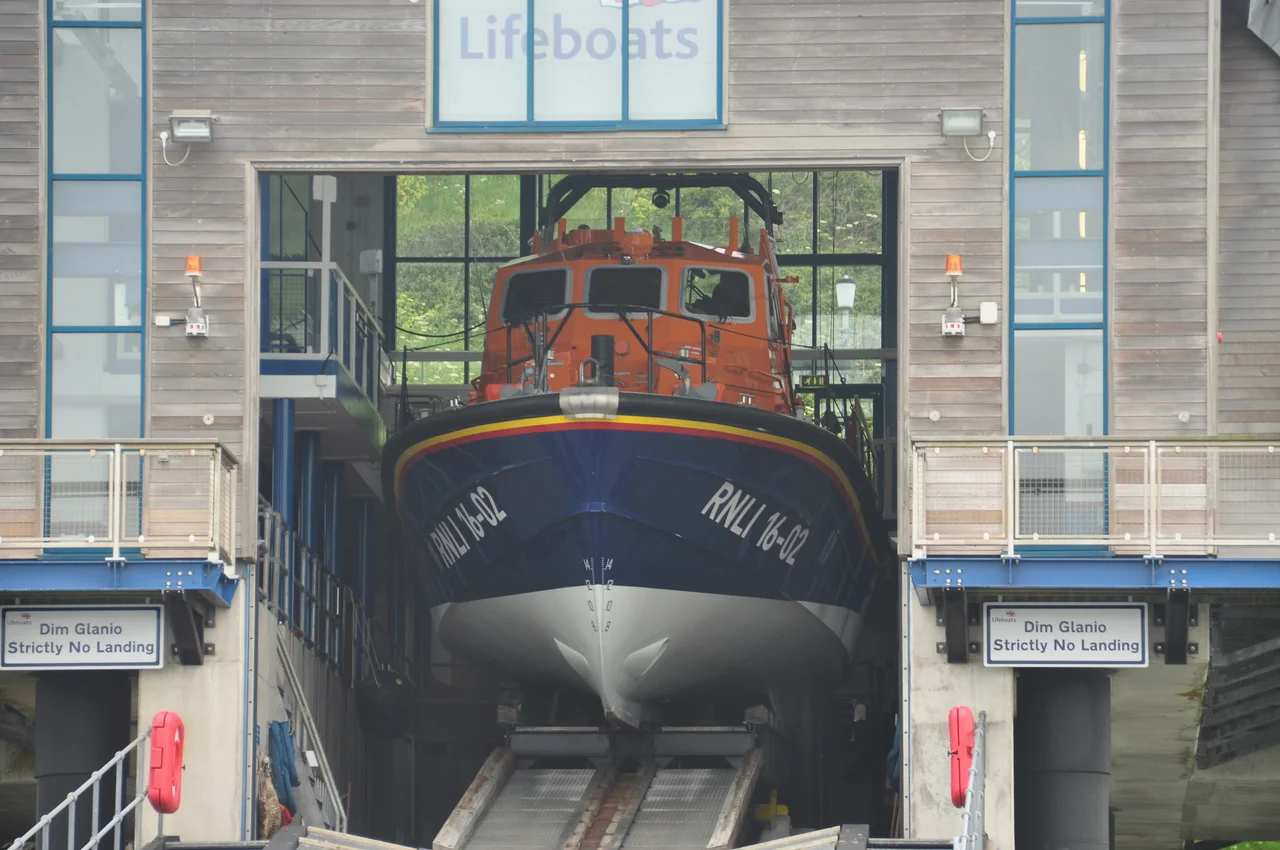
Haydn Miller was a Northamptonshire farmer who left three million pounds to the Royal National Lifeboat Institution in his will. He had no children. No one knows quite why he chose the RNLI; he farmed outside Kettering, far from any coast, and left no explanation. When the RNLI commissioned a new all-weather Tamar-class lifeboat for Tenby in 2006, they named it after him - and the people who launch it most weeks, year-round, do so with his name painted across the bow. The Tenby station has been pulling men and women out of the sea since 1852. The boats have changed; the work has not.
The Boatman and the Sloop
Before there was a lifeboat station, there was John Ray. On 22 October 1834, the boatman watched a man fall overboard from the sloop Mary in Tenby harbour and made more than a dozen attempts to reach him. The man drowned. Ray got back to shore. The Royal National Institution for the Preservation of Life from Shipwreck - the body that would become the RNLI twenty years later - awarded him their Silver Medal for gallantry, even though no one had been saved. Ray's name is still on the medals board inside the station. He was the start of a tradition that has, by careful count, awarded medals at Tenby on 22 separate occasions since.
Grace Darling and the Pivot
Tenby Lifeboat Station was founded in 1852 by the Shipwrecked Fishermen and Mariners' Royal Benevolent Society - a separate charity from the RNLI. The first boat, a 28-foot self-righting design by James Beeching of Great Yarmouth, cost £125 and was named Grace Darling after the Northumbrian lighthouse keeper's daughter who had become Britain's most famous lifesaver fourteen years earlier. The boat lived in a small boathouse tucked against the harbour wall, where the modern visitor can still see its outline. In December 1854, after two years of overlapping work, the SFMRBS and the RNLI agreed to divide their labour: the older charity would handle the welfare of survivors, the younger would handle boats and rescues. Tenby and seven other stations transferred across. Grace Darling went off to a London boatyard for modifications and came back to serve until 1863.
Castle Beach
The station moved to Castle Beach in 1862, where a new boathouse cost £190 and a new self-righting Pulling and Sailing lifeboat - sails and ten oars together - cost £260. The 1862 boathouse was demolished in 1894 and replaced on the same site with a limestone-and-ashlar boathouse designed by W. T. Douglas. The Great Western and South Wales railway companies brought each new lifeboat to Ferryside free of charge, as a public service. The medals kept coming. Lieutenant Richard Jesse won a Silver Medal in 1856. Chief Boatman Robert Parrott won one in 1856 and added a Second Service Clasp in 1859. The names accumulate down the years - Monger, Cottam, Thomas, Wilson, Crockford, Richards - the same Pembrokeshire surnames threading through five generations of crew.
The Farmer's Bequest
When the Haydn Miller arrived in March 2006, the crew were still training. The boat made its first successful rescue in April. Channel 4's Grand Designs filmed the next chapter: planning permission to demolish the old Grade II-listed station was refused, so the building was carefully converted to a private home and the work was finished in 2011. Then, in 2022, the RNLI bought the 1894 boathouse back - or at least the use of it. The Grade II-listed Victorian station on Castle Beach was refurbished, partly funded by the legacy of Dr and Mrs Geoffrey Wood-Smith in memory of their daughter Patricia, and reopened on 8 October 2022 as the inshore lifeboat house. The new inshore boat, a D-class named Kathleen Ann after donor Kathleen Ann Pearson, had already saved the lives of two fishermen by the time it was officially named.
Explore Station
The RNLI categorises Tenby as an 'Explore' station - their highest visitor-access rating. When the boats are home, the doors are open. Children can sit in the cox seat of the Haydn Miller. The shop sells RNLI keyrings and a small book listing every medal awarded at the station since 1835. Stand on the slipway at low tide and you can see the limestone bedding of Castle Beach beneath your feet - the same rock the Victorian station's foundations are anchored into. Stand at high water in a southwesterly gale, and you see why the place exists. The Atlantic comes hard at this corner of Wales. Someone is always out there. Someone always needs to go.
From the Air
Located at 51.6731 N, 4.6939 W on Castle Beach, Tenby, just below Castle Hill. Recommended viewing altitude 2,000-3,000 feet. The all-weather lifeboat station is the modern building with the long slipway angling down into the bay; the inshore boathouse is the older limestone structure on the same beach. Nearby airports: EGFP Pembrey (16 nm east) and EGFH Swansea (28 nm east). The medieval town walls and St Catherine's Island Napoleonic fort are visible immediately to the southeast.
Nearby Stories
- Gower Peninsula 0.2 km away
- St Davids Lifeboat Station 3.6 km away
- Dryslwyn Castle 8.1 km away
- Action of 17 November 1917 8.4 km away
- 102.5 Radio Pembrokeshire 9.6 km away
- Ilfracombe Lifeboat Station 15 km away
- Lighthouses on Lundy 19 km away
- Tehidy Country Park 121 km away