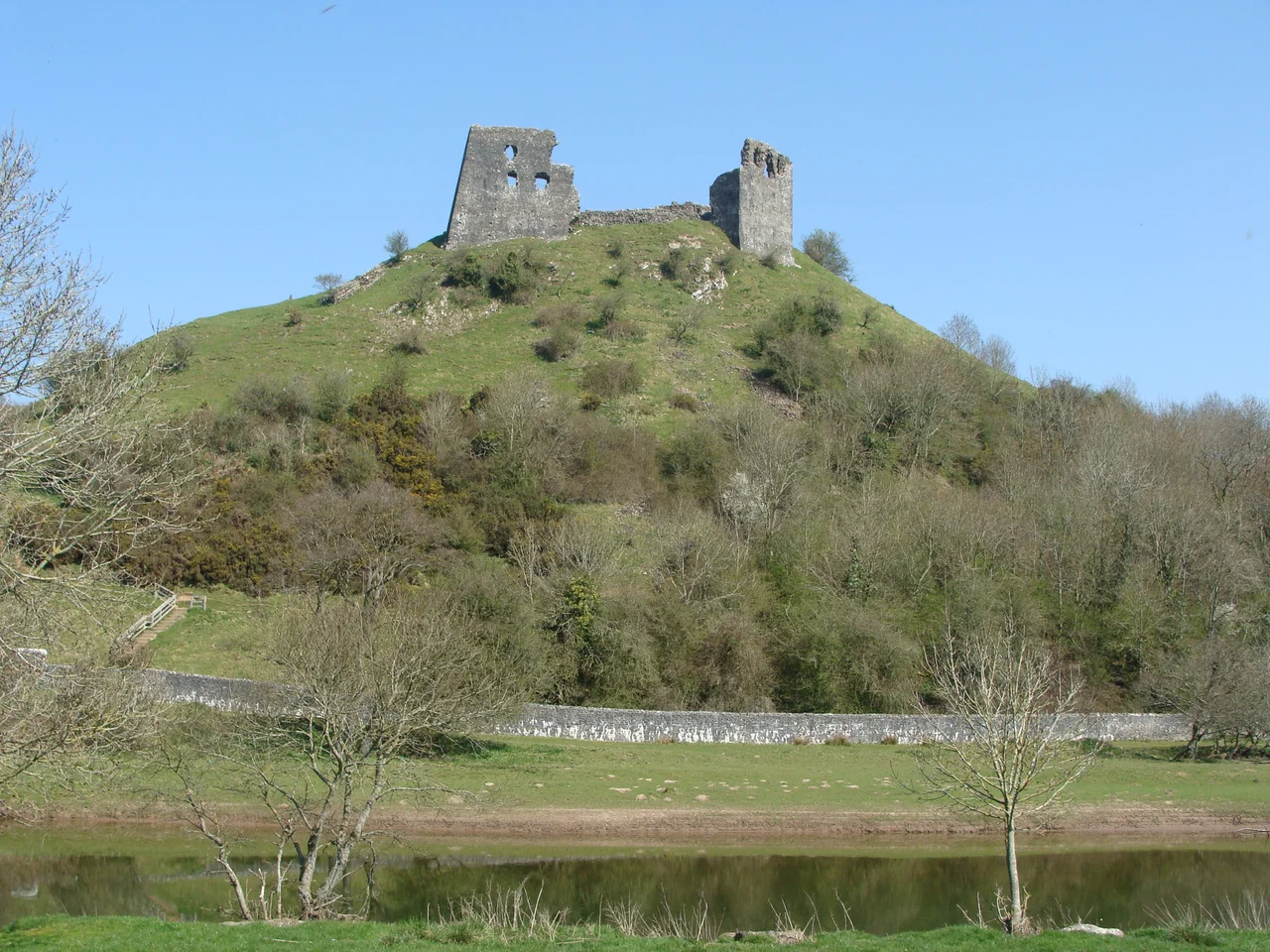

Dryslwyn Castle
Eleven thousand English soldiers stood at the foot of the rock in 1287, and the man on top still believed he could hold them. Rhys ap Maredudd had spent years strengthening the walls of Dryslwyn, augmenting what his ancestors built, making peace where other Welsh lords made war. He had been the cooperative one, the lord Edward I let keep his castle. Then he rose up anyway, and the king of England sent an army to remind him why submission had been the wiser choice. The trebuchet went up. The mines went down beneath the curtain walls. Three weeks later, the rocky hill above the Tywi Valley belonged to England.
A Prince's Inheritance
Lord Rhys ap Gruffydd held the kingdom of Deheubarth together through the late twelfth century, and on his death in 1197, his three sons promptly tore it apart. Welsh kingdoms could die of love as easily as war, divided again and again as fathers parcelled out land among contesting heirs. The vacuum drew in neighbours and English alike, and somewhere in the chaos of the 1220s, one of the surviving princes - probably Rhys Gryg - chose this isolated outcrop above the Tywi Valley and built. The castle that rose here was not English in design but native Welsh: a round tower with a flared base, an enclosing ward, a curtain wall hugging the contour of the hilltop. From the summit, a watchman could see for miles in every direction. The river curled beneath, slow and silver, and the valley opened wide enough to spot any army long before it arrived.
Two Castles, Two Sons
Rhys Gryg died in 1234, and the family theory holds that he had built two castles for two heirs - Dryslwyn here, and Dinefwr a few miles east. The pair are uncannily similar: same round tower, same flared base, same curtain wall flowing with the land. They guarded the heart of Deheubarth like matched siblings, each holding its hilltop, each watching the river road that connected them. For decades, this strip of the Tywi Valley remained one of the last redoubts of Welsh stone-castle ownership. An ancient chronicle records a siege at Dryslwyn in 1246, led by the Seneschal of Carmarthen on behalf of some unnamed rightful owner. The chronicle does not say who won. The castle changed hands in the way Welsh castles did, by argument and arms and inheritance, and through the late thirteenth century, the walls kept rising. New towers, thicker defences, a great hall, a kitchen, and along the wall a small structure that may have been a prison.
The Three-Week Siege
Dafydd ap Gruffudd, the last native prince of Wales, was executed in 1283, and the country he ruled vanished into the realm of Edward I. Almost every Welsh lord lost his castle. Rhys ap Maredudd kept his, because Rhys ap Maredudd had been conciliatory, accommodating, useful to the English Crown. Then in 1287, for reasons that history records but never quite explains, he revolted. Edward responded with overwhelming force. Eleven thousand troops marched on this rocky hill - more men than lived in any Welsh town - hauling a trebuchet and the engineering of late medieval siegecraft. The trebuchet hammered the walls from above. Below, English sappers tunnelled beneath the curtain, undermining the foundations. The work was deadly to both sides: at one point a mine collapsed while several English knights were inspecting it, burying them alive in the workings they had dug. Three weeks the siege lasted. Then the walls came down, the gate opened, and the castle fell.
What the Stones Remember
Rhys ap Maredudd escaped. His revolt sputtered out the following year, and captured in 1291 and executed in 1292. Dryslwyn remained in English hands but mattered less and less. The political centre of Welsh power had moved elsewhere, into the ring of Edward's massive new castles on the northern coast - Caernarfon, Conwy, Harlech, Beaumaris - and old hill-forts like this one fell out of strategic relevance. The garrison shrank, the walls weathered, the great hall went quiet. Today the ruins crown the hill the same way they have for nearly eight centuries, Grade I listed, free to visit, weather-worn and roofless. The shape of the round tower is still legible against the sky. So is the curtain wall, contouring the hilltop as it always did, and the soft scar in the ground where English miners burrowed under the Welsh defences and killed themselves doing it. From the summit, the Tywi Valley opens to the south and east, the river bending past as it has since long before stone was laid here. Cattle graze where besiegers camped. The view does the rest.
A Rare Survivor
Most of the castles Welsh princes built were demolished, replaced by English fortresses, or left to dissolve into the landscape. Dryslwyn is one of the few that survived in recognizable form. It is, by current reckoning, one of the most important remaining stone structures built by a Welsh chieftain. The neighbouring Dinefwr Castle, its presumed sibling, also stands. Together they form a kind of stone testament to the kingdom of Deheubarth - to the era when Welsh law, Welsh language, and Welsh princes still organised the politics of this corner of the world. They lost. The siege engines and the mines and the eleven thousand soldiers carried the day. But the hills remember whose hands shaped the stone first.
From the Air
Located at 51.86°N, 4.10°W, on a steep isolated hill above the Tywi Valley between Llandeilo and Carmarthen. The castle ruins crown a 200-foot rocky outcrop visible from above the meandering river, with the matching Dinefwr Castle a few miles east. Nearest airport is Cardiff (EGFF) about 50 miles southeast; Swansea (EGFH) is closer at roughly 25 miles south. Best viewed from the south or east at 2,000-3,000 feet AGL with the green Tywi Valley framing the ruin.
Nearby Stories
- Preseli Transmitting Station 6.2 km away
- Brecon Cathedral 8.5 km away
- Tenby Lifeboat Station 8.6 km away
- Swansea Castle 9.6 km away
- Cymmer Colliery Explosion 11 km away
- HMS Whirlwind (R87) 11 km away
- Llanerchaeron 13 km away
- Cwmhir Abbey 16 km away