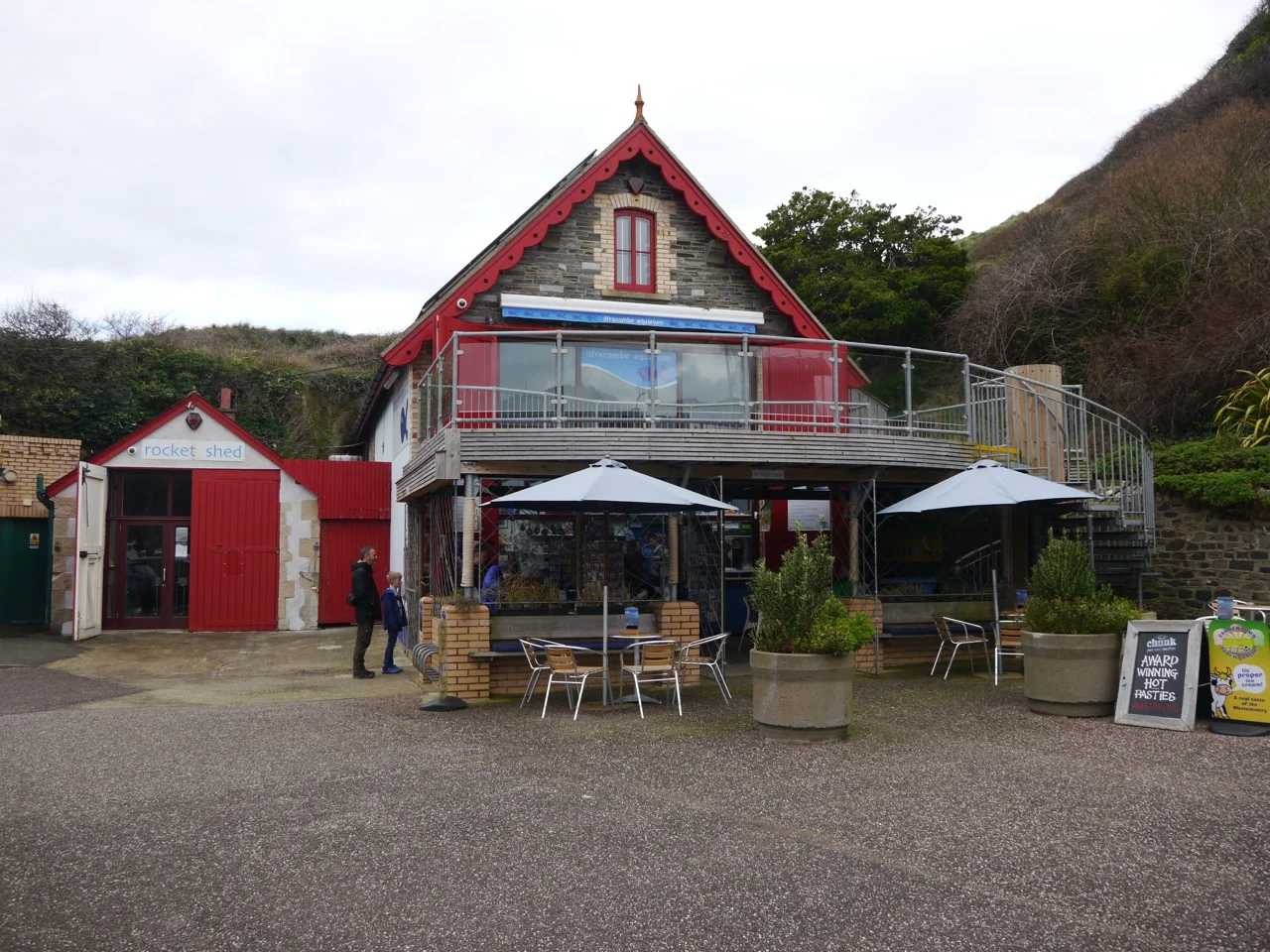

Ilfracombe Lifeboat Station
On 13 November 1949 the Spanish freighter SS Monte Gurugu lost her rudder in a severe storm off Morte Point. The Ilfracombe lifeboat Richard Silver Oliver launched into the gale, hauled the disabled ship clear of the shore, and took all twenty-three crew aboard before bringing them back to Ilfracombe. Coxswain Cecil Irwin received the RNLI silver medal. The Spanish government sent its own award. Two hundred years of similar work, much of it quieter, has happened on this coast since 1828.
From pilot boat to RNLI
Ilfracombe got its first lifeboat in 1828, a pilot boat fitted out for rescue work, before the modern RNLI existed in its current form. In 1850 local people bought a new lifeboat themselves and operated it from a boathouse in Hiern's Lane near the harbour. The RNLI's official service in the town began in 1866 when it built a proper boathouse near the pier at the bottom of Lantern Hill, with a slipway alongside. Alterations to the pier in 1871 destroyed the slipway, and the lifeboat then had to be hauled along the road to the harbour every time it was launched. By 1893 the original boathouse was outgrown; it came down to make room for a larger building suited to the new Co-operator No. 2, which at 37 feet was three feet longer than the previous boat. That replacement served until 1996, when the present station was built near the slipway.
Three boats, one name
In 1892 the RNLI received a legacy from the late Rev. Theophilus Sidney Echalaz of Surbiton, Surrey, which paid for three new lifeboats. In a quirk that still confuses RNLI historians, all three boats were given the same name: Theophilus Sidney Echalaz. One went to Morte Bay near Woolacombe, the Ilfracombe outpost about six miles southwest. The others went elsewhere. The Morte Bay station had been established in 1871 to cover the western side of Morte Point, with crew rowed across from Ilfracombe on a carriage when a launch was needed west of the headland. It proved a hard place to work. Strong westerly winds blew straight onto the west-facing beach, making launches treacherous. In May 1900 the station closed. The lifeboat moved up the coast to Watchet. The boathouse stayed where it was and has been incorporated into what is now the Boat House Cafe, where visitors order tea on a foundation built for rescue.
Volunteers who do not expect thanks
The RNLI is a volunteer service. Its records note carefully that crews 'do not expect reward or recognition for their work,' which makes the long list of letters, certificates, and medals more, not less, meaningful. The 1949 silver medal to Cecil Irwin sits in that tradition. So does the cumulative weight of decades of routine launches, the ones that did not require gale-force winds and disabled freighters, where a pleasure boat lost engine power, or a swimmer was carried out by the tide, or someone needed to be checked on after a flare was sighted. Most rescues end with a tow, a thanks, and a quiet return to harbour. The medal cases catch the dramatic moments. The station's true history is the unremarkable launches in between.
The boats at Ilfracombe today
Two lifeboats currently operate from the harbour. The all-weather lifeboat is the Shannon-class 13-09 The Barry and Peggy High Foundation, ON 1316, in service since 2015. Her predecessor was the Mersey-class Spirit of Derbyshire, on station from 1990 to 2015. The inshore lifeboat is the D-class Deborah Brown III, D-863. The all-weather boat is built for the Bristol Channel's tide rips and the long Atlantic swells that wrap around Morte Point. The inshore boat handles the close-in work: swimmers cut off by the tide, cliffside casualties, the dozens of small emergencies that a busy seaside town in summer can produce. Together they cover a coastline whose rock features have names like Hangman, Damage Hue, and Wild Pear Beach, and where the cliffs run higher than 250 metres just east of Combe Martin.
Why the station matters
The North Devon coast is one of the most beautiful in England and one of the most dangerous. Cliffs run to 318 metres at Great Hangman, the highest sea cliff on mainland Britain. The Bristol Channel funnels Atlantic weather into a tide range that exceeds nine metres on spring tides. Walkers misjudge tides. Sailors misjudge headlands. The South West Coast Path passes through Ilfracombe and continues along Exmoor's coast, attracting visitors who do not always understand what the sea here can do. Ilfracombe Lifeboat Station exists because that gap between scenery and risk has to be covered by someone, and volunteer crews have been covering it since 1828. The boathouse in Morte Bay sells coffee now. The work continues out of the harbour.
From the Air
Ilfracombe Lifeboat Station sits at 51.2100N, 4.1162W in Ilfracombe harbour on the North Devon coast. The harbour and pier are visible from medium altitudes; Lantern Hill rises immediately east. Best viewed at 1,000 to 2,000 feet AGL when the harbour mouth and the rocky cliffs east toward Hele Bay come into view. RAF Chivenor (EGDC) lies 10 nm south. Exeter Airport (EGTE) is 35 nm southeast. Watch for low cloud forming against the Exmoor escarpment to the east, especially with southwesterly flow.
Nearby Stories
- Minehead Lifeboat Station 4 km away
- Tiverton Castle 8 km away
- Mumbles Pier 8.5 km away
- Royal Mint 11 km away
- Lundy 11 km away
- Caldey Abbey 17 km away
- Okehampton Castle 28 km away
- 2004 Boscastle Flood 33 km away