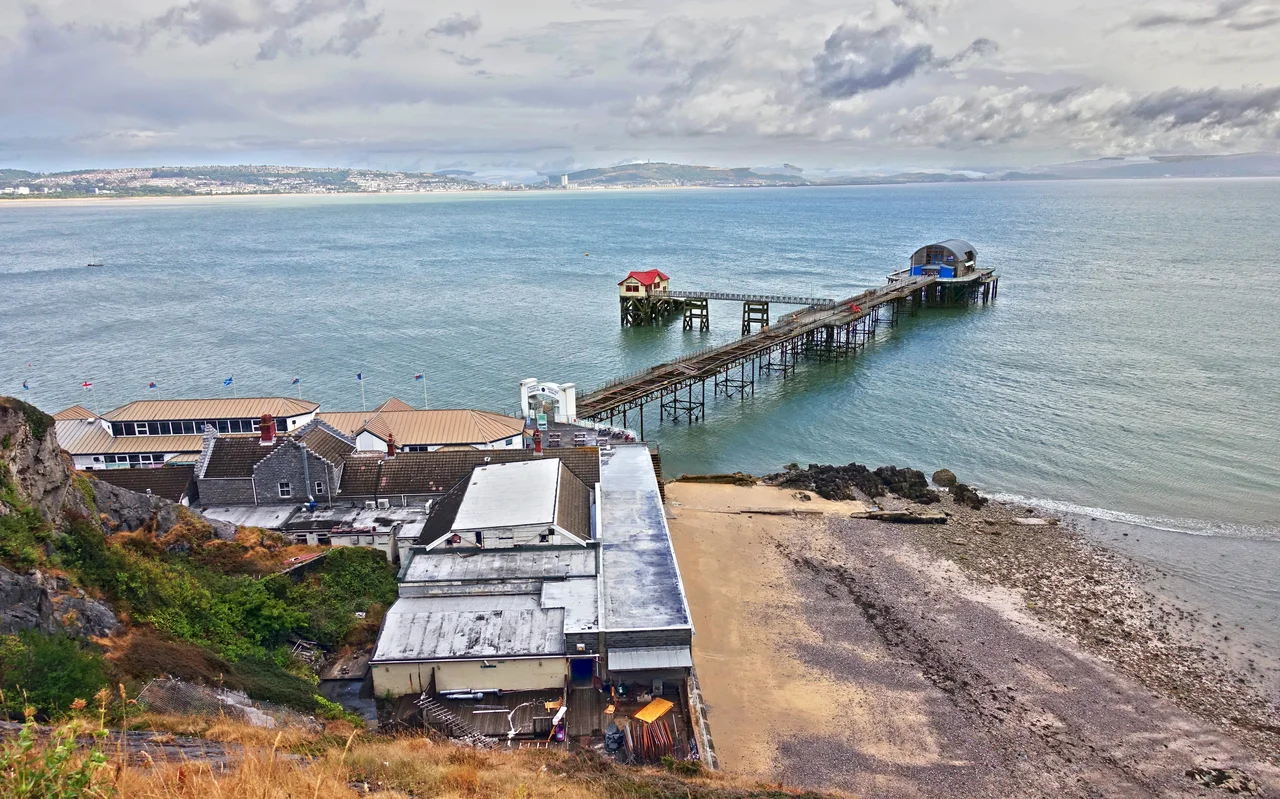

Mumbles Pier
On 10 May 1898 a pier opened at the south-western corner of Swansea Bay, 835 feet of cast-iron lattice and timber decking stretching out toward the Bristol Channel. It cost £10,000 to build and was promoted by the man behind the local railway, John Jones Jenkins of the Rhondda and Swansea Bay Railway. The pier had a job to do. It was the western terminus of the Swansea and Mumbles Railway, the first passenger-carrying railway anywhere in the world, and it also served as a landing for the White Funnel paddle steamers that brought day-trippers across the channel from Bristol and along the Severn. More than 125 years later the pier is still here, the steamers are not, and the railway closed in 1960. The lifeboats kept going.
The White Coons and the Variety Decades
In the summer of 1899, just over a year after the pier opened, a man called Will C. Pepper founded a concert party here called the White Coons. The name is jarring to read now. It was standard music-hall language of the period, and the troupe performed in blackface as part of the minstrelsy tradition that ran through British seaside entertainment for half a century before anyone questioned it. Pepper's sons Harry and Dick went on to become musicians of some reputation, but the White Coons themselves were one of dozens of similar acts working the country's piers. The Amusement Equipment Company took over operations in 1937, requisitioned the pier through World War II, and then bought it outright in 1957, when concert parties were quietly being replaced by slot machines and ice cream booths. By the 1960s the pier was an arcade, and the variety era was over.
The Arcade Cabinets
If you wandered into the Mumbles Pier amusement arcade in the 1990s you would have found a small archaeology of video gaming. A six-slot Neo Geo MVS cabinet rotating through Blue's Journey, Cyber-Lip, Ghost Pilots, Ninja Combat, League Bowling, and Eight Man. Super Street Fighter II in a deluxe cabinet next to Super Street Fighter II Turbo. Tekken 2 from 1995. A Wonder Boy machine that had been there since 1986. A Street Fighter II pinball table. The pier was never glamorous, but it preserved a stratum of arcade history that has mostly vanished from British seaside towns, where slot machines have edged out the cabinets that once defined them. Some of those games are still there.
The Lifeboat at the End
At the seaward end of the pier sits the Mumbles Lifeboat Station, completed during a major renovation in 2012 along with new fishing platforms. The station houses a Tamar-class lifeboat, one of the larger all-weather boats in the RNLI fleet, capable of pushing out into the Bristol Channel in conditions that would keep most boats in harbour. The old lifeboat station building still stands on the north side of the pier, connected by a walkway, and plans were announced in 2019 to convert it into a visitor centre and restaurant. The Mumbles station has launched lifeboats from this stretch of coast since 1866. It is one of the most decorated stations in the RNLI's history and one of the most marked by loss; the village remembers crews that never came home.
Decay, Refit, and Fire
Piers are difficult buildings to keep alive. Salt water rots steel, storms snap pilings, and maintenance costs always exceed what visitors will pay to walk a deck. AMECO spent £25,000 to £30,000 a year on steelwork through the late 1970s and early 1980s. The pier closed in October 1987 for a £40,000 refit and reopened on Good Friday 1988. By the early 21st century large sections were fenced off again, awaiting another round of repair. In August 2022 a fire destroyed both the fish restaurant and the nightclub at the base of the pier. The pier itself survived. The buildings at the landward end were a loss; the cast-iron structure walking out into the bay kept its quiet integrity, with the lifeboat station still operational at its tip.
From the Air
Mumbles Pier extends from 51.5697 N, 3.98028 W at the south-western corner of Swansea Bay, just east of the village of Mumbles and Mumbles Head. The pier points roughly south-east into the bay. Approaching from the east along the Bristol Channel you'll cross Port Talbot's industrial works, then the sweep of Swansea Bay, then the small village of Mumbles with the lighthouse on Mumbles Head and the pier just to its north. Swansea Airport (EGFH) is 4 nautical miles west-northwest on Fairwood Common. Cardiff (EGFF) is 28 nautical miles east. Recommended viewing altitude is 1,500 to 3,000 feet to take in the bay, the village, and the pier together.
Nearby Stories
- Dinefwr Castle 2.9 km away
- Cymmer Colliery Explosion 7.7 km away
- Brecon Beacons National Park 8.5 km away
- Caldey Abbey 9.4 km away
- Preseli Transmitting Station 12 km away
- Minehead Lifeboat Station 13 km away
- Ilfracombe Lifeboat Station 14 km away
- Lundy 19 km away