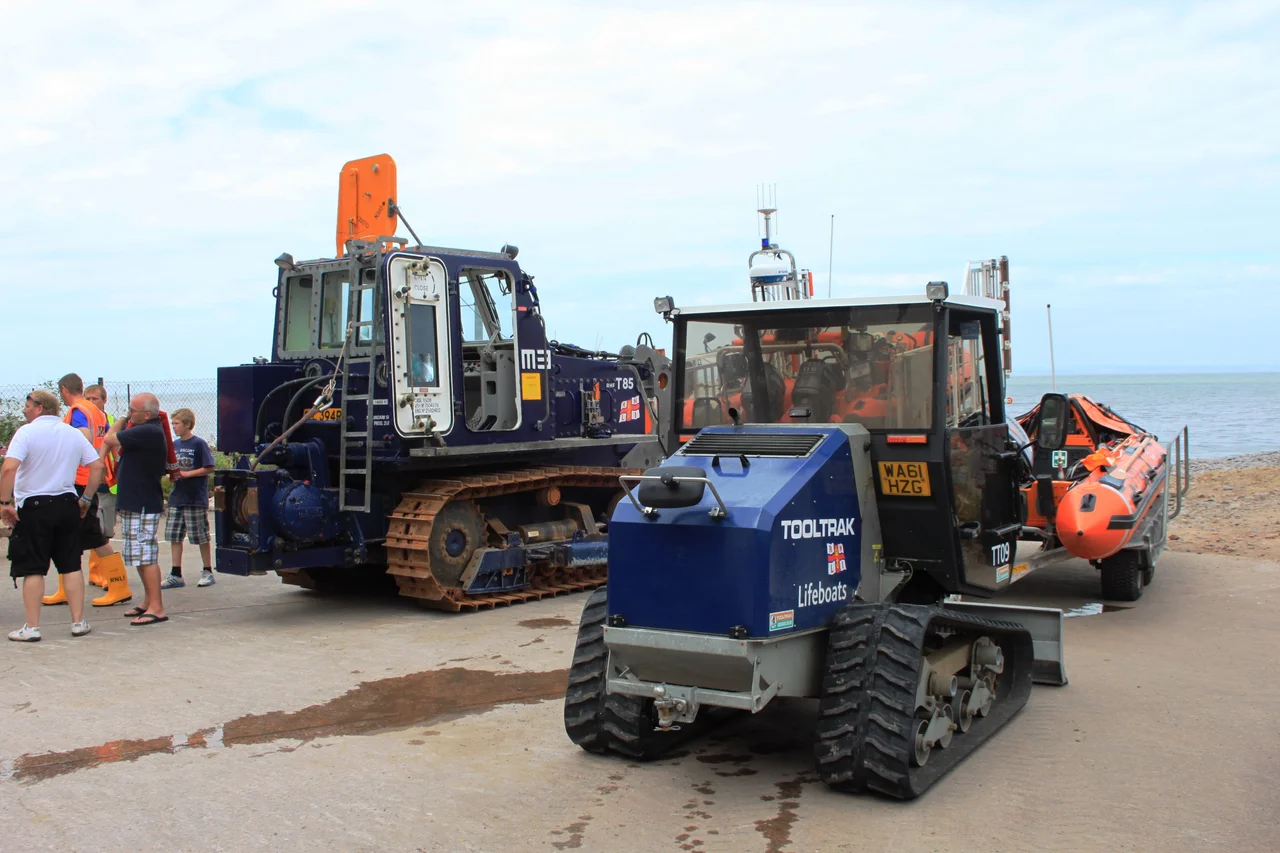

Minehead Lifeboat Station
On the evening of 19 December 1941, a partially submerged object was spotted drifting in Blue Anchor Bay east of Minehead. The Minehead lifeboat coxswain, John Slade, took his own private boat out with his cousin and the station's signaller, Thomas Escott, to investigate. They never came back. The object was a German magnetic parachute mine, dropped from an aircraft and lying just under the surface, and when their boat touched it the explosion was complete. Two men of the same family were killed in a single moment, doing the same thing that crews at this station have been doing for over a hundred and twenty years: getting into a boat and going out into the Bristol Channel to see if anyone needs help.
The 1901 Boathouse
The Royal National Lifeboat Institution built the original Minehead boathouse in 1901 for £785, at the western end of the town beyond the harbour where the beach gives access to the sea at any state of the tide. For the first two years the boat was dragged across the pebble beach on greased skids whenever a launch was needed; from 1903 a wheeled carriage made things easier; in 1950 a tractor garage was added so the boat could be towed in and out by machine. The boathouse stands on a pebble shore at the eastern end of the Exmoor cliffs - a place where the tide retreats so far that the harbour at Minehead dries out completely twice a day and the lifeboat needs that hard-standing on the beach to be useful at low water.
The Bristol Channel
The Bristol Channel has the second-largest tidal range in the world. Spring tides at Minehead can exceed eleven metres - water dropping and rising more than the height of a three-storey house twice in twenty-four hours. The currents in such a channel are fierce, the visibility from sea level to shore is poor at low water, and the seas a south-westerly Atlantic gale can drive into the funnel of the channel are punishing. Minehead's modern Atlantic 85 inshore lifeboat - a rigid-hulled boat with twin outboards - can launch in winds up to Force 7, run at thirty-five knots for two and a half hours, and cover the gap between the next stations west (Ilfracombe) and east (Burnham-on-Sea). The smaller D-class inflatable handles closer-in work. When something heavier is needed, the all-weather boat must come from Ilfracombe or, in extremis, across the channel from Wales.
Slade and Escott
John Slade and Thomas Escott were not strictly on duty that December evening in 1941. There was no official call-out for a wartime mine; what they thought they were going to investigate was wreckage. Slade was the coxswain, the senior man on the crew. Escott was the shore signaller, the one whose job was to flash lamps and run messages between the boat and the beach. They were cousins - small towns make small families - and they took Slade's own boat, not the official lifeboat, because the report seemed routine. The mine that killed them had been dropped from a German aircraft and had failed to detonate when it hit the water; it was waiting to be touched. The RNLI granted allowances to the widows. Their names are listed among the volunteers commemorated by the Institution's records of those who died in service. Minehead's modern station has been launched many thousands of times since, but the 1941 deaths sit quietly behind everything that follows.
Volunteers, Still
In 1970, after seven decades of pulling, sailing and motor lifeboats, an inflatable inshore lifeboat was added at Minehead and kept in the tractor garage. It proved so useful that in 1973 the all-weather boat was withdrawn altogether; the station has been an inshore-only operation ever since. A second, larger ILB joined the next year, and the current station - extended for the 1993 boat and again with a gift shop on the west side - is preparing to expand again under a fundraising drive launched in 2021. The crew, then and now, are volunteers. They take pagers home and into pubs and to family dinners and to bed. When the alarm sounds they leave whatever they are doing and run down to the boathouse on the beach, and they go out into the channel because that is what the station exists to do. They have done it more than a thousand times. Sometimes they bring people home. Sometimes, as in 1941, they do not come home themselves.
From the Air
Minehead Lifeboat Station sits at 51.21 degrees north, 3.48 degrees west, on the western edge of Minehead town along the Bristol Channel coast in Somerset. From the air the boathouse is a small stone building at the eastern end of a long pebble beach below the cliffs of Exmoor. Cruising altitude 2,000-3,500 feet gives a clear view of the dramatic tidal flats - at low water the sea retreats hundreds of metres, exposing dark sand and rock. The Bristol Channel is the broad water beyond. Exeter International (EGTE) lies thirty-five nautical miles south; Bristol International (EGGD) about thirty-five nautical miles north-east. South-westerly Atlantic systems push weather hard up the funnel of the channel.
Nearby Stories
- Cheddar Gorge 5.7 km away
- Royal Mint 6.6 km away
- Montacute Castle 7 km away
- Coldharbour Mill Working Wool Museum 8.3 km away
- Tidal Lagoon Swansea Bay 10 km away
- Caerwent 12 km away
- Ilfracombe Lifeboat Station 18 km away
- Okehampton Castle 29 km away