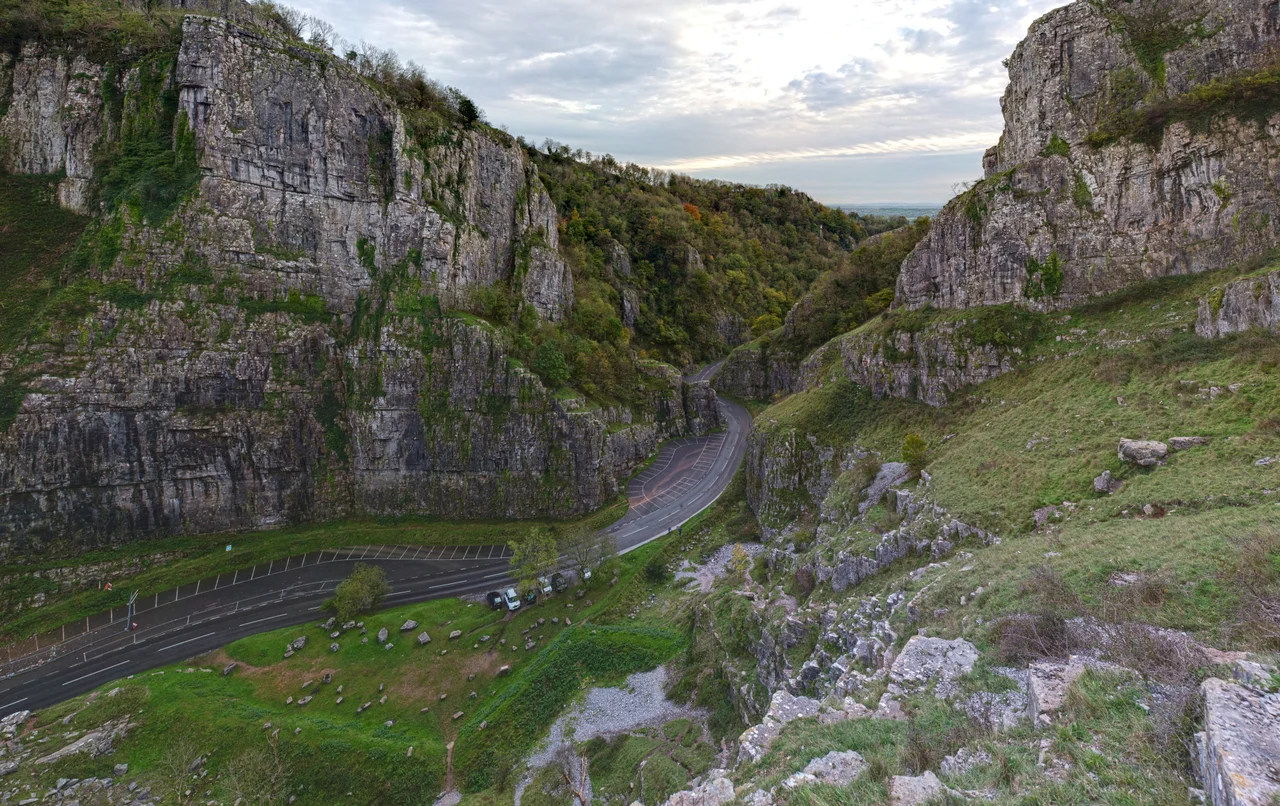

Cheddar Gorge
In 1903, a road crew widening a path into a cave at the head of Cheddar Gorge cracked open a passage that had been sealed for millennia. Inside they found a complete human skeleton, lying where someone had laid him down, still wearing fragments of his world. He was 9,000 years old. Cheddar Man, as he came to be known, is the oldest complete skeleton ever found in Britain - and when scientists at the Natural History Museum sequenced his DNA in 2018, they discovered something that startled the public: he had dark to black skin, dark curly hair, and pale blue eyes. The face of the first British family was not the face most British people had imagined.
How a Gorge Gets Made
Cheddar Gorge cuts 137 metres deep into the southern edge of the Mendip Hills, its walls rising in tiered limestone cliffs that drop almost vertically to the B3135 road below. The rock is Carboniferous Limestone, laid down on the bed of a warm tropical sea more than 300 million years ago, then folded and faulted by the Variscan orogeny when continents collided to assemble Pangaea. During the warm periods between ice ages, acidic groundwater dissolved the limestone from below, hollowing out the cave system that now drains the Cheddar Yeo river. During glacial periods, meltwater carved the surface gorge from above. Today the river runs underground for most of the gorge's length and only emerges, suddenly, at the entrance to Gough's Cave. The gorge above is dry. The drama is the height of the cliffs and the way the road threads between them.
Caves and Cheese
Two caves are open to the public, both on the Longleat estate's south side of the gorge: Gough's Cave, discovered by Richard Cox Gough in 1903, leading 400 metres into the cliff face and containing the chambers where Cheddar Man was found; and the smaller Cox's Cave, discovered by George Cox in 1837, now reimagined as a multimedia walk-through called Dreamhunters. Both were used in prehistoric times for maturing cheese - the caves hold a constant 11 degrees Celsius year-round and a steady humidity that is ideal for ripening. Cheddar cheese was named for the village at the gorge's foot, and small producers still mature wheels of it in the lower part of the gorge. J.R.R. Tolkien visited the caves on his honeymoon in nearby Clevedon in 1916 and named them years later as the inspiration for the Glittering Caves of Aglarond, the underground city behind Helm's Deep that Gimli founds after the War of the Ring.
The Cliffs and Their Climbers
The cliffs hold around 590 graded climbing routes on the south side and another 380 on the north. The Coronation Street route, named for the year it was first climbed - 1965, the year of the Tour of Britain stage race that ran up the gorge - was put up by Chris Bonington, who would go on to make the first British ascent of the southwest face of Everest. Climbers share the cliffs with adders, slowworms, dormice, yellow-necked mice, and feral Soay sheep that have lived in the gorge so long no one is quite sure when they arrived. The Longleat estate introduced goats in the 1970s to replace the grazing sheep, but the goats turned out to eat the Cheddar whitebeam - a tree that exists nowhere else on Earth - faster than the botanists could take cuttings. The Welsh National Herbarium now grows grafted whitebeams in case the goats finish the wild ones.
Voting and the Cable Car That Wasn't
In 2005 a poll of Radio Times readers ranked Cheddar Gorge the second-greatest natural wonder in Britain, beaten only by the Dan yr Ogof caves in South Wales. Five hundred thousand visitors come every year. In 2013 the visitor numbers at the show caves had dropped from a 1980s peak of 400,000 to about 150,000, and Ceawlin Thynn, Viscount Weymouth, who runs the Longleat estate, proposed a £10 million cable car to lift tourists 600 metres from the gorge floor to the clifftops above. The National Trust, which owns the north cliffs, opposed it as a 'fairground ride.' Planning permission and financing stalled. The cliffs remain unscarred by gondolas, and the clifftop walks - reached the hard way, by Jacob's Ladder's 274 steps - reward you with a 360-degree view from the watchtower at the top.
Standing in the Gorge
The B3135 runs the gorge's length with a maximum gradient of 16 percent, which is why the Tour of Britain has used it for hill-climb stages, and why cyclists treat it as a benchmark climb. Stand at the bottom on a summer morning and the cliffs lean inward, throwing the road into shadow until late morning. Feral goats pick their way along ledges thirty metres up. The Cheddar Yeo, having dropped through 90 metres of submerged chambers that British cave divers have spent eighty years exploring, comes out of Gough's Cave already moving fast. The longest dive into the system is 1,000 metres in from the entrance, and divers have reached depths of 90 metres before gravel chokes blocked the way. Most of the cave system, somewhere up there above the cheese, remains unmapped.
From the Air
Cheddar Gorge cuts north-south through the southern edge of the Mendip Hills at 51.282 degrees north, 2.765 degrees west, about 8 nm north of Wells. From the air it is a sharp linear gash in the limestone plateau, easily identifiable, with the village of Cheddar and its reservoir to the south. Maximum cliff height is 137 metres. Nearest airports: Bristol (EGGD), 12 nm north; Cardiff (EGFF), 25 nm northwest across the Severn. Best viewed from 3,000-5,000 feet AGL; lower altitudes reveal the cliff structure but obscure the gorge's full length.
Nearby Stories
- National Eisteddfod of Wales 4.9 km away
- Montacute House 6.1 km away
- Malmesbury Abbey 9 km away
- Quantock Hills 11 km away
- Severn Bridge 12 km away
- Coldharbour Mill Working Wool Museum 15 km away
- Stonehenge Cursus 21 km away
- Royal Naval Cordite Factory, Holton Heath 29 km away