.jpg)
Montacute House
Sir Edward Phelips needed a house that would announce what he had become. In 1598, when he commissioned the great Elizabethan mansion that still bears his family name at Montacute, he was a senior lawyer and Member of Parliament, soon to be knighted by James I, soon to be Speaker of the House of Commons, soon to be the prosecutor who would open the case against the Gunpowder Plotters in 1606. The honey-coloured Ham Hill limestone going up on his Somerset estate was meant to say all of that aloud, in stone, to anyone passing on the road below. It still does.
Architecture as Statement
The architect of Montacute is unknown, although the design is usually attributed to the mason William Arnold, who later worked on Cranborne Manor and Wadham College, Oxford. What is certain is that no expense was spared. The house was built on a roughly E-shaped plan, three storeys high, with paired stair towers tucked into the angles where the wings met the main range. The east front, originally the principal facade, faced an entrance court flanked by two ornamental pavilions with ogee-domed roofs and bordered by stone balustrading rather than fortified walls. The whole composition acknowledged the medieval tradition of the great house while leaving any defensive function behind. Renaissance gables sat above Gothic pinnacles. Italian niches between the second-floor windows held statues of the Nine Worthies dressed as Roman soldiers. The east facade became famous for the sheer extent of its mullioned windows, an innovation of the period, giving the upper storey something close to the appearance of a wall of glass.
The Phelips Century
Sir Edward Phelips died in 1614. His son Sir Robert Phelips succeeded him and continued the family's political tradition, eventually being arrested at Montacute and imprisoned in the Tower of London for opposing the proposed Spanish Match between the future Charles I and a Spanish Catholic princess. After Robert, the family's national prominence faded into the comfortable lives of West Country gentry. They represented Somerset in Parliament, served in the army and the church, and lived quietly on their estate for two centuries. That stable life ended with William Phelips, who inherited in the early nineteenth century. He started well, making improvements to the house and converting the Great Chamber into a library. He ended badly. A compulsive gambler, he was eventually declared incapable and confined for his own safety, by which time he had gambled away most of the family fortune and large tracts of the estate. His son William, who took control in 1875, found himself trying to maintain a Grade I house on collapsing rents.
Curzon and the White Elephant
The end came in 1911, when the Phelips family was forced to let the house for £650 a year and move out. They never returned. By 1915 it had been let to George Curzon, 1st Marquess Curzon of Kedleston, the former Viceroy of India, who lived there with his mistress, the novelist Elinor Glyn. Curzon's eccentric improvements included plumbing a bath into a wardrobe in the Garden Chamber. He also amalgamated the Tudor pantry and buttery to create the formal dining room the house had lacked since the seventeenth century. After Curzon's death the house drifted through tenants until in 1929, at a moment when many English country houses were being demolished for their materials, Montacute was put up for sale at a scrap value of £5,882. The contents were dispersed. The house sat empty on the market for two years. In 1931 the philanthropist Ernest Cook bought it and presented it to the Society for the Protection of Ancient Buildings, which transferred it to the National Trust. James Lees-Milne, the Trust's then country house secretary, famously described it as 'an empty and rather embarrassing white elephant.'
England's Longest Long Gallery
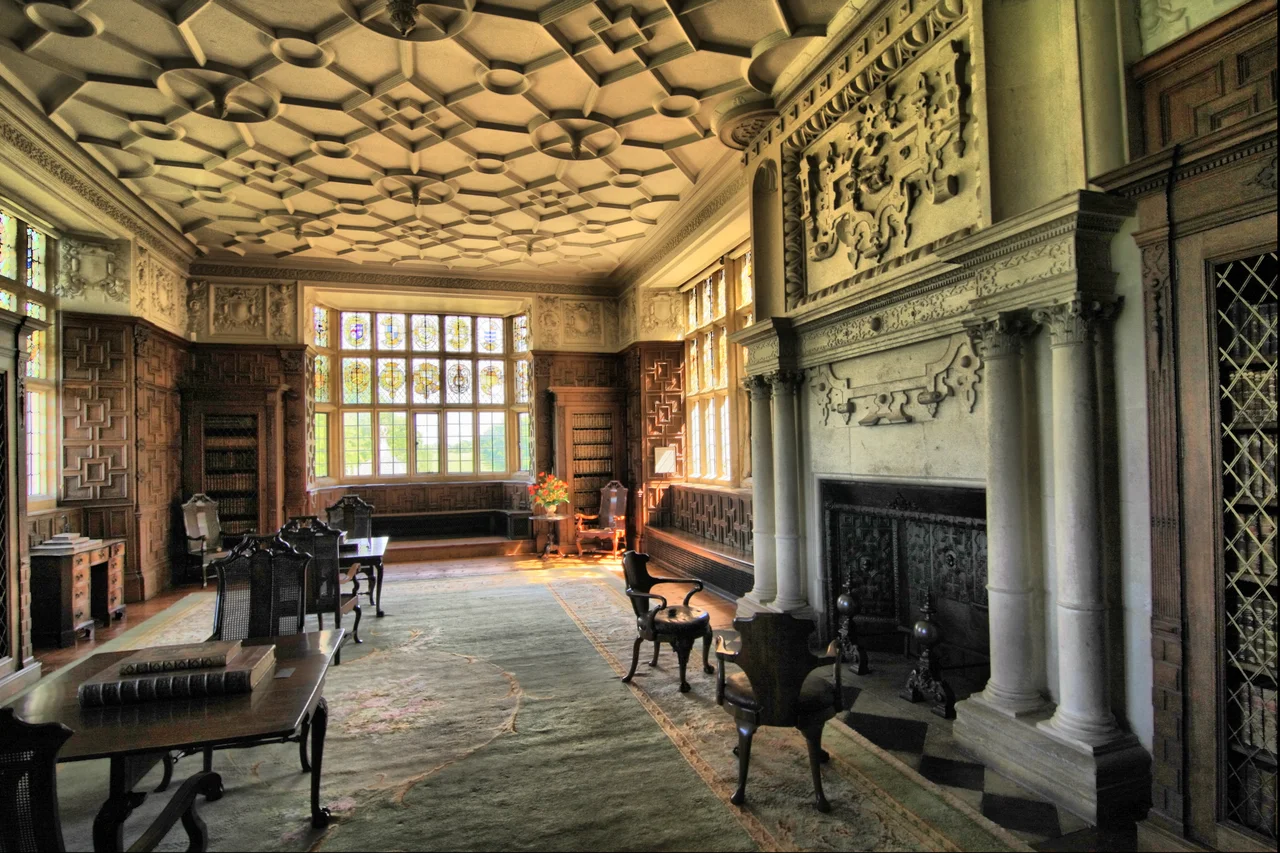
The most remarkable space inside Montacute is the Long Gallery on the top floor, 172 feet from end to end, the longest surviving Elizabethan long gallery in England. A continuous wall of glass runs the full length of its eastern side, and oriel windows project from each end so improbably that from outside they seem to cling to the masonry by nothing more than a small corbel. Long galleries served all kinds of purposes in great Elizabethan houses: a place to walk in bad weather, to exhibit pictures, to perform music, to display family wealth to visitors. The Phelips children, it was said, would ride their ponies up the stairs and along its length. Since 1975, by an arrangement that married an empty antique space with a collection too large for its London home, the Long Gallery has served as an outpost of the National Portrait Gallery, hung with historical portraits from the reigns of Henry VIII through Charles I.
Filmed, Restored, Reopened
Montacute is a star of the British heritage industry. The 1995 film of Jane Austen's Sense and Sensibility used it as a setting, as did the 2004 film The Libertine. A Canadian television Hound of the Baskervilles cast it as Baskerville Hall. In 2014 the BBC filmed scenes for its adaptation of Hilary Mantel's Wolf Hall in its rooms. And in 2012 the Wallace and Gromit short A Jubilee Bunt-A-Thon, made to celebrate the National Trust, was set in a house obviously modelled on Montacute, just as the fictional Tottington Hall in The Curse of the Were-Rabbit had been before it. The house was Grade I listed in 1961 and the gardens were added to the Register of Historic Parks and Gardens at the same grade in 1984. The mixed borders that the gardener Phyllis Reiss replanted in the East Court, after Vita Sackville-West's earlier scheme proved 'insipid to modern taste,' still burn with hot Edwardian colour. The 121 hectares of original parkland have largely gone, but the framework of the Elizabethan setting survives. In 2019-2020 over 183,000 people came to see it.
From the Air
Located at 50.952°N, 2.714°W in southern Somerset, four miles west of Yeovil. The honey-coloured Ham Hill limestone mansion sits on a slight rise with extensive gardens visible from above; the Long Gallery runs the full length of the upper floor. Best viewed from 1,500-2,500 feet. The nearby St. Michael's Hill (site of the medieval Montacute Castle) is a striking conical landmark just to the west. Nearest airfields: RNAS Yeovilton (EGDY) 5 nm north, Henstridge (EGHS) 9 nm east, Bristol Airport (EGGD) 27 nm north-north-west.
Nearby Stories
- Chapman's Pool Lifeboat Station 5 km away
- Glastonbury Cemetery 5.3 km away
- Watchet 12 km away
- Coldharbour Mill Working Wool Museum 12 km away
- Weymouth 13 km away
- Wardour Castle 17 km away
- Stonehenge Landscape 20 km away
- South Devon Railway sea wall 22 km away