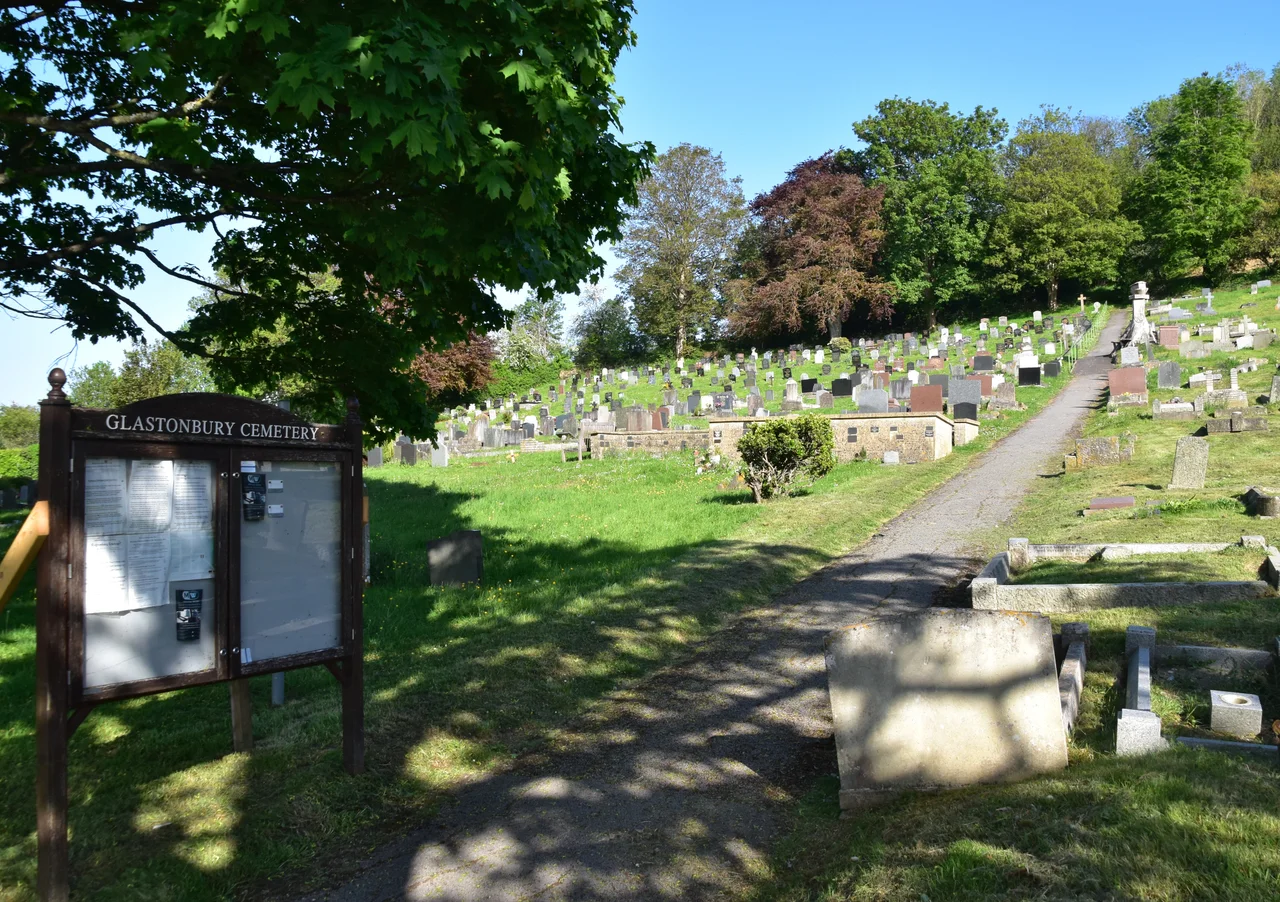

Glastonbury Cemetery
In October 1853, the vestry of Glastonbury sat down to a problem any thriving Victorian town would have recognised: where to put the dead. The churchyards at St John's and St Benedict's were nearly full. The population was growing. A burial board was formed, sites were considered - Fisher's Hill, Wearyall Hill, the fields north of St John's - and on 3 August 1854 the board settled on Edmund Hill, a slope on the edge of town named for the Saxon king who was crowned at Glastonbury Abbey in 1016. There was, the minutes recorded, 'some regret that a suitable site closer to the town could not have been found.' The cemetery on Edmund Hill opened the following spring, and the first grave was dug on 2 April 1855.
Charles Edmund Giles, of Taunton
The architect was Charles Edmund Giles, a Taunton man who specialised in the kind of solid Gothic Revival ecclesiastical work that Victorian England produced by the thousand. He designed three buildings for the site: a lodge by the entrance gateway, and two mortuary chapels - one for the Church of England, one for nonconformist Protestants. The two-chapel arrangement was standard in Victorian municipal cemeteries, where the Anglican and dissenting communities had to be served but kept separate. Each chapel had its own ceremony rooms; the two were paired but not interconnected. The Church of England section of the cemetery was consecrated on 8 August 1856 by Bishop Robert Eden of Bath and Wells. The nonconformist side never required consecration - that was rather the point - and dissenters were buried there from the start. Construction began in late 1854 and finished by 1855.
Running Out of Room
By 1899 the consecrated section was nearly full. A March 1900 report counted 26 consecrated and 203 unconsecrated spaces remaining - which says something about the burial preferences of late Victorian Glastonbury. A vestry meeting in September 1899 voted to buy three acres of adjoining land on the north side. The purchase cost £500; another £450 went to fencing, planting, and laying out paths. The work was contracted in October 1901 and the new Church of England section was consecrated on 9 May 1902 by Assistant Bishop Stirling, deputising for Bishop George Kennion of Bath and Wells, who was too ill to attend. A second extension came in 1999, when the Glastonbury and Sharpham Burial Joint Committee bought more land above the existing cemetery from Mendip District Council - enough plot space, the planners estimated, for another fifty years. Since 2005 part of the new ground has been the Edmund Hill Green Burial Site, where bodies are buried without embalming or impermeable coffins, returning to the soil through wildflower meadow.
Two Chapels, Twice Nearly Lost
By the mid-twentieth century the mortuary chapels had fallen out of use. The Church of England chapel saw occasional services; the nonconformist chapel was being used as a storeroom. Repair estimates were prohibitive. In February 1977 the town council voted to demolish both. Local resistance came swiftly. Glastonbury's mayor Hugh Barker and the Council for the Protection of Rural England pressured Mendip District Council to place a six-month preservation order on the buildings while listing applications were filed. On 2 August 1977 the chapels and the lodge became Grade II listed. The Burial Joint Committee still wanted them gone and applied for listed building consent to demolish; the Ancient Monuments Society, the Victorian Society, and the CPRE all opposed the application, and the District Council refused it in September 1977, ruling demolition would 'remove important visual elements from the cemetery to the serious detriment of its social, artistic and architectural character.' A second demolition application in 1986 was also refused. Eventually the committee accepted that the chapels were not going to be torn down and that they would have to be repaired. Builder Rowley Bisgrove from nearby Baltonsborough fixed the Anglican chapel between 1990 and 1992 for £21,500. The nonconformist chapel got its £41,000 restoration in 1994, funded by grants from the District and Town Councils.
Dion Fortune Among the Yews
Among the burials at Glastonbury Cemetery is Dion Fortune - born Violet Mary Firth in Llandudno in 1890, died in London in 1946 - one of the most influential occultists of the twentieth century. She moved to Glastonbury in the 1920s and founded the Society of the Inner Light, writing books on ceremonial magic and Western mysticism that still sell. Her presence here, in a Victorian Christian cemetery, says something about Glastonbury's strange spiritual tolerance: a Druid-friendly New Age priestess can lie a few yards from Anglican grocers and Wesleyan greengrocers, and nobody minds. The cemetery sits up on Edmund Hill with views back across the rooftops to the Tor. Yew trees soften the rows. The mortuary chapels - twice nearly lost - still stand at the centre of the layout. The newer ground above, set aside for green burials, runs into wildflower meadow.
A Town's Quiet Edge
Glastonbury Cemetery is the kind of place that does not appear in guidebooks. It is not the abbey ruins or the Tor or the Chalice Well. It is the town's working necropolis, where people are still buried, where the names on the older stones are the names of the families who ran the High Street shops in 1880, and where the green burials of the 21st century are spreading slowly across the upper field. The cemetery lodge stands by the gate where it has stood since 1855. Charles Edmund Giles's chapels are still there, repaired and preserved by the kind of patient civic stubbornness that has kept old buildings standing in English towns when economics said they should be cleared. It is the unglamorous, persistent work of a town that takes its dead seriously.
From the Air
Glastonbury Cemetery occupies a slope on Edmund Hill on the northeast edge of Glastonbury at 51.156 degrees north, 2.713 degrees west. From the air, look for the rectangular walled cemetery layout with its lodge at the southwest corner and pair of small chapels at the centre, half a mile northeast of the abbey ruins. Glastonbury Tor is one mile southeast. Nearest airports: Bristol (EGGD), 22 nm north; Exeter (EGTE), 50 nm southwest. Best viewed from 3,000 feet AGL on a clear day.
Nearby Stories
- National Eisteddfod of Wales 4.9 km away
- Montacute House 6.1 km away
- Malmesbury Abbey 9 km away
- Quantock Hills 11 km away
- Severn Bridge 12 km away
- Coldharbour Mill Working Wool Museum 15 km away
- Stonehenge Cursus 21 km away
- Royal Naval Cordite Factory, Holton Heath 29 km away