
Chapman's Pool Lifeboat Station
Fourteen years. That is how long the Royal National Lifeboat Institution kept a station at Chapman's Pool before quietly closing the doors and shipping the boat back to London. In the cove below St. Alban's Head, where landslips eat at the path and the cliffs of the Jurassic Coast plunge into the Channel, the RNLI discovered something its committee in London had not anticipated. A lifeboat is only as useful as the people willing to row it, and almost nobody lived close enough to Chapman's Pool to do that work.
An Anonymous Gift
The story begins on 8 April 1866, when the RNLI committee read the Inspector of Lifeboats' report and approved a new station for the Isle of Purbeck. The funding had already been arranged. A donor identified only as 'E. M. S.' had given £300 through Admiral Gambier, and a further £299 and ten shillings went into building a boathouse. In November of that year, the committee resolved that a lifeboat should be placed on the Isle of Purbeck to protect the crews of vessels wrecked on the rocky ledges in the neighbourhood and off St. Alban's Head. The thirty-foot self-righting Pulling and Sailing boat, equipped with ten oars and a mast, was carried free of charge by the London and South Western Railway to Wareham. From there she travelled overland, drawn on her carriage through the village of Corfe Castle to Swanage, where a crowd waited at the harbour.
Named by an Earl's Sister
At the naming ceremony in Swanage, Lady Augusta Henrietta Freemantle stepped forward to christen the new boat. She was the sister of John Scott, 3rd Earl of Eldon, the local landowner, and she gave the lifeboat his family name: George Scott. The crew launched her for a demonstration. The boat righted herself in the surf as designed, the spectators cheered, and the official record of the day implied that a long and useful career was about to begin. It was not. After that ceremonial launch into Swanage Bay, the George Scott was rowed around the coast to her purpose-built boathouse at Chapman's Pool, where she would wait for the wrecks that never quite came her way.
A Coast Without Crew
Chapman's Pool is beautiful and almost inaccessible. The cove sits below the steep grassland of Worth Matravers, four miles west of Swanage, hemmed in by Jurassic shale that slips into the sea after every winter storm. In 1866 the village above the cove was tiny, the cliff path treacherous, and the nearest pool of able-bodied men too small to fill a ten-oar boat at short notice. The RNLI's annual reports record the same problem in different words across the 1870s. Retaining a crew was extremely difficult. The location was hard to reach. The buildings kept being damaged by landslides. No service launch, no rescue, no medal-worthy night at sea ever made it into the station's record. The committee had built a perfect lifeboat house in the wrong place.
Closed in Silence
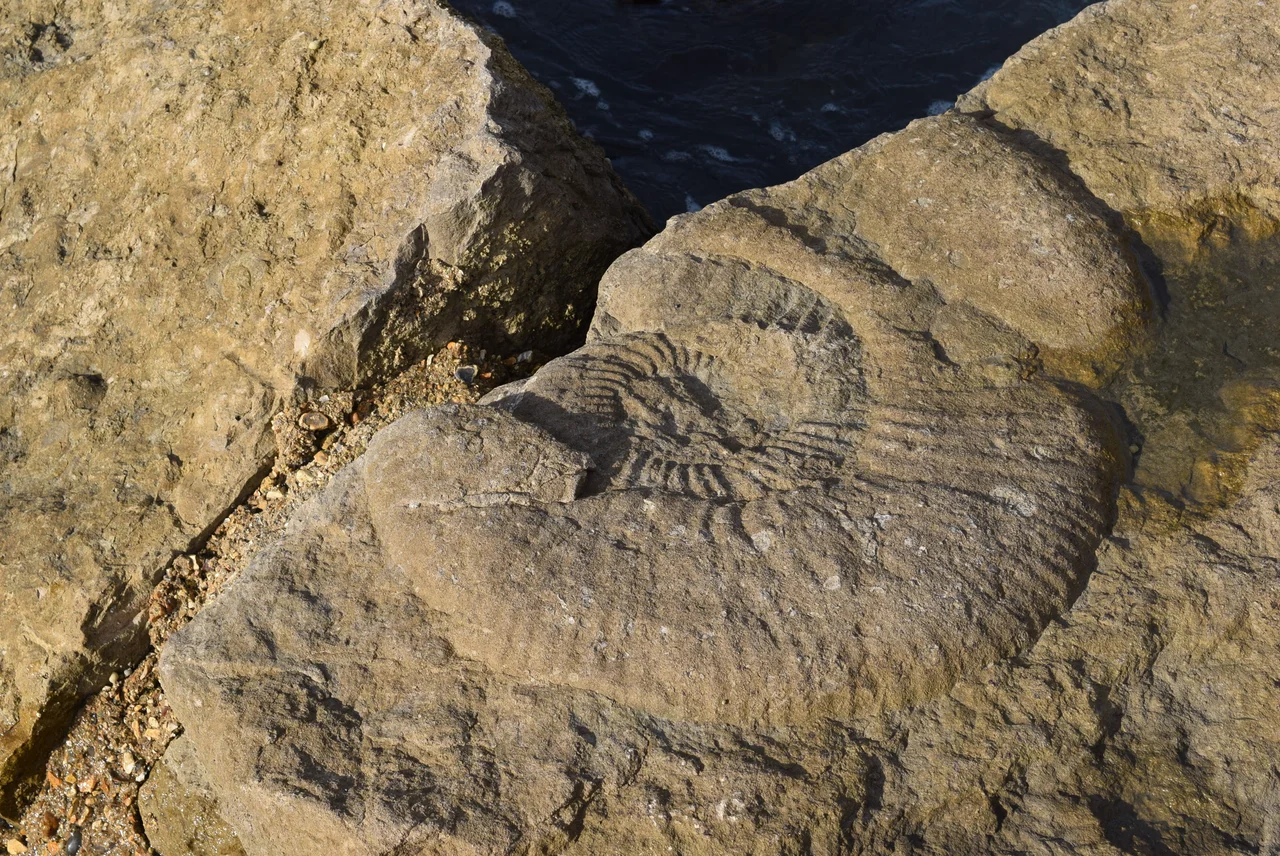
The RNLI Annual Report of 1881 records, almost as an afterthought, that Chapman's Pool Lifeboat Station was discontinued in 1880. The George Scott, the only lifeboat ever stationed there, returned to RNLI headquarters in London. No further records exist of where she went afterwards. The boathouse was eventually adapted for other uses, and today two refurbished sheds stand on the site. It is no longer clear which one held the lifeboat. Visitors who walk the South West Coast Path down through Worth Matravers still pass the spot, where a stone slipway and a fossil-embedded quay tell a story far older than 1866. The lifeboat sits inside that longer history as a small, instructive failure: a fine Victorian idea defeated by geography, by population, by the realities of the English coast.
What the Pool Keeps
Swanage Lifeboat Station, four miles east, opened in 1875 while Chapman's Pool was still nominally active. It survives today, with new boats and a new boathouse and a continuous line of crews who have answered the bell since the Victorian era. The pool itself remains as it was: a horseshoe of dark cliff, the water often a still, deep green, fishing boats pulled up on the shingle, the ribs of older wrecks visible at low tide. Walkers stop here for a flask of tea and a look at the ammonites embedded in the Kimmeridge clay. Few of them realise that the small stone building beside the slipway once held a thirty-foot lifeboat with sails and ten oars, waiting for a call that would never quite come.
From the Air
Located at 50.591°N, 2.063°W on the south coast of the Isle of Purbeck, four miles west of Swanage. Best viewed from 2,000-3,000 feet to take in the horseshoe cove, the steep Kimmeridge cliffs, and St. Alban's Head jutting south-west into the Channel. Nearest airfields: Bournemouth Airport (EGHH) 23 nm east, Compton Abbas (EGHA) 25 nm north. The Jurassic Coast cliffs make for dramatic low-level photography when winds are off the land.
Nearby Stories
- Calshot Castle 7.3 km away
- Battle of Portland 16 km away
- Sherborne Castle 16 km away
- Carisbrooke Castle 18 km away
- German Submarine U-672 25 km away
- Wardour Castle 28 km away
- Operation Donnerkeil 31 km away
- D-Day: The Longest Day 141 km away