
Wardour Castle
There is only one hexagonal castle in Britain, and it sits in a quiet Wiltshire valley fifteen miles west of Salisbury. Six sides, six towers, one courtyard at the centre, a design borrowed from France in the 1390s when six-sided castles were briefly fashionable on the Continent. Old Wardour was never copied. Two and a half centuries after it was built, royalist troops blew most of one wall apart during the Civil War, and it has stood like that ever since, a hexagon missing a corner.
Built to a French pattern
In 1392 or 1393 King Richard II granted John, the fifth Baron Lovell, permission to build a castle on land the Lovells had picked up after Sir Lawrence de St Martin died in 1385. The master mason was William Wynford, one of the great architects of the Perpendicular Gothic, and the stone was Tisbury greensand, quarried within sight of the building site. Wynford's design echoed French chateaux, particularly the château de Concressault, but no one in Britain had built anything like it. The hexagonal plan let him pack several self-contained guest suites inside the walls, also a first in England. Visitors today can still climb to the battlements and see how cleverly the geometry packs four or five storeys of rooms around a single small courtyard with a central well.
The Arundells, lost and recovered
The Lovells backed the wrong side in the Wars of the Roses. The castle was confiscated in 1461, passed through several owners, and was finally bought in 1544 by Sir Thomas Arundell of Lanherne, a staunch Roman Catholic who served Henry VIII's queen Catherine Howard. In 1552 he was executed for treason and Wardour was seized again. Eighteen years later his son, Sir Matthew Arundell, bought it back. Above the entrance Matthew carved the year 1578 and an inscription in Latin: Sub nomine tuo stet genus et domus, may the family and the house stand under Thy name. He widened the medieval windows, added classical doorways and a musicians' gallery above the great hall, and turned a fortress into a Renaissance country house. The Arundell coat of arms still rides above the gate.
Blown apart
By 1643 Wardour was held by Lady Blanche Arundell, in her sixties, while her husband was away fighting for the king. Parliamentarian troops besieged the castle. She held it for six days with a household of about twenty-five before surrendering. The castle changed hands twice more, and in 1644 royalist forces under her son Henry Arundell laid mines beneath the south-west walls and blew them up to dislodge the parliamentary garrison. The mine worked. The castle was rendered uninhabitable and never lived in again. Strangely, the destruction also let in the light: the central courtyard, which had been dark and pressed in by storeys of stone, opened up into the bright, spacious ruin that visitors see today.
Films, album covers, a Georgian grotto
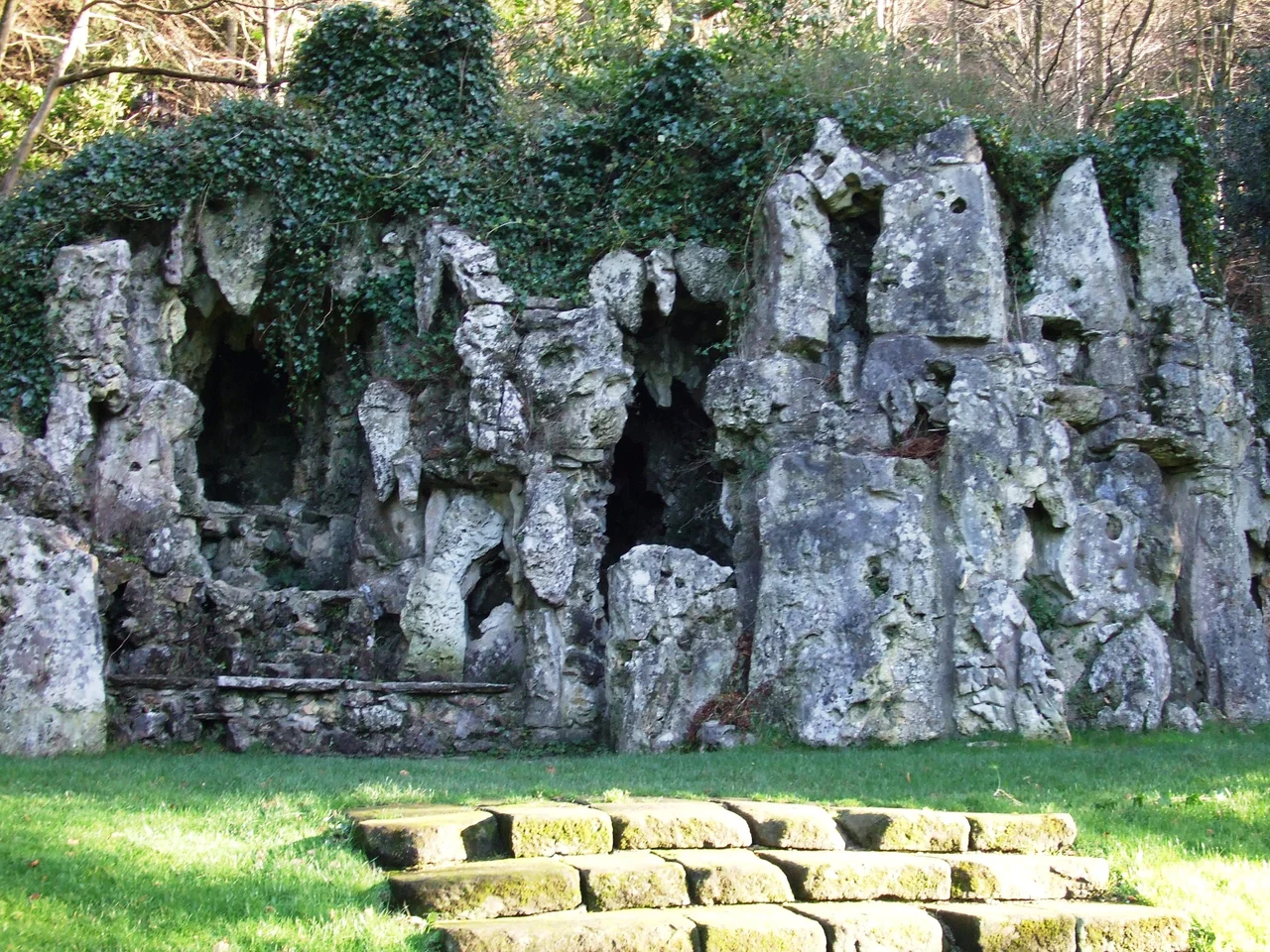
In 1792 Josiah Lane of Tisbury built a grotto on the grounds using stones taken from the castle ruins, set among three standing stones removed from a vanished Tisbury stone circle. The grotto and the surrounding parkland make a setting that filmmakers cannot resist. Kevin Costner's 1991 Robin Hood: Prince of Thieves filmed key scenes here, including the iconic grotto. Sting shot the cover of Ten Summoner's Tales inside the castle ruins. English Heritage manages the site today, and on a clear afternoon you can climb the spiral staircases, lean on the battlements, and look across the same Wiltshire greensand valley that William Wynford's masons quarried six and a half centuries ago.
From the Air
Coordinates 51.036 N, 2.089 W. Wardour Castle sits in a wooded valley on the boundary between Tisbury and Donhead St Andrew parishes, about 15 nm west of Salisbury and 5 nm south-east of Mere. From altitude, look for the hexagonal ruin on rising ground beside a small lake, with mature parkland around it. The South Western Main Line passes 1 nm north through Tisbury. Nearest airports: Compton Abbas (EGHA), a grass strip, lies 7 nm south; Bournemouth (EGHH) is 28 nm south-east; Boscombe Down (EGDM) is 15 nm east. Best visibility is morning, when low sun rakes the broken walls.
Nearby Stories
- Winchester Castle 6 km away
- Newbury, Berkshire 9.9 km away
- 1988 Poole Explosion 10 km away
- Norris Castle 10 km away
- West Kennet Long Barrow 11 km away
- Maiden Castle, Dorset 12 km away
- Glastonbury Festival 13 km away
- Bristol Temple Meads 16 km away