
Bristol Temple Meads
On 14 November 1909, the suffragette Theresa Garnett pushed through the crowd at Temple Meads with a riding whip in her hand and a sentence in her mind. The MP was on the platform. The man who had spoken so dismissively of women's suffrage was within arm's reach. She struck Winston Churchill across the face, opened a cut on his cheek, and shouted what she had come to shout before the police pulled her away. She got a month in jail. The station got a footnote in Churchill's biography, and went on doing what it had been doing since 1840: moving people through one of the most architecturally important railway buildings in the world.
Brunel's First Station
Isambard Kingdom Brunel was twenty-seven when he was hired to engineer the Great Western Railway, and the western terminus he sketched for Bristol was the first complete passenger station he ever designed. It opened on 31 August 1840, perched on a viaduct above the marshy water meadows that gave Temple Meads its name. The Tudor-style office block fronting the tracks was less a station and more a manifesto: railways were not just infrastructure but architecture, worthy of dignity and ornament. Behind the offices stretched a 200-foot train shed where Brunel's broad-gauge engines hissed and steamed. Services to Bath began that opening day. Less than a year later, after Box Tunnel was bored through the hills to the east, trains ran all the way to London Paddington, 118 miles distant. Brunel's original terminus is no longer part of the operational station, but it still stands, Grade I listed, a relic of the moment when railways stopped being mining curiosities and became the nervous system of an empire.
The Battle of the Gauges
For decades Temple Meads was the front line in a peculiarly British war: the battle of the gauges. Brunel had chosen seven feet for his broad gauge, convinced that wider tracks meant faster, smoother trains. The rest of Britain settled on four feet eight and a half inches. When the Midland Railway arrived at Temple Meads in 1844, the trains literally could not run on the same tracks. In 1854 a third rail was laid alongside the broad-gauge route to Gloucester, creating a mixed-gauge oddity where standard-gauge passenger trains and broad-gauge coal wagons rolled past one another on shared sleepers. Goods had to be transhipped at South Wales Junction, lifted from one set of wagons to another by sweating dockers. The broad gauge eventually lost. By 1892 it was gone entirely. But for half a century, Temple Meads was where two incompatible railway worlds met and refused to merge.
Fox's Curve
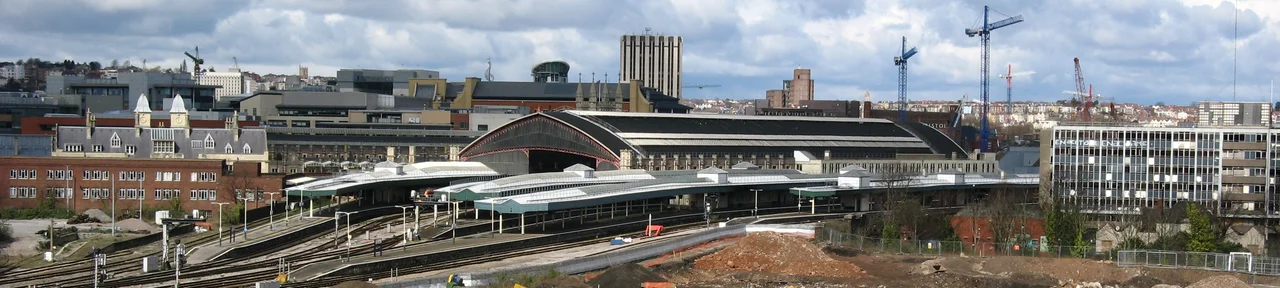
By the 1870s Brunel's terminus was choking on its own success. The Bristol and Exeter Railway had been reversing trains in and out of the cramped station for thirty years, and something had to give. The engineer Francis Fox designed an extension with a sweeping curved train shed, 500 feet long, built in wrought iron and supported by elegant ribbed arches. For decades the work was credited to Brunel's old colleague Matthew Digby Wyatt. In 2020, researchers established that the actual architect was a Bristol man named Henry Lloyd, working under Fox's supervision. Lloyd's identity had been quietly erased for 150 years. His curved roof, blackened by a century of soot and brightened by recent restoration, remains the visual signature of the station, the part most passengers actually walk under as they head for their trains.
Thirteen Platforms, Eight Tracks
Modern Temple Meads is a flexible puzzle of 13 numbered platforms serving eight tracks, with platforms 2 and 14 mysteriously omitted from the numbering. Platforms 3 through 12 share five tracks, divided into northern and southern halves so that any train can use any platform from either direction. It is the busiest station in South West England and the 35th busiest in Britain. Hitachi Super Express bi-mode trains glide in from London on diesel power because the planned electrification, announced in 2009 and repeatedly deferred, never reached Bristol. Severn Beach Line diesel units rattle out from Platform 1 to industrial Avonmouth. CrossCountry trains pass through on their long journeys from Cornwall to Edinburgh. The roof Fox built is being restored again. The eastern entrance has new foundations. After 186 years, the oldest large railway station in Britain is still being rebuilt around its working passengers.
Flight Context
Located at 51.449°N, 2.580°W, Bristol Temple Meads sits on the south bank of the Floating Harbour just east of the city centre. The arched train shed and the Tudor-style office block are distinctive landmarks from the air, easy to pick out against the surrounding mix of glass-and-steel offices in the Temple Quay redevelopment. Recommended viewing altitude is 2,000-4,000 feet. Bristol Airport (EGGD/BRS) lies about 7 nautical miles southwest. Cardiff Airport (EGFF/CWL) is 30 nautical miles west across the Severn Estuary, and Cotswold Airport (EGBP/GBA) sits 35 nautical miles northeast. The River Avon curves immediately south of the station; Brunel's Suspension Bridge and the city's harbourside are visible to the west.
From the Air
Located at 51.449°N, 2.580°W in central Bristol on the north bank of the New Cut. Recommended viewing altitude 2,000-4,000 feet. Distinctive arched train shed and Tudor-style stone offices visible against surrounding modern Temple Quay development. Nearest airport: Bristol Airport (EGGD/BRS) 7 nm SW. Also Cardiff (EGFF/CWL) 30 nm W and Cotswold (EGBP/GBA) 35 nm NE.
Nearby Stories
- Cosmeston Medieval Village 1.4 km away
- Glastonbury Festival 3.5 km away
- Tintern Abbey 3.6 km away
- Quantock Hills 4.8 km away
- Ebbw Vale Steelworks 10 km away
- New Wardour Castle 12 km away
- Windmill Hill, Avebury 16 km away
- Cotswolds 18 km away