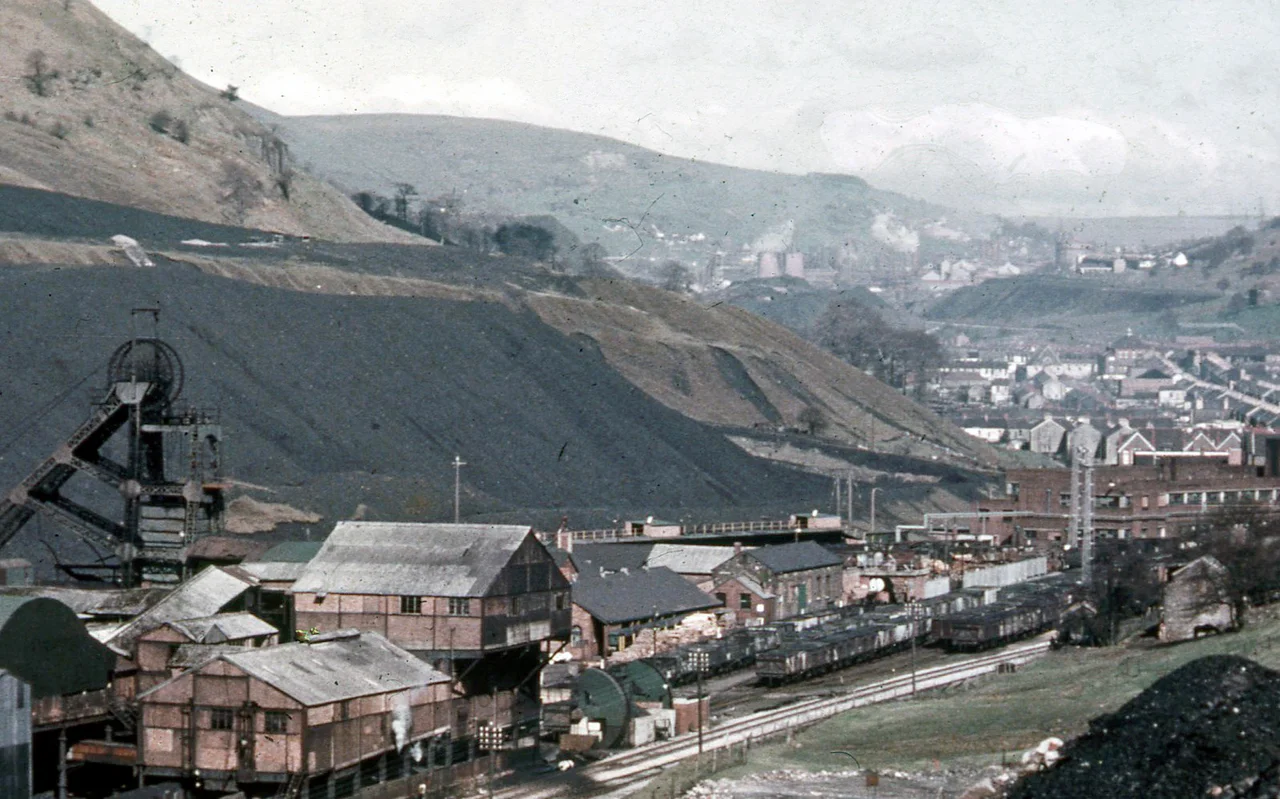

Ebbw Vale Steelworks
Before there was an Ebbw Vale, there were a hundred and twenty farmers in a steep-sided wooded valley along the upper Ebbw Fawr river, tending sheep and growing oats. In 1789 a forge owner named Walter Watkins, looking at a map and a coal seam, picked the valley as the place to build an ironworks. Two centuries later, what had begun as a leased farm at Pen y Cae had become the largest steel mill in Europe, employed thousands, and turned out the tinplate that filled cupboards across the world. Then, on 1 February 2001, Corus announced that the whole works would close and seven hundred and eighty more people would lose their jobs. The valley was emptier than it had been in 1789.
Why Here
The geography was the point. Ebbw Vale sits at the northern tip of the South Wales coalfield, in the steep cleft of the Ebbw Fawr river. To make iron you need coal, iron ore, limestone, and water; the first three were in the ground and the fourth was in the river. Watkins partnered with his son-in-law Charles Cracroft and the ironmaster Jeremiah Homfray of Penydarren, leased land from John Miles in 1789, and started making iron. The trick was getting it out. Limestone was hauled by mule train from Llanelly quarries four miles away. To move coal and finished iron to the docks at Newport, the valley owners cooperated on a network of tramways: the Rassa Railroad, the Llanhiledd Tramroad, the Sirhowy Tramroad, twenty-four miles of horse-drawn rails by 1805. In December 1829 a steam locomotive built at Tredegar Works ran the route for the first time, hauling iron toward the sea.
Mirror Iron and the Bessemer Shop
In 1844 the Hardford family sold to a new partnership of Coalbrookdale men, including Abraham Darby IV, the great-great-grandson of the ironmaster who had first smelted iron with coke. Capital flowed in. Engineers installed the most powerful blowing engine in the world to serve four furnaces. A Bessemer converter shop was built, and Ebbw Vale began producing the first steel ingots in the valley, including a high-carbon variety the Germans called spiegeleisen, mirror iron, because of how it shone when poured. The local technical breakthroughs reshaped British steelmaking. The mill moved away from making bars and plates and toward hot-rolled coils, sheets of steel rolled to consistent thickness then wound onto reels, which became the standard product for the tinplate and car industries of the twentieth century.
The Largest in Europe
By the late 1930s the Ebbw Vale plant was the largest integrated steel mill on the European continent. During the Second World War, steel-making was deemed essential, and most men in the works were exempt from the call-up. Some enlisted anyway, and for the first time in the works' history, women took over trades on the floor, rolling and rolling alongside men. The deep valley, which had been so awkward for the tramways of 1805, turned out to be a defence: the Luftwaffe tried more than once to bomb the works, but the geography that had once made it difficult to ship iron made it equally difficult to aim a bomb. The plant survived the war intact. In 1951 it was nationalised. By 1967 it was part of the British Steel Corporation, alongside Llanwern and Port Talbot.
What Made the Site Wrong
The same geography that had made Ebbw Vale right in 1789 made it wrong by 1970. The local coal and iron ore had been exhausted decades earlier; supplies now came from vast pits in other countries and from deep-water ports. Ebbw Vale was nowhere near a deep-water port. It was sixteen miles inland up a steep valley with a narrow road. Steel-making had become a business of bulk and tonnage, and Ebbw Vale could not handle the bulk. Iron and steel-making at Ebbw Vale ceased in the 1970s, and the works was refocused as a specialised tinplate plant. Then in 1999 British Steel merged with the Dutch firm Koninklijke Hoogovens to form Corus. The new company had too much European capacity. On 1 February 2001 it announced complete closure of the Ebbw Vale plant. Demolition began in August 2002 and took five years to complete.
What Came After
What Ebbw Vale did with the empty land has become a model for post-industrial towns across Wales. In 2007 the council and the Welsh Government announced a £350 million regeneration project: housing, retail, offices, wetlands, a learning campus. The first piece opened in 2010, Ysbyty Aneurin Bevan, Wales's first all-individual-bed hospital, named for the local boy from Tredegar who founded the National Health Service. The Grade II-listed Steelworks General Offices, built between 1913 and 1915, were refurbished after a £12 million refit and reopened in October 2011 as a visitor centre, archive, and a four-dimensional immersive cinema. The Gwent Archives moved in, bringing ten kilometres of shelving and documents going back to the twelfth century. Queen Elizabeth II opened it on 3 May 2012 as part of her Diamond Jubilee tour. The works are gone, but the valley has decided what to put in their place: schools, hospitals, archives, things that will outlast another industrial cycle.
From the Air
Ebbw Vale sits at 51.77 N, 3.20 W in the steep upper Ebbw Fawr valley, in Blaenau Gwent. Best viewed at 3,000 to 4,000 feet, with the valley running roughly south to north and the regenerated steelworks site forming a clear plateau on the eastern side of the town. The Heads of the Valleys road (A465) runs east-west just north. Cardiff Airport (EGFF) is 30 nm south-southwest; Bristol (EGGD) about 28 nm southeast. Expect rapid changes in cloud base on the head of the valleys.
Nearby Stories
- Portishead Point Lighthouse 3 km away
- St Fagans National Museum of History 5 km away
- Museum of Cider 6.5 km away
- Monmouth 8.3 km away
- Carreg Cennen Castle 11 km away
- Builth Castle 14 km away
- Craig Gwrtheyrn 29 km away
- Ilfracombe Lifeboat Station 37 km away