
Monmouth
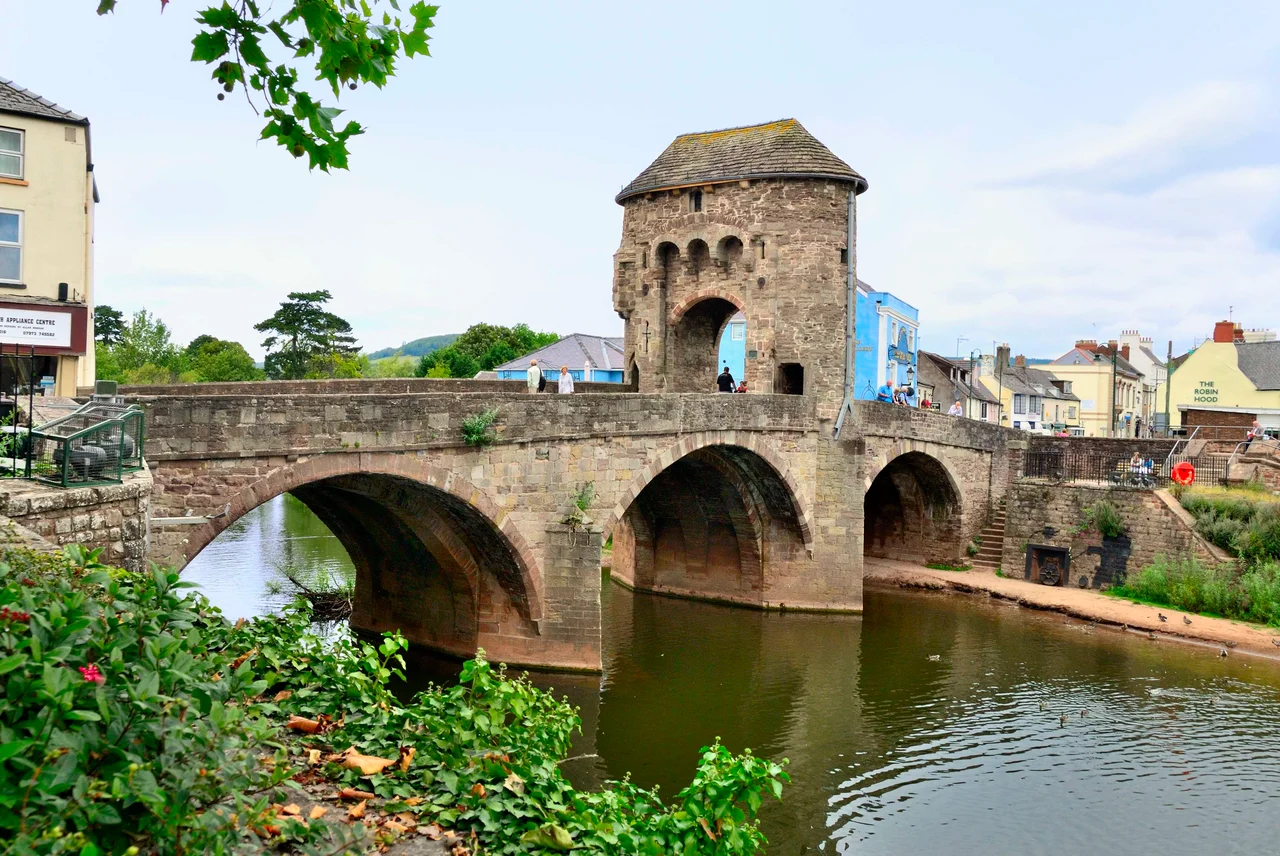
Cross the Monnow into Monmouth and you walk through something no other British town can offer: the country's only surviving medieval gated bridge, a thirteenth-century fortified causeway with a stone gatehouse sitting plumb in the middle of the road. People still drive through it. The arch was built when Welsh raiders were a credible threat, when iron-working in the Forest of Dean kept forges glowing through the night, and when a small Anglo-Norman market town beside the confluence of the Monnow and the Wye was important enough to need a defensible front door. Henry V was born up the hill at the castle. Charles Rolls grew up just outside, lost his life in Britain's first powered-flight fatality, and got a statue in the square. The Council for British Archaeology calls Monmouth one of the top ten towns in Britain for archaeology. Most of the people who live here just call it home.
Iron, Saints, and a Saxon Raid
The name is an English contraction of "Monnow-mouth", the place where the River Monnow joins the Wye. In Welsh the town was once Abermynwy and is now Trefynwy. People have lived here a long time. Excavations near Monnow Street have turned up a Bronze Age boat-building community on a vanished lake, and beneath it a Neolithic dwelling on stilts driven into the lakebed, the oak posts shaped with stone axes. The Romans built a small fort here called Blestium, on the road between Glevum (Gloucester) and Isca Augusta (Caerleon), and exploited the local iron ore. Between the second and fourth centuries the site was a working iron centre. Saxon and Welsh power then ebbed and flowed across this border; in 1056 the Welsh prince Gruffydd ap Llywelyn led an army of Welsh, Saxons, and Danes through the region on his way to sack Hereford. Charters of the period mention the smiths and the heaps of cinders that built the foundations of streets. Cinderhill Street in Overmonnow still keeps the name.
House of Lancaster
After the Normans built Monmouth Castle in the late 1060s, the town settled into its medieval rhythm. In 1233 royal forces under King Henry III were routed near here by Richard Marshal, Earl of Pembroke. In 1267 the castle became part of the lands of the Earl of Lancaster. A century later John of Gaunt married Blanche of Lancaster and the Lancastrian house made Monmouth its own. In 1386 John's grandson was born in the gatehouse Queen's Chamber: known as Henry of Monmouth before his coronation, victor of Agincourt in 1415, the king Shakespeare made a hero. The town remembers him in Agincourt Square and in the statue on the Shire Hall. From the fourteenth century, Monmouth caps, knitted woollen caps in red, became famous; Shakespeare's Welsh captain Fluellen describes them in Henry V. After the wars ended, Monmouth Castle was slighted, but the town stayed. Great Castle House (1673) rose on the ruins. The Shire Hall went up in 1724, with the markets running beneath.
Last Sentence of Its Kind
In January 1840, in the Shire Hall, three Chartists, John Frost, Zephaniah Williams, and William Jones, became the last men in British history to be sentenced to be hanged, drawn, and quartered. Their crime was leading the Newport Rising of November 1839, when twenty supporters of universal male suffrage died trying to seize the Westgate Hotel. The court convicted them of treason and pronounced the medieval punishment. Public horror was so swift that the sentence was commuted within weeks to transportation to Van Diemen's Land. The case effectively retired the punishment forever. Two decades earlier, Admiral Horatio Nelson had visited the town in 1802 to inspect the Forest of Dean's timber, vital for naval shipbuilding, and approved a small naval temple on the nearby Kymin Hill that still stands. Wooden ships up to 500 tons were laid down at a shipyard below the town's bridge until 1816, when the new Chepstow bridge captured the trade.
The Rolls Family and Modern Monmouth
In 1904, the local landowner Charles Rolls met an engineer named Henry Royce in Manchester and went into business with him; the cars they built together still bear both their names. Rolls was also a pioneering aviator. On 12 July 1910, his Wright Flyer broke up over Bournemouth and he was killed at thirty-two, the first Briton to die in a powered-flight accident. Monmouth raised him a statue in Agincourt Square, where he stands today holding a model aeroplane. A second memorial in St Mary's Church remembers the men of HMS Monmouth, a Royal Navy armoured cruiser sunk with all 735 hands on 1 November 1914 by the German cruisers Scharnhorst and Gneisenau at the Battle of Coronel off the coast of Chile. The town still holds a service for them every year. Two pillboxes from 1940 still stand on the Wye Bridge, built to slow a German invasion that never came. The river itself remains the dominant force: in December 2025 the Monnow burst its banks in flooding described as the worst in fifty years, and a major incident was declared. The town is still here, picking up after the water.
From the Air
Located at 51.81 degrees N, 2.72 degrees W on the border between Wales and England, two miles from the international line. The confluence of the Monnow and the Wye is the most obvious landmark from above; look for the medieval Monnow Bridge at the south-west end of the old town and the broader Wye Bridge to the south-east. The A40 sweeps north-east to south-west around the town. Nearest major airports are Gloucestershire (EGBJ) 16 nm east-north-east, Cardiff (EGFF) 25 nm south-west, and Bristol (EGGD) 24 nm south-east. The terrain rises sharply to the east into the Forest of Dean.
Nearby Stories
- National Museum Cardiff 2.2 km away
- Kings Weston Roman Villa 2.2 km away
- Ebbw Vale Steelworks 2.6 km away
- Hereford Cathedral Library 6 km away
- Pershore Abbey 9.1 km away
- Chedworth Roman Villa 14 km away
- Windmill Hill, Avebury 18 km away
- Builth Castle 21 km away